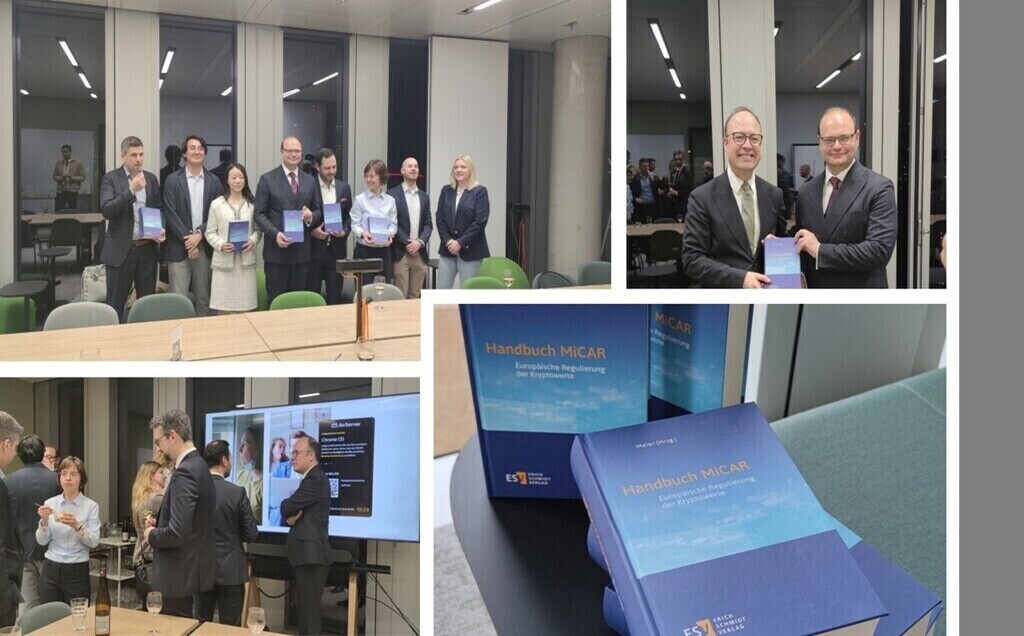
Initial meeting

Jun 27, 2022

Systematic Internalization with Crypto Assets – Can That Be Regulated Proprietary Trading?

The professional trading of crypto assets in Germany for the trader’s own account in many cases requires an authorization of BaFin for proprietary trading. According to German regulatory law, proprietary trading may occur in four different variations. The so-called Market Making e.g. is applicable in cases, in which a company continuously offers the purchase and sale of crypto assets on regulated financial markets by utilization of its own funds at self-determined prices and for its own account. Services of a service provider which offers its clients the trading of crypto assets, respectively facilitates the clients access to the trading of crypto assets may also be subject to authorization as proprietary trading. Not as widespread in crypto trading is the application of high frequency algorithmic trading techniques at organized trading venues which may also require the respective company to acquire an authorization for proprietary trading. Finally, there is the proprietary trading variation of systematic internalization for the field of the so-called Over-the-Counter (OTC) trading. This may be applicable, if operators regularly conduct organized and systematic trading with clients for their own account to a significant extent and outside of an organized market or multilateral trading facility. Systematic internalization also refers to financial instruments and therefore generally also to crypto assets. Nevertheless, it is questionable if the variant of systematic internalization can be fulfilled while trading with crypto assets.  

Only the Heavyweights in OTC-Trading Shall be Regulated

OTC-trading is characterized by the fact that it occurs outside of strictly regulated and supervised exchanges. Since there is a large number of actors which in some cases only trade financial instruments to a rather small extent, not all actors in OTC trading are required to be supervised. The law stipulates specific thresholds which must be exceeded by providers of OTC trading of financial instruments in order for them to qualify as systematic internalisers. The question if a provider actually conducts trading to a significant extent in the abovementioned sense is determined either by the share of the OTC-trading volume of the provider in relation to the total trading volume of the provider for that specific financial instrument or by the ratio of the OTC-trading volume of a provider to the total trading volume of the provider for that specific financial instrument within the European Union. This threshold may also be exceeded by providers trading crypto assets OTC. Furthermore, the law also stipulates that systematic internalization can only be fulfilled if the pre-set limits that are set for the purposes of determining what constitutes frequent systematic and substantial OTC trading are exceeded to a considerable extent. Those pre-set limits are laid out in the organization requirements for investment firms in articles 12 to 17 of the EU regulation no. 2017/565. However, the EU regulation does not define the term crypto asset since this term is only defined and regulated on the national level and instead merely defines thresholds for financial instruments of the categories recognized by the MiFID regulation. There are no provisions regarding crypto assets in this regulation. The stipulated requirement as set out in German regulatory law that the thresholds in accordance to the EU regulation Nr. 2017/565 must be exceeded can therefore not be fulfilled in cases involving the trading of crypto assets.

Is regulated Systematic Internalization Possible with Crypto Assets?

The absence of thresholds for the OTC trading of crypto assets in the EU regulation Nr. 2017/565 could argue for the position that systematic internalization in the sense of the German supervisory law cannot be fulfilled in this field. Likewise, it could be argued that requirements regarding the exceedance of thresholds set by the EU regulation in cases involving crypto assets are not applicable, since there is no specific regulation. In the latter case, the scope of the terms of frequent systematic trading and considerable trading extent in OTC-trading with crypto assets would not be definable. In light of these legal uncertainties an interpretation decision by BaFin would be helpful and necessary. Either way, most providers that would be affected by this problem will be obligated to obtain an authorization for proprietary trading since they are usually providing proprietary trading as a service for third parties. That being said, the clarification of this legal question would be very welcome since a qualification as a systematic internaliser would go hand in hand with additional regulatory obligations for the affected company. In order to circumvent legal uncertainties those affected by this problem could voluntarily comply with the regulations for systematic internalisers and apply for the respective authorization with BaFin.

Attorney Lutz Auffenberg, LL.M. (London)

I.  https://fin-law.de

E. info@fin-law.de

subscribe to Newsletter

    Contact

    info@fin-law.de

    Jun 13, 2022

    DLT Pilot Regime – What is Subject of the Upcoming EU Regulation?

    One of the three pillars of the Digital Finance Package of the EU Commission from 2022 is the creation of a so-called “Regulatory Sandbox” for market infrastructures that are based on distributed-ledger-technologies. The European regulator finally published the final version of its DLT Pilot regime on the 2nd of June 2022. The new regulation will be effective as of the 23rd of March 2023. The DLT Pilot regime will not have anything to do with crypto assets such as Bitcoin or Ether. At least for the time being it will rather be about the creation of a temporary, simplified regulatory environment for investment firms, market operators and central securities depositories, which intend to engage in the trading of tokenized securities on regulated markets pursuant to the MiFID II regulation. The regulation will create simplified conditions for DLT-based multilateral trading facilities (DLT MTF), DLT securities settlement systems (DLT SS) and DLT trading and settlement systems (DLT TSS). The objective of the pilot regime is to enable the trading of tokenized securities (Security Tokens) on regulated markets in the EU.

    Why is the DLT Pilot Regime Required for the Organized Trading of Security Tokens?

    There have been numerous issuances of security tokens in the last couple of years worldwide and also within the EU, which qualified as transferable securities pursuant to MiFID II in accordance with the applicable financial markets regulations. These tokens were regularly offered outside of regulated markets. There was no listing of tokenized securities on regulated exchanges and multilateral trading facilities. The reason is that it is required for the admission of a security to an organized market, that the security is registered as a book entry security with a central securities depository. The central securities depository is tasked with the safe custody of the (securitized) security and shall ensure the correct documentation of the transaction record of the respective security. Both aspects are essential for functioning professional trading on organized markets. According to the applicable regulations, these tasks are not performed by the market operator itself, but instead by a trusted third party, the central securities depository. In contrast, in case of tokenized securities, the tokens can be kept in custody and transferred by the owners themselves instead of a securitized document which requires to be kept in custody. The transfer of a security token may take seconds, minutes or even hours depending on the specific underlying DLT, which is not feasible for organized trading. The DLT Pilot regime will enable investment firms, respectively market operators to either take on the obligations of a central securities depository or to temporarily release them of those obligations, if they fulfill specific requirements.

    How Will Investment Firms and Market Operators Benefit from the DLT Pilot Regime?

    In order to benefit from the privileges of the DLT Pilot regime, market operators, investment firms and central securities depositories will have to apply for special authorizations and prove to the respective competent national authorities that they are eligible. They must show in their applications which technical precautions they undertake in order to ensure a sufficient security level for all involved parties and what transitional measurements they implement to ensure a transition to a proper regulation, after expiration of the DLT Pilot regime. The DLT Pilot regime will initially be effective for three years. Subsequently, the member states will report their experiences with the Pilot regime to the European Securities and Markets Authority (ESMA) in order to create the basis for a validity extension or for the creation of a follow-up regulation.

    Attorney Lutz Auffenberg, LL.M. (London)

    I.  https://fin-law.de

    E. info@fin-law.de

    subscribe to Newsletter

      Contact

      info@fin-law.de

      Jun 07, 2022

      Crypto Security Registrars – BaFin Publishes Note on Authorization Process

      On the 1st of June 2022, BaFin published its eagerly awaited note concerning the financial service of operating a crypto security registry. The note specifically targets the upcoming authorization process of companies that intend to offer crypto security registry services in the future. According to the applicable interim regulation, companies which were interested in offering the services had the option to obtain a provisional authorization by informing Bafin about their intention until the 10th of October 2021 and starting the respective business activities on the 10th of December 2021 at the latest. The law also stipulates that operators of such provisionally authorized activities must submit a complete application to BaFin until 10th of June 2022. In case of missing the deadline, the provisional authorization must be revoked. With that in mind, the note of BaFin outlining the requirements that the authority applies to the application in terms of completeness of the authorization application are published only ten days prior to the expiration of the deadline and therefore quite late.

      What Information does BaFin Provide on the Authorization Process for Crypto Securities Registrars?

      The published note does not tackle every relevant aspect of the authorization process, but rather focusses on specific aspects. Next to explanations concerning the transitional period and the provisional authorization, the supervising authority also points out that the authorization process pursuant to section 32 subsection 1 of the German Banking Act (KWG) is based on the requirements stipulated by the reporting ordinance on the KWG. With regards to the content of the applications, BaFin clarifies that it expects the focus to be put on information security. BaFin also points out, that operators of crypto security registries must show a regulatory starting capital of at least 150,000 euro and that the applicable regulations only require the businesses to be managed by a single fit and proper director who is able to dedicate a sufficient amount of time to the business. Nonetheless, BaFin emphasizes that it will generally be appreciated, if two or more directors are simultaneously in charge in order to be able to comply with the doublecheck principle, which is applicable in many fields of financial services. Furthermore, the authority reminds the registrars of the fact that they will be subject to the stipulations of the German Money Laundering Act because they are financial service institutes and that they will have to fulfill their preventive obligations. Finally, BaFin informs about the fact that fees for the authorization process are not redeemable should the authorization be rejected.

      What Are the IT Requirements for Operators of Crypto Security Registries?

      The operation of a crypto security registry is necessarily a purely IT-based service. It is therefore not surprising that BaFin, just as with crypto custodians, places the regulatory focus on the security of the IT-systems and the general strategic direction of the businesses in the IT-area. BaFin already intends to focus the evaluation of the professional aptitude of directors of operators of crypto security registries on the technical and IT-specific skills of the potential directors. It is therefore required to comprehensively display the IT-strategy and architecture of the business within the application. The implemented technical and organizational security measurements must be explained. The security needs in the IT-area must be phrased and processes for the implementation have to be displayed. Specific must be met should businesses intend to use cloud-solutions. These include e.g. the guarantee that all data must be stored in Europe. Besides all this, information regarding the rights and role concept within the authorization management must be provided and an effective supervisory concept must be installed. Furthermore, BaFin’s supervisory minimum requirements concerning the IT of banks (BAIT) as published in the BaFin memo 10/2017 are applicable just as with all other financial services institutes.

      Attorney Lutz Auffenberg, LL.M. (London)

      I.  https://fin-law.de

      E. info@fin-law.de

      subscribe to Newsletter

        Contact

        info@fin-law.de

        May 23, 2022

        Governance Votes – How Should dPoS-Validators Deal with them?

        The collapse of the stablecoin TerraUSD as well as of the underlying cryptocurrency Terra Luna (LUNA) lead to massive losses for the involved investors. The value of TerraUSD depegged from the value of the US-dollar and Luna tokens are now only worth a fraction of a US-dollar cent. The core function of the project – the pegging of TerraUSD to the US-dollar via an algorithmic solution – did not work. The collective trust of investors and the market is now severely impaired. The project founders therefore approached the Terra community last week with a plan that aims to revive the project. The voting on the reviving plan was conducted via the validators of the network and each LUNA token that was delegated to a validator represented one vote. These kinds of governance votes are often a dilemma for operators to whom third-party tokens have been delegated. While certain delegators push the validators to approve the governance measure, other push for an opposing voting behavior. How should the operator of the validator act in these cases?

        No Right on Specific Voting Behavior Without Contractual Agreement

        Delegators are not entitled to demand a certain voting behavior from the operator of a validator under German law, if there is no prior contractual agreement regulating these matters between them and the operator of the validator. The absence of such a specific agreement is generally the case, especially because the operator of the validator usually has no specific knowledge about the individuals that delegate tokens to him. The delegation of dPoS-compatible crypto units is generally conducted by the delegator by choosing a validator in the respective wallet software. The operator of the validator merely receives the information that crypto units have been delegated to him. An individual and specific contractual agreement concerning a certain voting behavior is generally not concluded in these cases since there is no real communication between the involved parties. Therefore, a specific promise of the operator of the validator towards the delegators to vote in a specific way or even to vote at all in case of a governance vote is usually not made. The situation is quite different in cases in which the operator of a validator in some form communicates to the delegators – e.g. via his website, e-mail or messenger service – that he intends to vote in these cases in a specific way. In these cases, there may be a contractual relation between the involved parties that may also require the general observing of the delegators interests by the operator of the validator in the form of contractual ancillary obligations.

        Clear and Consistent Communication is Important

        Operators of validators have the lowest risk in connection with governance votes if they communicate in a clear and consistent way with their delegators. It may be advisable to operators of validators to not take part in governance votes, because the interests of different delegators with regards to the results of a governance vote may be contradictory to each other and to communicate this intention – if possible – beforehand to the delegators. Delegators that have a specific interest in the outcome of a governance vote are then able to withdraw their crypto units from the validator and make sure that the votes associated with their units are used in the way they desire. Otherwise, there is the risk that delegators who suffered a disadvantage from the outcome of a governance vote may try to hold the operator of the validator liable for damages resulting of that outcome.

        Attorney Lutz Auffenberg, LL.M. (London)

        I.  https://fin-law.de

        E. info@fin-law.de

        subscribe to Newsletter

          Contact

          info@fin-law.de

          May 16, 2022

          Crypto Derivatives – What is Their Regulatory Status and Who can Offer Them in Germany?

          The crypto market is not only attractive for direct investments in Bitcoin, Ethereum or Ripple. Especially in times of declining prices, investors may focus on alternative investment options – crypto derivatives. Such offers have been around for many years. These alternative options are futures which allow investors to bet on a rising or declining market price of a crypto asset. The German Banking Act (KWG) and concurrent to it the German Investment Firm Act (WpIG) regulate futures, which reference financial instruments as the underlying asset as well as futures that reference a non-financial underlying asset. Futures may be designed as fixed or option transactions. They may be either be conducted over the counter (OTC) or at regulated markets. The offering of derivatives is regulated in Germany. Providers require authorization to conduct proprietary trading in accordance with the KWG or the WpIG.  

          Are Crypto Derivatives Financial Instruments in the Sense of German Regulatory Law?

          German regulatory law differentiates primarily between two forms of derivatives. On the one hand, derivatives are futures that reference an underlying asset which qualifies as a financial instrument. The KWG as well as the WpIG define securities and money market instruments, foreign exchange and units of account, interest rates or other revenues, financial indexes, derivatives or emission certificates as underlying assets that qualify as financial instruments. Crypto assets are missing from this list even though both regulatory regimes recognize them as financial instruments. Crypto derivatives therefore only qualify as futures that reference an underlying asset of non-financial nature. Futures on non-financial base values are only derivatives in the sense of German financial regulatory law, if they additionally are either settled in cash or may be settled in cash at the option of one or more of the parties, or traded on a regulated market or a Multilateral Trading Facility, or serve non-commercial purposes and fulfill the other requirements laid out in Art. 7 of the Commission Delegated Regulation (EU) 2017/565.

          Next to the two alternatives laid out above, crypto derivatives may in individual cases also be designed as contracts for difference (CFDs).

          Who May Offer Crypto Derivatives in Germany?

          The trading of derivatives is strictly regulated in Europe and therefore also in Germany. In the end, derivatives are contracts between two parties that enter into a bet regarding the development of an underlying asset. Providers offering the opportunity to enter into these kinds of contracts are – depending on the business volume and other business activities – required to obtain authorization from Bafin to conduct proprietary trading in accordance with the KWG or WpIG, if they conduct this activity in a commercial or at least professional scope. In cases in which the crypto derivatives are designed as CFDs, it must additionally be observed that the marketing, distribution and sale of CFDs to retail investors have been severely restricted by BaFin via general ruling in 2019. For the offering of OTC derivatives regulations stemming from the European Market Infrastructure Regulation (EMIR) obligate providers to fulfill broad transparency and documentation obligations.

          Attorney Lutz Auffenberg, LL. M. (London)

          I.  https://fin-law.de

          E. info@fin-law.de

          subscribe to Newsletter

            Contact

            info@fin-law.de

            May 09, 2022

            Crypto Management – Which Activities Are Covered by the Management Alternative of the Crypto Custody Business?

            Since the regulation of crypto custody business as a financial service in the German Banking Act (KWG) as of January 1st, 2020, the crypto custody business not only includes the actual custody of crypto assets and of associated private keys for customers. BaFin authorization for operation of the crypto custody business may also be required, if the service provider intends to offer crypto management services for crypto assets. It is at this point in time not quite clear what exactly is included in the management alternative of the regulation, because BaFin in its explanatory notes regarding crypto custody did not substantially exceed the explanations provided in the legislator’s explanatory memorandum of the former federal government – when it transposed the fifth AML directive. BaFin as well as the former federal government merely point out that management in the sense of the crypto custody business includes the exertion of rights stemming from the customers crypto assets. This very broad definition is only restricted by the fact that BaFin requires an actual “taking into custody” of crypto assets respectively of private keys for all alternatives of the crypto custody business.  

            What Exactly Is the Exertion of Rights Stemming from a Crypto Asset?

            The definition offered by the supervisory authority is not very conclusive and sadly also leaves further leeway for interpretation which leads to little legal certainty in this context. BaFin´s understanding of the term “right“ is also unclear. It is questionable, if the term includes only those rights that must be asserted versus another legal entity, or if the term also includes those rights that benefit the bearer without any ado. A similar question arises with regards to the exertion part of the definition. Does “exertion” in this context only apply to the active and actual exertion of client’s rights versus a third party or does exertion in this context also refer to the case in which the service provider merely accepts the advantages stemming from a right on behalf of a client, without any actual activity on the part of the service provider?  

            When Is the Definition of Crypto Management Relevant?

            Thanks to the unambiguous statement in the explanatory note of Bafin, at least it is clear that crypto management may only be considered in cases in which the service provider takes the crypto assets of its clients into custody and actually has access to them. This generally requires that the service provider has knowledge of the private keys of the customer. As stated above it is unclear at this point, if crypto management requires an active action of the service provider or not. This question may become especially relevant in cases of airdrops, which are credited to the bearers of a crypto asset without any active action on their part but merely because they keep crypto assets in a compatible wallet which entitles them to participate in the airdrop. In contrast to that, the assertion of voting rights that are connected to crypto assets, delegating tokens for the purpose of staking, the assertion of return claims of security tokens or voting for governance purposes on the basis of token ownership will all regularly require an active action of the service provider.

            Attorney Lutz Auffenberg, LL.M. (London)

            I.  https://fin-law.de

            E. info@fin-law.de

            subscribe to Newsletter

              Contact

              info@fin-law.de

              Apr 25, 2022

              AML Prevention in the Crypto Market – Old Regulatory Approach for New Problems?

              The main driver in the global context of increasing regulation of the crypto market was the fear of many legislators and international institutions that Bitcoin and other cryptocurrencies might be used for illicit purposes such as money laundering, terrorist financing and cybercrimes, if no adequate regulation was put in place as counter measures. Even though there are actual cases of money laundering that are connected to crypto assets, the annual numbers published by the German Financial Intelligence Unit (FIU) indicate that at least in Germany the number of suspected cases of money laundering connected to crypto transactions is rather low. In addition to that, the utilization of cryptocurrencies for criminal transactions is not necessarily expedient from a technical point of view. Both, criminal crypto transactions will be recorded on the publicly available and forgery-proof blockchain, just like those that are made in good faith and in accordance with the law. The tracking of cryptocurrencies which are acquired through criminal activities is therefore generally easy.

              Legislators Apply Traditional Rules to Prevent Money Laundering with Cryptocurrencies

              In the recent three decades, the Anti Money Laundering (AML) regulation has developed into an extremely complicated field of law. The Financial Action Task Force (FATF) which was formed at the end of the 1980s in Paris issues recommendations to the global community for the effective design of Anti Money Laundering regulation, which are adopted by most states in a timely manner. In October of 2018, the FATF explicitly included crypto assets in its recommendations. This being said, the FATF did not choose a new approach from a systemic point of view, but instead recommended to subject crypto service providers to the same AML obligations that are already in place for other obliged entities such as banks, financial service institutes and payment institutes Such obligations include the careful customer due diligence when entering into new business relations (KYC), executing transactions and in cases of suspicious indicators as well as reporting of suspicious cases to the national FIUs. In this scenario the state adopts a regulatory and sanctioning position and merely supervises the AML obliged entities with regards to the correct fulfillment of their obligations.

              Can the Traditional Regulatory Approach Effectively Counter Money Laundering Risks in the Crypto Market?

              The most important technological achievement of the blockchain technology is the option to execute transactions without the mandatory involvement of a central settlement institution. But such necessary intermediaries are the substantial starting point of the traditional AML systematic. Under the traditional AML regulations, the obliged entities are primarily those being necessarily involved in the settlement of transactions in the traditional financial system. Crypto transactions on the other hand do not require a central settlement institution. Users may transfer crypto assets directly and immediately between each other. Those direct Peer-to-Pees transactions completely circumvent traditional AML regulations because there is no central settlement institution.

              Is the Inclusion of Crypto Service Providers in the AML Regulation Useless?

              Even though the inclusion of crypto service providers in crypto transactions is not mandatory, most transactions will nevertheless be settled through them. Crypto service providers lower the access barriers, provide a user-friendly access to the crypto market and therefore assume an important role in this market. Especially the exchange of crypto assets into legal tender such as US dollar or euro usually requires a centralized acting trading partner. On the other hand, it must be taken into consideration that the inclusion into the AML regulation will be connected to increased bureaucratic expenditure and therefore costs for the companies and indirectly also for their clients. Criminal users on the other hand will still have the option to conduct their crypto transactions without the inclusion of a regulated crypto service provider. The AML measures taken by the crypto service providers make the utilization of crypto assets for criminal purposes harder, but not impossible. Especially with the rise of offers in the field of Decentralized Finance (DeFi), which completely lack a central service provider it may be time to strike a new path in AML regulations.

              Attorney Lutz Auffenberg, LL.M. (London)

              I.  https://fin-law.de

              E. info@fin-law.de

              subscribe to Newsletter

                Contact

                info@fin-law.de

                Apr 11, 2022

                Allowing Interest on Crypto Deposits – Is That a Regulated Activity?

                Already since the 1st of January 2020, the crypto custody business has been a regulated financial service in Germany. Companies intending to offer their clients the custody, management or safeguarding of crypto assets respectively of the associated private keys must obtain authorization from BaFin for the operation of the business prior to the start of the activity. Crypto custody is a service of utmost importance in the ever-evolving crypto market and it is an essential component at least for all crypto business models with centralistic design. As essential as the crypto custody service for the mass adaptation of cryptos may be, it is not the main focus of the market and remains a second-tier service. In this regard, crypto custody services remain somewhat of an accessory to services such as crypto exchanges or lending/staking business models. The profit margins for the actual custody of crypto assets are rather small. This raises the question, if crypto custodians may offer their clients an interest rate next to the custody service for the crypto assets they keep in custody.

                Crypto Custody Authorization Covers Three Different Business Activities

                The authorization of BaFin for the operation of crypto custody services allows crypto custody service providers not only to keep crypto assets and associated private keys in custody, but instead the authorization which is regulated in the German Banking Act (KWG) also allows for two additional services to be provided by the authorized service provider, being the management and the safeguarding crypto assets. BaFin and the German legislator define the management of crypto assets in the broadest sense as the execution of rights stemming from the managed crypto assets for others. The safeguarding of crypto assets relates to the custody of cryptographic keys on storage media, regardless if the storage media is of digital (cloud storage) or physical nature (USB stick or even written on paper). The safeguarding variation requires that the operator has actual access to the crypto assets of his clients via the custody of the private keys, just the same as in the two other variations. Since BaFin interprets the management variant rather broadly, the question arises, if allowing interest for managed crypto assets is also covered by a license for crypto custody services.

                Crypto Management Only Possible in Triangular Setups?

                Even though Bafin interprets the management variant of the crypto custody business rather broadly, the better argument can be made against the interpretation that allowing interest on crypto balances by the crypto managers can is covered by the license. The explanatory memorandums published in the administrative practice of BaFin and in the legislative proposal prior to the introduction of the crypto custody business require for the execution of rights for others that the crypto manager asserts the right of a client versus another party. Such assertion from a semantic perspective requires that the other party is a third party and not the custodian. The allowing of interest for the crypto balance kept in custody would be a claim of the client versus the custodian, which the custodian could not assert versus himself on behalf of the client. The allowing of interest for crypto balances would therefore not be considered to qualify as crypto management in the sense of the second variant of the crypto custody business as it is laid out in the KWG.

                Can Interests on Crypto Balances then be Allowed without any Authorization?

                Even if the allowing of interest for crypto balances is not qualified as crypto management, such an activity may nevertheless be subject to authorization by BaFin depending on the individual case. It is e.g. conceivable that the offeror of the interest would operate as a financial portfolio manager, if he would be allowed to utilize the crypto balance of his clients at his own discretion to generate profits to finance the interest to be paid to the custody clients.

                Attorney Lutz Auffenberg, LL.M. (London)

                I.  https://fin-law.de

                E. info@fin-law.de

                subscribe to Newsletter

                  Contact

                  info@fin-law.de

                  Apr 04, 2022

                  New European Funds Transfer Regulation – The End to Self-Custody of Crypto Assets?

                  Right after the European crypto industry had averted the combined attack of the Green Party, Social Democrats and the Left-Wing Party in the European Parliament on the PoW consensus-mechanism with a narrow majority, new drama is on the horizon. An amendment to the European Funds Transfer Regulation has been proposed, which not only obligates crypto service providers in the European Union to verify the identities of the owners of all involved crypto wallets of a crypto transaction, but also prohibits crypto service providers to allow transfers to wallets which do not allow these identification procedures. The proposal is intended to prevent anonymous transactions involving crypto assets in the regulated financial system of the European Union. It especially aims at ridding money launderers, financiers of terrorism and other crooked market participants of the option to move wealth in crypto assets around and afterwards transfer it back into the regulated financial system. A conversion of crypto into fiat money via a crypto exchange will only be possible for completely identified users, should the aforementioned proposal be adopted, because crypto exchanges will be supervised institutes in Europe as soon as the Markets in Crypto Assets regulation (MiCA) goes into effect.

                  European Parliament Adopts the Proposal – Trilogue Negotiations Ahead

                  Last week, the EU parliament voted in favor of the proposed amendment to the European Funds Transfer Regulation with a narrow majority. Nevertheless, the amendment is not yet finally adopted, because the draft bill now must be negotiated and adopted in the so-called trilogue negotiations between the EU parliament, the EU commission and the council of the European Union before it can come into effect. The European crypto industry fears that the usage of crypto assets in most parts of Europe will only be possible when utilizing an authorized and supervised crypto service provider, should the current version be adopted. The crypto service providers fear the enormous administrative effort connected to the proper identification and verification of every party involved in every transaction. This regulation may be a potential showstopper for the connection between the centralized financial system and the decentralized crypto market. This is especially true for so-called unhosted Wallets, meaning crypto wallets that are not operated by an authorized provider, but instead are operated privately or in a decentralized way.

                  What Are the Implications of the New Regulation for Private, Unhosted Wallets?

                  With regards to privately managed wallets, it should also in future be possible for operators to identify the respective private person and verify their identity, in case that the proposal is passed. The self-custody option for crypto assets would therefore not necessarily be endangered. From a practical point of view it would nevertheless imply a cost-intensive effort for many operators to identify and verify every private wallet. Operators could therefore come to the business decision to exclude unhosted wallets from transactions altogether. Crypto users could therefore be forced to solely utilize authorized crypto custody service providers which would constitute an additional third-party risk with regards to the “not your keys – not your cryptos” principal. In summary, the regulation would once again lead to a substantially more centralized crypto market. The technical innovation of the blockchain technology, meaning the ability to conduct decentralized transactions without the necessity of a service provider acting as an intermediary would thereby again be heavily reduced.

                  Attorney Lutz Auffenberg, LL.M. (London)

                  I.  https://fin-law.de

                  E. info@fin-law.de

                  subscribe to Newsletter

                    Contact

                    info@fin-law.de

                    Mar 28, 2022

                    Crypto Trading under the Liability Umbrella – Which Requirements must be Fulfilled by Tied Agents?

                    A lot of companies are interested in offering their clients access to the crypto markets, ever since cryptocurrencies successfully changed their image from the preferred payment method of money launderers and internet fraudsters to a modern alternative for the investment portfolio. However, because most cryptocurrencies are regulated as financial instruments in the sense of the financial supervisory law in Germany, the commercial offering of trading activities associated with cryptocurrencies generally requires authorization by BaFin. Crypto trading may be qualified as e.g. proprietary trading, financial brokerage or investment brokerage, depending on the specific design of the offered service. The application of the appropriate authorization requires a significant amount of time and financial resources, not only during the preparation for the application itself, but also during the subsequent ongoing supervision by BaFin and Bundesbank once the authorization is granted. The obtaining of such authorization is therefore a supposed showstopper for many companies. The cooperation with a sufficiently authorized institute – the so-called liability umbrella – may be a solution for business models that are designed as investment brokerage, investment advisory or as placement businesses.

                    Which Crypto Business Models Can Be Offered Under a Liability Umbrella?

                    Not all activities that require authorization can be offered under a liability umbrella. Specifically, proprietary trading, financial brokerage business and the operation of a multilateral trading facility cannot be designed this way. The exemption can only be utilized in cases of intermediary services. The connection to a liability umbrella as a supervisory design tool is out of question, should a business intend to acquire or sell cryptocurrencies in its own name. The activities that are permitted by the exemption being investment brokerage and placement business are only given, if the business itself does not become a contracting party of the commercial transaction, but instead merely acts as an intermediary respectively for the supply and demand. When it comes to placement business, there must also be a placing agreement between the offeror and the seller of the cryptocurrency. Investment advisory services, which are also permitted to be operated under a liability umbrella only relate to the issuing of investment advice that is tailored to the actual profile and needs of the investor. 

                    What Are the Supervisory Requirements for a Tied-Agent-Solution?

                    The setup of a tied-agent-solution can be implemented relatively quickly and with low costs compared to the application for an individual BaFin authorization. It requires a contractual agreement between the business and an institute, which is authorized to perform Investment brokerage, Investment advisory services or placement business. That agreement must include stipulations for the inclusion of the tied agent in the compliance infrastructure of the liability umbrella and furthermore oblige the liability umbrella to be responsible for all damages vis-à-vis the clients resulting from the covered activities of the tied agent. The fact that the liability umbrella institution takes over the liability must be disclosed by the tied agent to his clients. The inclusion of the tied agent must be reported to BaFin by the liable institute. The liable institute also must confirm to the supervisory authority, that the tied agent is fit and proper. BaFin keeps a public registry on its website where the inclusion of the tied agent after disclosure by the liable institute is published.

                    Attorney Lutz Auffenberg, LL.M. (London)

                    I.  https://fin-law.de

                    E. info@fin-law.de

                    subscribe to Newsletter

                      Contact

                      info@fin-law.de

                      Mar 21, 2022

                      Turning Point for Proof-of-Work – Could the EU Just Outlaw the PoW Consensus Mechanism?

                      The commotion within the crypto industry was huge when the Green Party, the Social Democrats and the Left-Wing Party of the European Parliament last week proposed a last minute change to the Markets in Crypto Assets regulation (MiCA), which, if adopted, could have resulted in a de facto ban of the commercial handling of Bitcoin and also – with regards to its current technical state – Ethereum. The proposal was rejected by a narrow margin, meaning that this danger to the crypto industry is warded off for now. Subject of the proposed change was a regulation according to which crypto assets in the EU could only be issued, offered or authorized for trading, if their consensus mechanism would fulfill minimum requirements regarding ecological sustainability which the EU commission would have had to define. Since the Proof-of-Work consensus mechanism is the least ecological sustainable consensus mechanism, it would probably not have fulfilled the to-be-determined minimum requirements. Especially the dominating cryptocurrency Bitcoin, which uses the PoW consensus mechanism for the validation of transactions in its network, would probably have faced its demise in Europe.

                      What Would Be the Consequences of a PoW Ban in Europe?

                      The political ambition to ecologically improve the consensus mechanisms of cryptocurrencies is surely a legitimate and in light of the ongoing and escalating, global climate crisis a welcomed one. It nonetheless seems very questionable, if a ban could and should be the way to do so. From an economical perspective, a ban of Ether and Bitcoin which combine account for more than 60% of the market capitalization of the crypto market would have been the deathblow to the European crypto market, because almost no business model in the crypto industry can exist without the utilization respectively the offering of Bitcoin or Ether. Crypto exchanges that do not offer the trading of Bitcoins would be of no interest to users in the current market situation. Tokenization projects also generally run on protocols associated with the Ethereum blockchain and therefore on a PoW based network. This ban would have hit already issued security tokens which run on the Ethereum blockchain hard. The trading of these tokens would have become impossible in Europe and a transfer of the trading to areas outside the European Union would have probably been impossible without a complete remodeling of the mandatory prospectuses which are required under regulatory law. The trading in Europe would only have continued to be possible if the tokens in question would have migrated to a different technical infrastructure which fulfilled the ecological minimum requirements. Both approaches would have been associated with considerable costs for the issuers which in the end the investors would have had to bear.

                      Would a PoW Ban in the EU Been Legally Possible?

                      Since the Treaty of Lisbon took effect in 2009, the European Charta of Fundamental Rights guarantees the European fundamental rights with which European primary law must be compatible. Also the MiCA regulation as an EU regulation being directly applicable to all Europeans must adhere to the standards set out in the European Charta of Fundamental Rights. Protected by the European fundamental rights is the occupational freedom as well as the entrepreneurial freedom of the citizens of the European Union. A PoW ban in the EU would exclude European crypto service providers from more than 60% of the current crypto market, even though MiCA is intended to provide a suitable and effective regulatory framework for exactly that market. The ban would directly and massively threaten already existing projects and business models in their existence. Especially critical would have been the fact that the proposed amendments for MiCA regarding the PoW ban according to their wording would have delegated the actual ban from the regulation itself to the level of the technical standards concerning MiCA which in turn are going to be determined by the EU commission without any legislative process. The EU Charta of Fundamental Rights would therefore have provided good arguments for a seised court to overturn the PoW ban in the EU. It would have been an interesting legal discussion to see, whether the abovementioned arguments could outweigh the environmental protection that is also imposed by the European Charta of Fundamental Rights.

                      Attorney Lutz Auffenberg, LL.M. (London)

                      I.  https://fin-law.de

                      E. info@fin-law.de

                      subscribe to Newsletter

                        Contact

                        info@fin-law.de

                        Mar 07, 2022

                        Staking Pools – Can Joint Staking be an Alternative Investment Fund?

                        Over the last couple of years, crypto staking has become an attractive and very profitable possibility to generate passive income. It is not only possible for investors to stake their crypto holdings themselves, but instead the market offers numerous easy-to-access offers of service providers offering investors access to staking projects. Such providers pool their client’s funds in so-called staking pools in order to receive more block rewards and thereby generate higher return rates. There is an abundance of service providers for these kinds of services and investors are promised return rates of up to 20% or more per annum. It is obviously highly relevant for the operators of these staking pools, if their services may qualify as Alternative Investment Funds (AIF) from a regulatory point of view. In that case, the management of the assets that are bundled in the pool would require authorization or at least registration according to the German Capital Investment Act (KAGB). There would also be restrictions and information obligations with regards to the marketing of such a staking pool.  

                        Staking Pools as Investment Funds

                        Staking pools may only be qualified as AIFs, if they qualify as investment funds in the sense of the KAGB. According to the legal definition of the KAGB, an investment fund is any organism for the purpose of joint investments which procures capital from a number of investors in order to invest it in accordance to defined strategies for the benefit of the investors and which is not an operating company outside of the financial industry. An organism in the abovementioned sense can be given in almost any conceivable form. It is e.g. not required that the company is a registered legal entity. Rather, it is sufficient that the capital is pooled in any form. Therefore, silent investments, participation rights constructs or smart contracts may qualify as organisms in the sense of the KAGB. Staking pools in which fiat or crypto funds are being pooled in order to have more assets to dispose over can therefore also qualify as organisms in the abovementioned sense. A defined strategy is generally also given, because staking pools disclose in which staking projects they intend to invest the pooled capital. Since most of the staking rewards will generally be distributed amongst the participants the investment is made for the benefit of the investors.

                        Do Staking Pools Serve the Purpose of Joint Investments?

                        The requirement of the KAGB according to which the organism must have the purpose to serve joint investments poses problems. An organism serves joint investment purposes, if it procures and pools capital in order to generate a joint rate of return for the investors which results from the joint risk of buying, holding and disposing of assets. This is not necessarily the case with staking pools. This requirement may not be fulfilled, should the participation in a staking project merely require the delegation of the tokens or a voting process associated with the crypto assets and not a direct transfer of the crypto assets itself. The organism will neither buy nor dispose over crypto asset but instead merely hold them, should the investors transfer their crypto assets to the organism solely for the purpose of participating in a staking process. Should investors on the other hand transfer fiat money, the organism will regularly have to acquire the crypto tokens first which it will subsequently use for staking purposes.

                        Are Staking Pools Operating Companies Outside the Financial Industry?

                        Finally, for the organism to be qualified as an investment fund pursuant to the KAGB it is also required that it is not an operating company outside the financial industry. This requirement is problematic with staking pools, because it cannot be generally assumed that staking pools are a part of the financial industry. Even though many blockchain units that are suitable for staking are also crypto assets and therefore financial instruments pursuant to German regulatory law, there are also other crypto units which do not qualify as financial instruments. Furthermore, the activity of staking blockchain units in staking projects is not necessarily a regulated activity. An activity which would be relevant in the sense of German financial regulatory law cannot be assumed in cases in which the staking pool has no power of disposal over the blockchain units of the investors, because a mere delegation is sufficient or in cases in which the stakeable units do not qualify as financial instruments. In these cases, the staking pool cannot be qualified as a company of the financial industry.

                        Attorney Lutz Auffenberg, LL.M. (London)

                        I.  https://fin-law.de

                        E. info@fin-law.de

                        subscribe to Newsletter

                          Contact

                          info@fin-law.de

                          to top