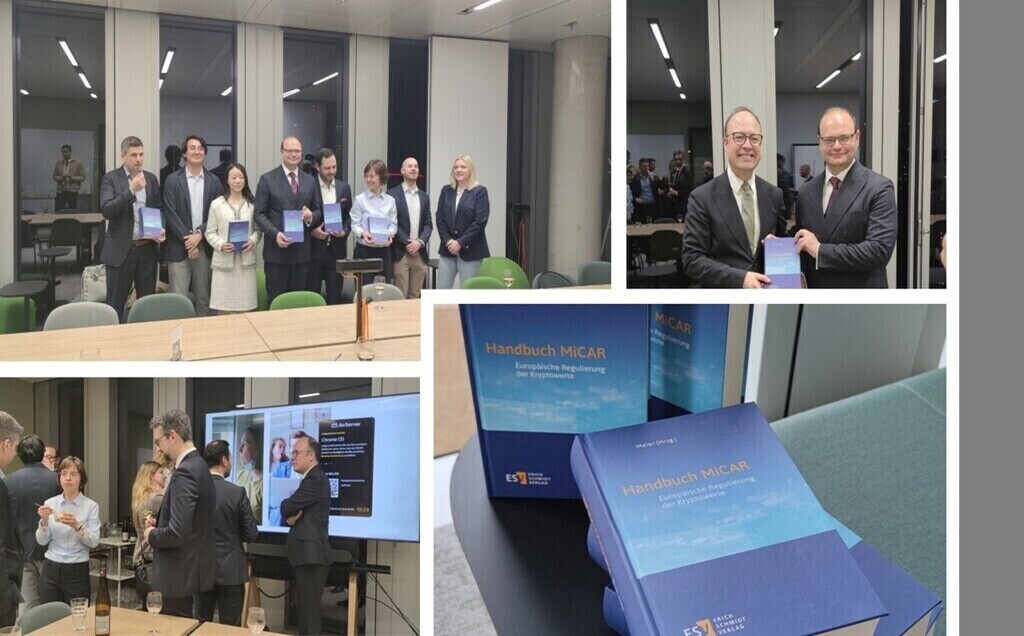
Initial meeting

Oct 28, 2019

Crypto Information Services – Is That Subject to Authorization in Germany?

The trading of cryptocurrencies grew more and more complex over the past ten years. Nowadays, investors do not only have the option to directly sell and acquire Bitcoins but instead they can also hold long or short positions of Bitcoin. These derivative transactions allow them to bet on rising or falling prices without ever acquiring cryptocurrencies directly. Margin trading with cryptocurrencies has also been possible for years now. The offered cryptocurrencies range from blockchain-based currency tokens such as Bitcoin, Litecoin or dash to countless utility tokens that can only be used as vouchers in a specific eco-system. In this more and more maturing market, information concerning exchange rates and trade volumes of crypto assets is of vital importance. Since there is no official listing for cryptocurrency exchange rates, numerus private service providers now offer this information in real-time in a consolidated, compiled and useable form to their customers. Precise and up-to-date information regarding the development of exchange rates are of crucial importance to traders of cryptocurrencies. The information service providers do therefore play an essential role on the global crypto market.

WHY COULD A REGULATION OF CRYPTO INFORMATION SERVICE PROVIDERS MAKE SENSE?

Erroneous information regarding exchange rates and trade volumes can potentially cause massive damages to investors and is suitable to disrupt and compromise the crypto market in its core functions. Adding the fact that cryptocurrencies, in contrast to securities that are traded at the traditional security markets which are regulated by MiFID 2 and MiFIR, usually lack of emitters that would be obligated to inform market participants continuously via ad-hoc-notifications, prospectus and amendment obligations about incidents that have the potential to influence exchange rates. In light of the aforementioned circumstances an approval of crypto information service providers prior to the start of their operations by a supervision authority regarding the collection and evaluation as well as the publication of their data would not be entirely absurd. Nevertheless, such an official regulation is currently not in place. Providers of crypto information services are neither subject to an initial authorization requirement nor to an ongoing supervision of their services.

CAN CRYPTO INFORMATION SERVICE PROVIDERS BE DATA REPORTING SERVICE PROVIDERS ACCORDING TO MIFIR?

The European Markets in Financial Instruments repealing Directive (MiFID 2) as well as the European Regulation on Markets in Financial Instruments (MiFIR) call for the supervision of Data Reporting Service Providers. These service providers support emitters of securities with the fulfilment of their publication and reporting obligations. Certain Data Reporting Service Providers – the so-called Consolidated Tape Providers (CTP) – provide their collected data in a consolidated form to the public. In Germany, these Data Reporting Service Providers are subject to BaFin authorization according to sec. 32 subsection 1f of the German Banking Act (KWG). However, crypto information service providers cannot qualify as Data Reporting Service Providers in that sense, because cryptocurrencies generally do not qualify as financial instruments in the sense of MiFID 2 and MiFIR. Therefore, the activities of crypto information service providers are not covered by the European financial markets regulations MiFID2 and MiFIR. In contrast to that, publications of information that concern security tokens, which are designed as blockchain-based securities and therefore constitute financial instruments in the sense of the aforementioned regulation can be data reporting services, given that the service provider is involved in the fulfillment of the emitters publication and reporting obligations and publishes the so collected data in a consolidated form. On the other hand, crypto information service providers that merely provide and publish information about exchange rates and trading volumes are not subject to any financial regulation in Europe and Germany.

Attorney Lutz Auffenberg, LL.M. (London)

I.  https://fin-law.de

E. info@fin-law.de

subscribe to Newsletter

    Contact

    info@fin-law.de

    Oct 21, 2019

    Multisig Wallets and Crypto Custody – What is Regulated Under the New Law?

    After the highly anticipated debate in the German Bundestag regarding the transposition of the provisions of the fifth European AML Directive only marginally included a discussion of the introduction of crypto custody services as a new financial service, it is still not foreseeable if the proposed draft, prior to the final vote will be revised following the criticism of the German Bundesrat or not. It has to be assumed that on 1st January 2020 crypto custody services will be included into the catalogue of sec. 32 of the German Banking Act (KWG) as proposed by the Federal Government. If so, it will not be possible for companies to commercially store, manage or secure crypto assets or corresponding private keys for customers as a crypto custody service without prior BaFin authorization. The legal design of crypto custody services in the German law will at that point in time substantially exceed the requirements of the fifth European AML Directive, which merely requires the operators of electronic wallets to actively enforce AML measurements and does not call for an authorization obligation. But who will be subject to this German solo effort and what is exactly will be considered as a crypto custody service by this regulation?

    CRYPTO CUSTODY APPLIES TO THE CUSTODY OF PRIVATE KEYS FOR CRYPTO ASSETS
    The term “custody” is, from a technical point of view somewhat misleading. It stems from the physical taking of objects, as e.g. security certificates. Things are different with crypto assets: They are only digitally existing information of the allocation of tokens to a certain address of the underlying blockchain. This information can only be changed if someone uses the corresponding private key of the blockchain address in order to transfer the tokens to a different blockchain address. The information which token is allocated to which address is stored decentralized on the blockchain itself and therefore on numerous so called “full nodes” that are operated all over the globe. Crypto custody therefore cannot refer to the storage of tokens on local storage media, but only to the case in which virtual tokens are received on a blockchain address to which the custodian holds the private key.

    IS THE SAFEKEEPING OF PRIVATE KEYS TO MULTISIG WALLETS A CRYPTO CUSTODY SERVICE?
    Multisignature wallets require private keys of two or more users in order to transfer tokens. This ensures that wallet holders can only collectively dispose of the tokens allocated to that wallet. Multisig wallets are e.g. used if crypto assets are temporarily kept in fiduciary capacity to settle transactions. The fiduciary cannot dispose over the wallet balance without the client and vice versa. This ensures a safe transaction settlement for all participants. According to the wording of the draft, this would constitute a crypto custody service by the fiduciary because he would hold private keys that are intended to transfer or manage crypto assets for his client. The definition draft of crypto custody services does in no way require the sole power of disposition over the crypto assets or private keys by the service provider.

    CAN IT BE INTENDED TO REGULATE FIDUCIARIES USING MULTISIG WALLETS AS CRYPTO CUSTODY SERVICE PROVIDERS?
    According to the explanatory memorandum to the draft proposal of the German Government, it is intended that especially service providers storing their client’s crypto assets in a collective holding without the client’s knowledge of the cryptographic key are subject to this regulation. In contrast to that, the mere providing of hard- or software to secure customer private keys without the provider having access to the stored data to use them shall not be subject to the regulation as long as the customer is solely responsible for the storage. Multisig fiduciaries, which are not explicitly addressed by the explanatory memorandum are in between the two alternatives. It is therefore unclear if the German Government wants to subject them to the regulation or not. According to the explanatory memorandum the overall reason for the regulation of crypto custody services are AML considerations. The business model of Multisig fiduciaries, the settling of transactions, is rather prone for money laundering which is a good argument for their subjection to the regulation. On the other hand, fiduciaries are already subject to the Money Laundering Act which only in certain cases subjects them to AML obligations. It seems as if at first BaFin as the competent authority and maybe later the administrative courts will have to define the details of this regulation via administrative practice or rather via judgement.

    Attorney Lutz Auffenberg, LL.M. (London)

    I. https://fin-law.de

    E. info@fin-law.de

    subscribe to Newsletter

      Contact

      info@fin-law.de

      Oct 14, 2019

      Let´s Sell a Security Token – Who is Actually Allowed to Sell Tokenized Financial Instruments?

      In 2019 BaFin allowed the first security token offerings in Germany and approved the corresponding and necessary security prospectuses. Blockchain-based capital markets issuances are therefore possible in Germany and a viable alternative for issuers seeking to acquire capital. However, the approval of the necessary prospectus is just the first step to a successful emission. The economic success of a capital markets emission depends heavily on the placement of the product with financially strong investors. The planed volume of STO emitters usually ranges between 50 and 500 Million euros. Amounts that are hard to reach with investors hailing from the IT and blockchain communities that are still shaken from the 2017 and 2018 ICO-hype. For blockchain-based capital markets emissions to reach these numbers, professional and reputable sales partners with access to wealthy individuals and institutional investors are needed.

      IS A TOKEN SALE UNDER THE ISSUERS OWN DIRECTION POSSIBLE?

      It is of course still possible for STO emitters to sell and market their security tokens to interested investors. Emitters do not need a BaFin license to distribute their own security tokens as long as they do not also offer other banking, financial or payment services. Emitters wanting to take the sale of their tokens into their own hands can still employ the services of external agencies to help them with the organization of the sales distribution. These external agencies are however not allowed to directly sell or establish any contact to investors. Their services are restricted to marketing advice during the token sale.

      WHICH FINANCIAL SERVICE PROVIDERS ARE ALLOWED TO HELP WITH THE DISTRIBUTION OF SECURITY TOKENS?

      In order to legally offer security tokens to investors in Germany, the service provider must be BaFin authorized as an investment intermediary or investment broker. If the service provider also advises the investors and provides customized investment recommendations that are tailored to the financial capabilities of the respective investor a BaFin authorization for the provision of investment advisory is additionally required. Besides these authorized service providers, numerous tied agents operate in Germany, offering their services under the liability umbrella of authorized financial institutions. They are allowed to distribute financial instruments of all kinds including security tokens. Therefore in Germany, there is a sufficient number of service providers that can legally offer the distribution of security tokens. Nevertheless, still only very few financial service providers dare the inclusion of security tokens in their distribution portfolio, may it be due to fear of rookie mistakes, blockchain related IT risks or simply because their customers do not yet demand tokenized securities as an investment option. If security token offerings establish themselves as a more commonly accepted alternative to traditional capital markets emissions, the distribution providers will most probably follow suit and expand their services accordingly.

      CAN A DISTRIBUTION OF SECURITY TOKENS ALSO BE OFFERED BY FINANCIAL INVESTMENT AGENTS IN THE SENSE OF THE TRADE AND INDUSTRIAL CODE?

      The distribution of financial instruments as defined by the German Banking Act (KWG) generally requires a BaFin authorization. Certain financial instruments, precisely investment assets as defined in the German Investment Asset Act (Vermögensanlagengesetz) and open-end and closed-end investment funds as defined by the German Capital Investment Code (KAGB), can be distributed without a BaFin authorization as long as the distributer is licensed as a financial investment agent in accordance to sec. 34f of the German Trade and Industrial Code (GewO). Of course, the distribution of tokenized versions of the aforementioned financial instruments is also possible. Tokenized securities as e.g. bonds and shares are not included in this exemption and can therefore only be distributed by a BaFin authorized distributer. A token that can also be distributed by financial investment agents being licensed in accordance with the German Trade and Industrial Code must therefore be designed as an investment asset or as a share of an investment fund.

      Attorney Lutz Auffenberg, LL.M. (London)

      I.  https://fin-law.de

      E. info@fin-law.de

      subscribe to Newsletter

        Contact

        info@fin-law.de

        Oct 07, 2019

        Let’s Create a Stablecoin – Can Politics Prohibit Libra?

        In the last couple of weeks, the pressure on Facebooks stablecoin project Libra intensified. Government representatives like the German minister of finance Olaf Scholz and his French counterpart Bruno LeMaire see numerous problems and fear systemic risks if private companies offer their own means of payment as an alternative to national currencies. They therefore threaten Facebook with prohibiting Libra in Europe even prior to the project’s implementation. According to the current plan, Libra is supposed to be covered by a government bonds and currency basket in order to ensure value stability of the coin. According to the current plan Libra is going to be administered by a swiss-based association with members like Paypal, Visa and Mastercard that are linked to the payment industry but also companies like Ebay, Uber and Spotify. The basket-mechanism is supposed to ensure value stability. A direct connection to a specific national currency as e.g. the Euro is not planned. But how exactly could politics prohibit Libra and comparable stablecoins?

        HOW COULD THE PROHIBITION OF LIBRA BE JUSTIFIED?

        The prohibition of Libra or other Stablecoins within the constitutionally organized European Union would require a statutory basis. According to the Treaty of the Functioning of the European Union, only the European Central Bank has the power to authorize the issuing of euro banknotes which are the sole legal tender in the union. Libra would neither claim to be a legal tender nor would it be denominated in euro. The German Bundesbank Act penalizes on a national level the unauthorized issuing of monetary units even if they are not denominated in euro. If the term “monetary units” refers to blockchain units or only to the explicitly stated value tokens, cash money coins, bank notes or other certificates is questionable. Regardless of this a prohibition can only be stipulated in the cases where the issuing of alternative means of payment is not explicitly allowed by law.

        COULD LIBRA BE E-MONEY IN THE SENSE OF THE SECOND EUROPEAN E-MONEY DIRECTIVE?

        The prohibition of Libra in Europe could therefore be ruled out, if the stablecoin would meet the requirements for a qualification as e-money according to the second European E-money Directive, the Libra Association as the Libra issuer met the authorization requirements to conduct e-money-business and would additionally apply for such authorization in a EU member state. E-money is defined by the second E-money Directive as an electronically, including magnetically, stored monetary value as represented by a claim on the issuer which is issued on receipt of funds for the purpose of making payment transactions and which is accepted by others than the issuer. A cryptocurrency that is designed as a means of payment and that is issued by a central emitter it can be purchased from and re-exchanged with can therefore in many cases be defined as e-money. As stated, e-money is a recognized manifestation of money under EU law. If Libra and the Libra Association would therefore fulfill the aforementioned requirements, a prohibition of Libra would at least legally be hard to justify. That scenario would however require that Libra would be designed as a claim against the Libra association and could be purchased and re-exchanged at any time.

        Attorney Lutz Auffenberg, LL.M. (London)

        I.  https://fin-law.de

        E. info@fin-law.de

        subscribe to Newsletter

          Contact

          info@fin-law.de

          Sep 28, 2019

          Credit Cards and Crypto Business – Crypto Companies as High-Risk Merchants

          The vast majority of goods and services that are purchased online is still paid for via credit card. This also applies companies from the blockchain industry since cryptocurrencies as a means of payment, even in this field of business, have not yet reached mass adoption. It is therefore crucial for e.g. crypto exchanges, token emitters and crypto custody service providers to offer the most common credit card schemes as a payment option for their customers. It is precisely these big, global credit card providers that classify crypto related businesses as High Risk Merchants already since 2018. If a crypto company therefore wants to be become a part of the Mastercard network, it must undergo a special due diligence process in order to comply with the current Mastercard Statutes since the inclusion of Cryptocurrency Merchants in the Mastercard Business Risk Assessment and Mitigation Program (BRAM) as of 16th April 2018.

          WHICH BUSINESSES ARE CRYPTO MERCHANTS ACCORDING TO MASTERCARD?

          Mastercard defines businesses that are related to crypto transactions as Crypto Merchants. According to Mastercard´s Security Rules and Procedures – Merchant Edition from 14th February 2019 (SPME) a crypto transaction in this sense is basically every incident in which a credit card holder uses an account to buy or sell cryptocurrencies. Therefore, all crypto related business that offer their customers the option to buy or sell cryptocurrencies are generally affected. These are first and foremost crypto exchanges but also e.g. token issuers wanting to sell their issued tokens to investors.

          WHAT REQUIREMENTS DOES MASTERCARD IMPOSE ON CRYPTO MERCHANTS?

          Strictly speaking Mastercard´s SPME do not obligate the crypto businesses directly but rather their merchant acquirers to account for a certain due diligence in relation to the crypto business. According to number 9.4.9 of the SPME, merchant acquirers of crypto businesses have to be supplied with copies of authorizations according to which the activities of the crypto business are authorized in the countries in which business is supposed to be conducted with card holders. If the activity is not subject to authorization in countries in which business is supposed to be conducted with card holders but e.g. subject to an entry in an official register, a copy of the register is sufficient. Most crypto services in Germany are subject to BaFin authorization. Crypto businesses therefore must supply their merchant acquirer with a copy of their authorization notification or e.g. an officially approved excerpt from the tied agents register if they act as tied agents. Companies that merely conduct passive business with German card holders, meaning that these companies do not actively target the German market, are not subject to BaFin authorization and in consequence do not have to provide the merchant acquirer with documents of the aforementioned kind. In any case, Crypto Merchants must provide their merchant acquirer with a reasoned legal opinion of a qualified law firm explaining the regulatory obligations of the crypto business as well as the card holders for every country in which Mastercard payments shall be accepted, no matter if the business is conducted actively or passively. The SPME states that these legal opinions have to be “acceptable to Mastercard” which means that a certain level of quality should be observed when creating the legal opinion. For the German market, FIN LAW offers the creation of such legal opinions. For legal opinions concerning other jurisdictions FIN LAW disposes of a broad international network of qualified partner law firms.

          Attorney Lutz Auffenberg, LL.M. (London)

          I.  https://fin-law.de

          E. info@fin-law.de

          subscribe to Newsletter

            Contact

            info@fin-law.de

            Sep 23, 2019

            Introducing Digital Securities – What are the Implications for Security Token Offerings?

            The German Federal Government resolved its blockchain-strategy on 18th September 2019. The resolved version includes 44 specific measures not only concerning initiatives that are related to capital and financial markets but also the promotion of blockchain projects that have an impact on the real economy, as well as research, cooperation initiatives and the implementation of the technology in the Government’s own administrative structures. The first project is due to be realized later this year: The digital security is supposed to be introduced into German law and should render the paper document obsolete, that is currently still needed to certify securities according to German securities law. But what are the specific measures that the German capital markets can expect? Are there legal consequences for security token offerings and will the novelization make blockchain-based public offers on the capital markets easier in Germany?

            DIGITAL DEBENTURE BONDS AS A KICKSTARTER

            In a first step, the German Federal Government will introduce digital debenture bonds. The introduction of digital stocks and digital investment fund shares is planned for the next couple of years, after experience is gained from the introduction of digital debenture bonds. And indeed, bonds are well suited for the first phase of digitalization of the securities law, because in contrast to shares, bonds are mere contractual relationships between the emitter of the bond and the investor. Bond investors obtain contractual claims vis-à-vis the issuer such as a return claim (fixed or variable) and a repayment claim. Shares on the other hand could grant dividend claims and shareholder participation rights. Moreover, Germany already has experience when it comes to tokenized bonds that are issued to the capital markets via a BaFin-approved security token offering.

            WHY IS THERE A NEED FOR DIGITALIZED DEBENTURE BONDS IF STOS ARE ALREADY POSSIBLE UNDER CURRENT LAW?

            Bonds are traditionally certified in a paper document in order to make them tradable freely at the capital markets. In order to enable a rapid and efficient trade it is essential that the claims arising from the bonds are unencumbered. That means that the security in question must be free from rights and claims of former owners as e.g. a right of retention, the objection to set-off or a pledge. Acquirers must furthermore be able to rely on the fact that the purchase of a security is effective even if the seller was not the owner of the security, for example to enable short selling. According to German law an unencumbered, bona fide purchase is only possible in regard to objects. Claims are not objects in the required sense and therefore cannot be purchased bona fide. This is the reason why debenture bonds currently are embodied in paper documents. The paper document itself is an object and so subject to property law. It can therefore be purchased bona fide and unencumbered while the owner of the paper document can assert the embodied claim. Blockchain tokens on the other hand are digital assets and so not objects in the required sense. They can therefore not replace the paper document as an object. The Security Tokens which were subject to the BaFin-approved offerings earlier this year were designed to be transferred by a mere contractual assignment of the represented claims to the purchaser instead of a property transfer. A bona fide purchase of these tokens is therefore currently not possible. For a professional exchange trading, where securities sometimes change hands in a matter of milliseconds e.g. through high frequent electronic trading,, the legal possibility of an unencumbered, bona fide purchase is essentially required. Therefore, the next level of digitalization of the capital markets must be the introduction of a reliable legal framework of an unencumbered, bona fide purchase of tokenized bonds. The German Federal Government wants to do that by introducing the digitalized debenture bond.

            WHAT DOES THE INTRODUCTION OF DIGITALIZED DEBENTURE BONDS MEAN FOR EMITTERS AND SECURITY TOKEN OFFERINGS?

            The announced introduction of digital debenture bonds might be the breakthrough security tokens need in order to be potentially available for trade on the secondary markets. If the unencumbered bona fide acquisition of security tokens becomes legally possible, the transfer of security tokens would no longer only work on basis of the contractual assignment of the represented claims but could instead be performed by a simple transfer of the tokens from the seller to the purchaser. Emitters of security tokens would face considerably less legal uncertainty with regards to the legal fate of their tokenized bonds and could offer their investors the prospect of exchange trading after the initial token sale. All of this under the condition that the German legislator properly implements digital debenture bonds into German securities law.

            Attorney Lutz Auffenberg, LL.M. (London)

            I.  https://fin-law.de

            E. info@fin-law.de

            subscribe to Newsletter

              Contact

              info@fin-law.de

              Sep 16, 2019

              Spot on Crypto Payment Providers – How is that Regulated?

              Next to crypto exchanges and Bitcoin ATMs, crypto payment service providers were one of the business models of the Blockchain community from the very get-go. The user of these services can transfer Bitcoin to the service provider which will in return transfer the equivalent in e.g. Dollar or Euro to a bank account of the customer’s choice after deducting a service fee. These services therefore enable the payment of debts with Bitcoin that are owed in fiat currency. Some crypto payment providers offer the reverse service. In these cases, the customer transfers fiat currency to the service provider which will then (after the deduction of a service fee) transfer the equivalent amount of crypto currency to a wallet address of the customer’s choice. Another existing variation is a service where a payment is made in one cryptocurrency and the service provider transfers the equivalent amount in another (most of the times in Bitcoin) to a crypto wallet determined by the customer. The most frequent form of crypto payment service however is crypto to fiat payment which will therefore be the subject of this blog. How are these services regulated under German law and what do the operators of these services have to consider when offering their services in Germany?

              CRYPTO PAYMENT SERVICES ARE SUBJECT TO TWO DIFFERENT REGULATORY REGIMES

              In fact, crypto payment services constitute a hybrid under German financial regulation. The basic idea of these services is the execution of customer payments to the respective recipient. If this service would not involve crypto currencies but only fiat currencies, it would be considered a mere money remittance servicein the sense of the second payment services directive and therefore be treated as a classical payment service. The operation of such a business requires a BaFin authorization in accordance to the German Payment Services Act (ZAG) if the business operates commercially or at least requires a professional business set-up in Germany and no legal exemption from this obligation is applicable. Crypto payment service providers on the other hand not only offer the aforementioned service but also an exchange service. As shown, the customer transfers e.g. Bitcoin to the crypto payment service provider who then forwards the payment to the recipient’s bank account in fiat currency and thereby effectively exchanges crypto currency into fiat currency. This exchange is, depending on the individual circumstances, either qualifies as a financial commission business or proprietary trading. Both alternatives require the service provider to be BaFin authorized in accordance with section 32 of the German Banking Act (KWG).

              DO CRYPTO PAYMENT SERVICE PROVIDERS REALLY NEED TWO BAFIN LICENSES?

              Naturally, also crypto payment service providers have the possibility to outsource the parts of their business that require authorization to a partner that is already authorized for these activities. If the service provider wants to be independent from these kinds of partners, the question arises if the different activities requiring individual authorization can be authorized by one single license with regards to either the German Payment Services Supervision Act (ZAG) or the German Banking Act (KWG). In the context of a single authorization, section 10 para. 1 2nd sentence of the German Payment Services Act (ZAG) might be interesting. This provision allows authorized payment institutions to also provide closely associated ancillary services such as foreign exchange transactions without a generally mandatory KWG license. Licensed payment institutions are therefore authorized to perform foreign exchange transactions in order to execute payment processes in the currency which their client requested even though these transactions are considered proprietary trading and would therefore normally require a separate BaFin authorization. BaFin considers Bitcoin and comparable crypto currencies as units of account. According to section 1 para. 11 no. 7 German Banking Act (KWG), units of account and foreign exchange are both financial instruments. The explanatory memorandum of the German legislator that accompanied the introduction of units of account into the KWG emphasizes that units of account must be comparable to foreign exchange. It could be argued that because of the comparability of foreign exchange and units of account the payment institutions should also be allowed to trade units of account in the same manner as foreign exchange as long as the trading is an ancillary service to a payment service. BaFin has proven to be rather conservative when it comes to these kinds of privileges, even more so when cryptocurrencies are involved. It therefore seems unlikely that BaFin would simply accept the aforementioned argument. It might however be an interesting option for crypto payment providers and should therefore be further discussed.

              Attorney Lutz Auffenberg, LL.M. (London)

              I.  https://fin-law.de

              E. info@fin-law.de

              subscribe to Newsletter

                Contact

                info@fin-law.de

                Sep 09, 2019

                European Market Abuse Regulation – What do STO Issuers Have to Consider?

                With the introduction of the European Market Abuse Regulation (MAR), which is directly applicable in the member states without transposition, in July of 2016 the regulations for securities trading with regards to insider trading, market manipulation and the publication of insider information are harmonized within the EU. The national capital markets regulations of the member states now only define the competent authority and the specific sanctions for violations of the MAR. Even though there had been a couple of economically successful ICOs prior to the summer of 2016 almost no one thought of the possibility to publicly offer a regulated, blockchain based security, in other words a security token. The goal of almost all ICO issuers until the end of the ICO-hype in spring 2018 was to issue a basically unregulated so-called utility token to avoid all forms of regulation in the form of prospectus and authorization obligations. Nowadays this trend has shifted in favor of regulated STOs. and issuers are exposed to the question to what extend the MAR regulations are applicable to security tokens.

                WHAT EXACTLY DOES THE MAR REGULATE?

                The MAR provides standardized regulations within the EU capital markets for financial instruments in order to prevent market manipulations. The strict rules and regulations are supposed to ensure that market price of securities will not be manipulated by e.g. the publication of important but delayed, misleading or even false information about the issuer and his business. The MAR obligates the issuer of securities to publish all information that have the potential to influence the market price of the issued financial product. This kind of information has to be published immediately, the so-called ad-hoc publication. Furthermore, the MAR regulates if and how employees, advisors and other associates that possess intimate or sensitive information about the issuer or the business are allowed to take part in the trading of the issued financial products. Insider trading by one of the aforementioned is obviously also suited to affect the trade rates of the financial product in question. In addition, issuers of MAR regulated financial products as well as operators of authorized trading facilities have to inform the competent authorities of any request regarding the listing or delisting of the financial product with the trading facility in question. The provisions of the MAR are very complex and to a great extent subject to interpretation, which is why the European and national supervising authorities provide extensive interpretive notes regarding the MAR.

                IS THE MAR APPLICABLE TO SECURITY TOKENS?

                The application of the MAR to security tokens is generally possible. However only financial instruments that are actually traded at the secondary markets are subject to the MAR regulations. Therefore, only financial instruments that are already traded or that are in the process of being listed at authorized exchanges, multilateral trading facilities or other organized trading systems are subject to the MAR. Security tokens that are solely and directly sold by the emitter to the investor and which are not afterwards traded at exchanges or other public trading places are not subject to the MAR regulations with its extensive publication obligations, restrictions and prohibitions. If an STO emitter wants his tokens to be listed at a public trading venue such as e.g. a crypto exchange, the MAR with its strict obligations can potentially be applicable.

                Attorney Lutz Auffenberg, LL.M. (London)

                I.  https://fin-law.de

                E. info@fin-law.de

                subscribe to Newsletter

                  Contact

                  info@fin-law.de

                  Sep 02, 2019

                  Let´s Build an Equity Token – Why don´t We Bring Stocks to the Blockchain?

                  Tokenizing is one of the hottest topics at the capital markets right now and with the authorization of the first security token offerings by the national supervising authorities the subject is picking up speed. BaFin, the competent authority in Germany, already approved two security prospectuses for security token offerings and it is just a matter of time until more will follow. However, the approved prospectuses were related to blockchain based bonds that grant the investors return and repayment claims. But would it also be possible to issue blockchain based stocks? If so, investors would not only be able to profit from the issuing companies business success but could also determine the company’s fate by executing their voting rights at shareholder meetings. Such equity tokens would turn investors into shareholders. So, can stocks be emitted as blockchain tokens according to German law?

                  MUST STOCKS IN GERMANY BE ISSUED AS PAPER DOCUMENTS?

                  According to German law, stocks do not necessarily have to be issued as paper documents. Registered shares can be also created by a mere declaration of the shareholders within the shareholders agreement when a stock company is founded. In order to be recognized by the company as shareholder of registered shares it is however necessary that the new shareholder gets listed in the share register of the company instead of the old shareholder. This registry includes information such as the name and address of the shareholder, the date of birth, the amount and serial numbers of the shares the shareholder holds. The shareholder can only execute his rights with legal effect vis-á-vis the company if he is registered. Bearer shares on the other hand are shares that grant rights and claims to its holder. They can only be issued if the right of the shareholder to demand issuance of individual share certificates is excluded in the shareholder agreement. Furthermore, a global certificate of the issued shares has to be kept with either a securities depository bank, an authorized central securities depository (CSD) or a comparable security depository according to foreign law. The decisive factor for the question whether bearer shares can be issued in the form of an equity token under German law is therefore if the global certificate has to be a paper document or not.

                  WHAT IS A GLOBAL CERTIFICATE?

                  The German Securities Deposit Act (DepotG) defines global certificates as securities that evidence in writing a multitude of rights which could be individually certified in securities of the same kind. The wording of this definition leaves almost no room for interpretation. An “evidencing in writing” without a paper document seems hardly possible. If the Securities Deposit Act would instead use the word “representation”, a global certificate in the form of a smart contract token would at least hypothetically be possible. As it stands with the current wording of the law, a paper document is unavoidable for creating a global certificate. Issuing bearer shares in form of a blockchain token without a global certificate in paper form is therefore currently impossible under German law.

                  ARE REGISTERED SHARES IN THE FORM OF AN EQUITY TOKEN A POSSIBILITY?

                  Uncertified (in this case meaning “not in paper form”) registered shares can, according to German law, be transferred by simple assignment and therefore theoretically with nothing more than a handshake to the new shareholder. As long as the transfer by assignment can be displayed by a smart contract on the blockchain, the issuance of equity tokens that represent uncertified registered shares is generally possible. In order to be recognized as a shareholder by the issuing company, the shareholder has to be registered with the share registry of that company. It would therefore be useful if the smart contract would not only settle the issuing and transferring of the token but also automatically run the company’s shares register on the blockchain. A problem with a blockchain based shares register is however that the former shareholders have the right to demand that their personal data is erased from the shares register once they have sold their shares. If the register is blockchain based, a complete deleting of the data from the blockchain would be impossible, due to the unforgeable and uneditable technology of the blockchain. This general problem, which is also controversially discussed with regards to the European General Data Protection Regulation (GDPR), massively complicates a blockchain based shares register.

                  Attorney Lutz Auffenberg, LL.M. (London)

                  I.  https://fin-law.de

                  E. info@fin-law.de

                  subscribe to Newsletter

                    Contact

                    info@fin-law.de

                    Aug 26, 2019

                    Crypto Custody vs Securities Deposit Business – Who Will be Allowed to Store Security Tokens?

                    Security Tokens of German issuers so far have been issued solely as securities according to the German Securities Prospectus Act respectively the EU Prospectus Regulation. They are designed as identical and freely tradable blockchain tokens that grant its owners certain investor rights such as a return on investment and a repayment claim. Security tokens can be held by the owner on a blockchain address to which only he knows the private key. But what are the options for investors who want their tokens stored and managed by a service provider? Can security tokens be professionally stored by service providers or does that kind of service require a BaFin authorization?

                    HOW ARE TRADITIONAL SECURITIES DEPOSITED?

                    In German private law, securities are traditionally paper documents and therefore objects that can be owned and transferred according to German property law. This means that an unencumbered, bona fide acquisition is possible if e.g. the seller of the security was not the owner or the security was burdened with third-party rights. Even though security transactions in Germany are (corresponding to international standards) these days done by simple account postings at the security depository banks, the legal construction of the transfer of the security in question still includes and depends on the transfer of ownership of the paper document that embodies it. As long as the securities are not traded at stock exchanges or any other public marketplace, the paper documents can be held by the investors themselves. Alternatively, they can be handed to banks that are authorized to handle customer securities. If, on the other hand, the securities can be traded on the capital markets the EU Central Securities Depositories Regulation (CSD) requires that the securities are booked into a securities register at an authorized securities depository bank. This enables the quick, non-physical and electronic transfer of securities at stock exchanges and other public marketplaces.

                    HOW DID THE GERMAN LEGISLATOR DESIGN THE CUSTODY OF CRYPTO ASSETS?

                    The German legislator decided to define the custody of crypto assets as a financial service that will require prior authorization from BaFin as of 2020. In the future, crypto assets will be defined in the German Banking Act (KWG) as financial instruments. According to these plans, the definition of crypto assets will include crypto assets that are used either as alternative means of payment or as investment vehicles. Both can be crypto assets as long as they are digital embodiments of value that are electronically transferrable, storable and tradable and that are not issued by an official authority. Security tokens will fall under that definition. Therefore, they can only be stored as crypto assets by service providers that are BaFin authorized for the new financial service of crypto custody. These crypto custody service providers are, according to the legislative plans, exclusive service providers. This means that BaFin can only authorize service providers as crypto custody service providers if these companies do not engage in any other activity that requires authorization according to the German Banking Act (KWG). According to the explanatory memorandum to this law, the legislator wanted to prevent that IT-related risks that arise from crypto custody services impact banking or other financial services.

                    CAN CRYPTO CUSTODY SERVICE PROVIDERS STORE SECURITY TOKEN?

                    According to the German Banking Act (KWG) the depository and management services for securities are subject to authorization. It is, as of this point in time, legally unclear if security tokens qualifying as securities in the regulatory sense are also to be qualified as securities in the sense of the securities deposit business. In support of this, the German Banking Act does not explicitly specify that securities have to be paper documents and that from a regulatory point of view, security tokens are digitalized securities. On the other hand, “deposit” in the sense of the depository business means “physical storage with custody” which is obviously unnecessary, even impossible, when it comes to the storage of digital tokens respectively the digital private keys. This legal uncertainty in German regulatory law will be eliminated with the exclusivity of crypto custody services in the future. If security tokens were to be defined as securities in the sense of the depository business, they could neither be stored for customers by security depository banks nor by crypto custody service providers. Due to the exclusiveness of the new financial service, the crypto custody service providers could not additionally get licensed for the security depository business and the security depository banks could not be authorized for offering crypto custody services. Investors could only rely on holding and storing the tokens themselves. This means that the depository banks in the future will not be able to serve the tokenized securities market and will have to leave the field to the crypto custody service providers.

                    Attorney Lutz Auffenberg, LL.M. (London)

                    I.  https://fin-law.de

                    E. info@fin-law.de

                    subscribe to Newsletter

                      Contact

                      info@fin-law.de

                      Aug 19, 2019

                      Security Token as Asset Investment – Is that Possible?

                      This year, BaFin already approved two securities prospectuses for security token offerings. In July of 2019 it approved a prospectus concerning the offering of token based subordinated bonds in the form of profit participation certificates and in January of 2019 a prospectus concerning a security token in the form of a registered bond. The approval of the January prospectus is remarkable because registered bonds are explicitly defined by German law as asset investments and not as securities. Nevertheless, BaFin approved the offering of the security token via a securities prospectus instead of an investment asset prospectus and explained the decision later in an article in the BaFin Journal of April 2019.

                      BAFIN: SECURITY TOKEN AS A SUI GENERIS CLASS OF SECURITIES

                      In the opinion of BaFin, blockchain technology blurs the boundaries between securities and asset investments. The marketability of blockchain tokens leads – according to BaFin – to a qualification of said token as a security even if the product that is embodied in the token would be qualified as an asset investment under normal circumstances. BaFin refers to tokens as a sui generis class of securities. The authority justifies this qualification with the “Substance over Form” principle of the European Securities and Market Authority (ESMA). According to this principle the legal qualification of a financial instrument relies on the content-related design of the instrument and not on the (misleading) name it is given. The market must provisionally work with the opinion of BaFin even though it can and should be criticized. The “Substance over Form” principle is useful to legally qualify and regulate new financial products but it cannot justify the legal qualification of a product as a security if it is, according to its content, in fact an asset investment. These cases do not evolve around a misleading name of a new financial product but rather around the legal qualification of it and its content.

                      WHAT ARE THE LEGAL REQUIREMENTS OF A SECURITY?

                      The decisive factors in order to qualify a product as a security are its free transferability and the marketability of the product on the capital markets, while BaFin regards crypto exchanges as capital markets in this sense. Additionally, the product must grant its holder rights that are similar to those of a security. That means shareholder or contractually designed subscription rights. Traditionally in Germany these rights are embodied in a paper document. The approval of two security prospectuses for STOs shows that the embodiment of the security rights can now also be achieved with a crypto token. If the product lacks the aforementioned free transferability, the law qualifies it as an asset investment rather than a security. The prospectus for such an asset investment has to be created and compiled according to the Asset Investment Act rather than the Security Prospectus Act and the EU Prospectus regulation. Security tokens in general are unrestrictedly transferrable between wallets of the users and therefore, according to BaFin, are generally to qualify as securities and not as asset investments.

                      IS IT POSSIBLE TO DESIGN A SECURITY TOKEN AS AN ASSET INVESTMENT?

                      Designing a security token as an asset investment can be advantageous especially when it comes to the sales of the token. Contrary to securities, asset investments cannot only be sold and brokered by BaFin authorized investment intermediaries and financial advisers but also by financial asset brokers that are (only) authorized in accordance to the Federal Commercial and Industrial Code. The inclusion of financial asset brokers in the sales network of a security token means a greater reach and additional investors for the issuer and an additional field of business for the financial broker. Neither the BaFin publication from April 2019 nor BaFin’s recently published information sheet on crypto tokens eliminate the possibility of designing a security token as an asset investment. The token terms could for example exclude the free transferability of the token by providing a mandatory consent of the token issuer for an effective token transfer to a third party. Thereby, a legal qualification of the token as a security would no longer be possible. For STO emitters wanting to initially distribute their product solely in Germany and not internationally, the design of the security token as an asset investment instead of a security can therefore be an interesting alternative.

                      Attorney Lutz Auffenberg, LL.M. (London)

                      I.  https://fin-law.de

                      E. info@fin-law.de

                      subscribe to Newsletter

                        Contact

                        info@fin-law.de

                        Aug 12, 2019

                        Would a BaFin issued Crypto Custody License be EU-Passpotable?

                        In less than six month the new financial service of crypto custodian services will be introduced to the German banking regulatory law unless the German legislator does not change his mind. The decision to subject crypto custodians to BaFin authorization is currently being criticized and discussed massively. Especially the proposed introduction of section 32 subsection 1g into the German Banking Act (KWG) that would, if passed, only allow authorizations for companies that do not offer any other regulated banking or financial services is the subject of the criticism. The German blockchain community is asking itself if such a massive interference in the occupational freedom of the crypto custodians can be legally justified. The German federal government promised in 2018 within its coalition treaty to promote a sensible and reasonable legal framework for international and European crypto and token trading. It seems obvious that this idea has been abandoned in the meantime. Instead it seems as if the federal government plans a national solo effort in the regulation of cryptocurrencies.

                        UNDER WHAT CIRCUMSTANCES IS IT POSSIBLE TO USE A BAFIN LICENSE IN OTHER EUROPEAN COUNTRIES?

                        With the so-called European Passport, banks and financial service providers can use a license to operate their business that they obtained in a member state of the European Economic Area (EEA) also in other member states as long as they report the intended use to the authority that originally issued the license. As long as the regulatory supervision of the offered service in the issuing member state is comparable to the standards of the target member state the supervision is solely conducted by the originally issuing authority. Most of the laws regarding banking and financial services originate from European regulations and directives. A comparable standard of regulation is therefore in most cases ensured within the European Union. If e.g. a BaFin regulated German private bank wanted to offer loans to commercial customers in France it would be sufficient for them to inform BaFin about this intention and BaFin would inform the French ACPR.

                        WHAT ARE THE LIMITS OF EU-PASSPORTING?

                        The EU-Passporting of a license is not possible if the regulatory standards of the member states in question are not at a comparable standard. Consequently, EU-Passporting is not applicable if a member state decided to regulate an activity that it is not obligated to regulate according to the EU directives. The regulation of such an activity is unnecessary in the other member states because the activity in question is not subject to authorization there. Therefore, the standards of regulation are not comparable between those member states and so the EU-Passporting is impossible for a license regarding this activity. Regularly, the companies in these cases will not have any interest in passporting their license because they will be able to offer their services in the target member state even without any license. This becomes problematic if two or more member states regulate an activity differently from each other. In these cases, companies that operate in more than one member state or even in the entirety of the EWR would have to apply for a license in each of these member states separately in order to ensure a proper regulated business operation.

                        IS THE REGULATION OF CRYPTO CUSTODY SERVICES BASED ON THE 5. EUROPEAN AML DIRECTIVE?

                        The German legislator used the transposition of the provisions of the 5. European AML Directive as an opportunity to regulate crypto custody services as financial services that are subject to authorization by BaFin. Nevertheless, the EU-Passporting will not be applicable to crypto custody services because the directive does not call for it to be a financial service that is subject to approval by the competent authority of the member states. The directive merely obligates the member states to order custodians of virtual currencies to comply with the due diligence obligations of the AML regulations. This primarily means that they have to identify new customers (KYC) and that they have to verify the identity when and if the customer receives or authorizes a bigger transaction or any if any other suspicious facts should arise. In this respect the introduction of crypto custody services as a financial service that is subject to authorization is a national solo effort that is not based on the AML Directive. Therefore, the German federal government massively hinders the European freedom of services of crypto service providers with this proposed legislation.

                        Attorney Lutz Auffenberg, LL.M. (London)

                        I.  https://fin-law.de

                        E. info@fin-law.de

                        subscribe to Newsletter

                          Contact

                          info@fin-law.de

                          to top