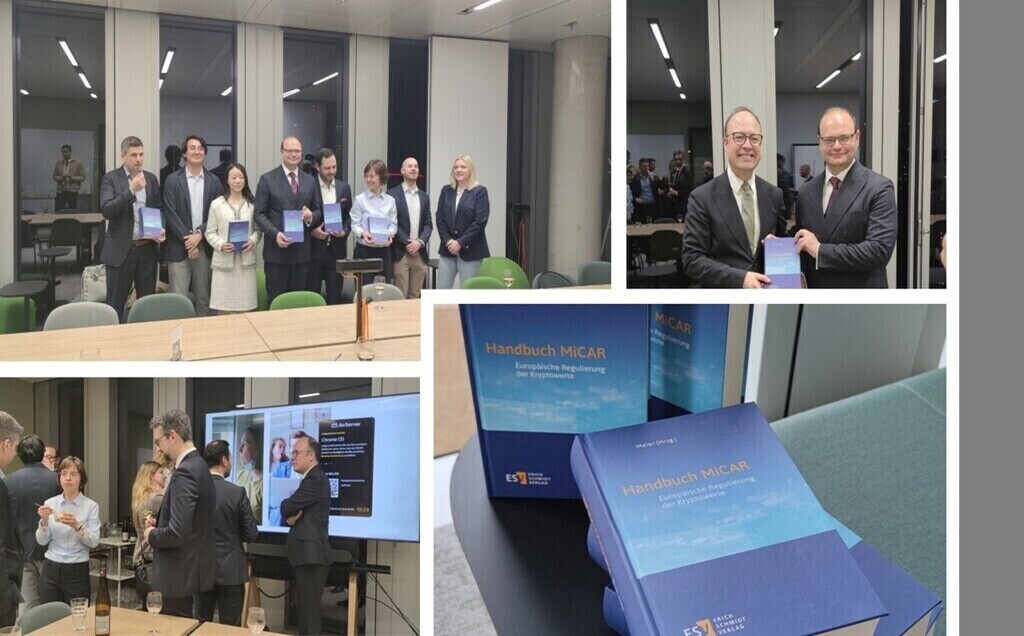
Initial meeting

Sep 04, 2023

The MiCAR Whitepaper (Part III) – What Content is Required for the E-Money Token Whitepaper?

The Markets in Crypto Assets Regulation (MiCAR), which will have legal effect in the European Union as of June 30, 2024, requires that a whitepaper be prepared in the event of a public offering of e-money tokens or admission of e-money tokens to trading on a trading platform. In the first two parts of the series, we addressed the content requirements for a whitepaper in the case of an offering or admission of crypto assets other than asset-referenced tokens or e-money tokens, as well as asset-referenced tokens. In this part, we address the whitepaper requirements for e-money tokens. MiCAR defines an e-money token as a crypto asset that is intended to maintain value stability by reference to the value of an official currency. In this context, issuers of e-money tokens may in principle only be legal entities that are licensed as credit institutions or as e-money institutions.

Content Requirements for a MiCAR Whitepaper for E-Money Tokens

The content requirements for a whitepaper for e-money tokens have many similarities with the content requirements for the whitepaper for crypto assets and asset-referenced tokens supplemented by some unique features for e-money tokens. The whitepaper for e-money tokens must also contain information about the issuer. In particular, it must be evident from the whitepaper what the legal form and company ID of the issuer is and what its address is. In addition, issuers must provide information about their financial performance over the past three years in an e-money token whitepaper if the issuer has been in existence for that long. As mentioned above, only regulated companies licensed as credit institutions or as e-money institutions may issue e-money tokens. Accordingly, a whitepaper for e-money tokens must contain accurate information about the authorization as an issuer of the e-money token and the name of the competent authority that granted the authorization. In the event that the issuer also issues other crypto tokens or also performs activities related to crypto tokens, this must be clearly stated. Information about the e-money token must then be included, such as the token’s characteristics and precise details of any natural or legal persons involved in the token’s design and development. Specific information about the e-money token’s public offering or admission to trading must also be included. This information includes such things as the total number of tokens. In another section of the whitepaper, the rights and obligations associated with the e-money token must be described, as well as information about the technology underlying the tokens. A separate section must also present and explain the issuer-related and e-money token-related risks.

The Requirements Specified for E-Money Tokens by MiCAR Must be Addressed

The section on the rights and obligations associated with e-money tokens must include information on how the issuer ensures compliance with the requirements established by MiCAR for the issuance of e-money tokens. MiCAR stipulates that holders of e-money tokens are entitled to a claim against the issuer of the relevant e-money tokens. Upon demand by the holder of an e-money token, the issuer must repay the monetary value of the e-money token to the holder at any time and at par value. Accordingly, a detailed description of the right to redeem at par value and the procedure and conditions for exercising such rights must be included. As with asset-referenced tokens, a reorganization plan and a redemption plan must be established for e-money tokens. The redemption plan must document that the issuer of the e-money token is capable of redeeming the outstanding issued e-money token without causing undue economic harm to its holders. Accordingly, the whitepaper must include a description of the rights associated with the implementation of the reorganization plan and the redemption plan.

Rechtsanwalt Dr. Konrad Uhink

I.  https://fin-law.de

E. info@fin-law.de

The lawyer responsible for providing advice on MiCAR whitepaper creation in our law firm is Attorney Dr. Konrad Uhink.

subscribe to Newsletter

    Contact

    info@fin-law.de

    Aug 28, 2023

    Europe goes Crypto (Part XVI) – How is Crypto Advisory Regulated under MiCAR?

    The Markets in Crypto Assets Regulation (MiCAR) will regulate numerous activities as crypto asset services as of December 30, 2024. German providers of crypto asset services will not be allowed to operate without a corresponding BaFin license unless their business falls under an exemption regulated by MiCAR. One of the crypto asset services that will be regulated under MiCAR in the future is the provision of crypto advisory services. The wording of the crypto asset service itself initially does not specify which particular advisory services will be covered by the permission requirement and thus by the requirement for a BaFin license. However, MiCAR contains a definition in this respect that brings more clarity. According to this definition, advice on crypto assets includes offering or making personalized recommendations to clients or agreeing to make such recommendations at the request of the client or at the initiative of the crypto asset service provider providing the advice with respect to one or more transactions relating to crypto assets or the use of crypto asset services. The somewhat cumbersome definition clearly shows that advice on crypto assets can by no means refer only to transactions involving crypto assets. Rather, it is also intended to cover advisory services that relate to the use of crypto asset services. The definition thus goes further than its counterpart in the MiFID regulation, which only refers to transactions with financial instruments.

    BaFin License according to MiCAR Only for Personalized Recommendations

    According to the above-mentioned definition, the focus of the provision of crypto advisory is therefore not on the subject matter of the advice, but rather on the offer or provision of personalized recommendations to customers. These can then relate either to transactions with crypto assets or to the use of crypto asset services. The latter can be those offered by the advisor itself or those offered by third parties. A recommendation will be considered personalized if it refers specifically to the personal circumstances of the advised person, i.e. if it takes into account his personal financial situation, his experience and his willingness to take risks. With regard to the necessity of a BaFin license, it will make no difference whether the advisor actually takes the personal circumstances into account. Rather, it will be sufficient to justify the obligation to obtain a BaFin license under MiCAR that the advisor gives the appearance to his client that he is providing him with personalized advice tailored to his needs. With respect to the recommendation of crypto asset services, crypto advisors will have to appreciate in particular the personal needs of their clients with respect to the use of crypto asset services. However, not only the crypto asset service type itself will be relevant, but also the conditions of a service offer in light of the customer’s personal circumstances, insofar as the use of specific offers of a specific crypto asset service provider is advised.

    MiCAR Obligates Crypto Advisors to Comply with Specific Compliance Obligations

    Crypto advisors will not only have to apply for a BaFin license under MiCAR but will also have to fulfill specific compliance obligations once the MiCAR license is granted. In particular, they will have to inform their clients whether they provide their advisory services independently. All potential conflicts of interest that could be capable of impairing the advisory service must be disclosed. For example, if preferential advice is given on the use of crypto asset services from a particular provider, this must be disclosed. Crypto advisors must also provide their clients with detailed information on how they conduct the analyses on which their recommendations are based. Furthermore, according to MiCAR, crypto advisors must provide comprehensive information about costs and ancillary costs. This includes the costs of their own advisory services as well as costs of the crypto assets recommended to or marketed to the client and the client’s payment options in this regard. Finally, crypto advisors are subject to extensive disclosure obligations with regard to the risks associated with recommended crypto assets or crypto asset services. Crypto advisors must also point out any risks of loss, limited liquidity and the fact that crypto assets are not covered by the commonly known deposit protection systems.

    Attorney Dr. Lutz Auffenberg, LL.M. (London)

    I.  https://fin-law.de

    E. info@fin-law.de

    The competent lawyer for questions regarding crypto asset services and BaFin license under MiCAR in our law firm is Attorney Dr. Lutz Auffenberg, LL.M. (London).

    subscribe to Newsletter

      Contact

      info@fin-law.de

      Aug 21, 2023

      The MiCAR Whitepaper (Part II) – What Needs to Be in the Whitepaper for Asset-Referenced Tokens?

      The Markets in Crypto Assets Regulation (MiCAR), which will take legal effect in the European Union as of June 30, 2024, stipulates that a whitepaper must be prepared in the event of a public offering of asset-referenced tokens or admission of such tokens to trading on a trading platform. In the first part of the series, we looked at the content requirements for a whitepaper in the case of an offering or admission of crypto assets other than asset-referenced tokens or e-money tokens. In this part, we address the whitepaper requirements for asset-referenced tokens. Such a token is understood to be a crypto-asset that is not an e-money and that purports to maintain a stable value by referencing another value or right or a combination thereof, including one or more official currencies. In this context, issuers may in principle only be credit institutions or legal entities that have obtained a license under MiCAR.

      Content Requirements for a MiCAR Whitepaper for Asset-Referenced Tokens

      The content requirements for a whitepaper for asset-referenced tokens basically have many similarities with the content requirements for the whitepaper for crypto assets other than asset-referenced tokens or e-money tokens supplemented by specifics for asset-referenced tokens. First, the whitepaper must contain information about the issuer. This information includes, in particular, the most important company data (e.g., legal form, address, company ID) as well as precise information on the issuer’s financial performance over the last three years, provided the issuer has been in existence for as long as that. Since issuers generally require a license or must be a credit institution, information on the relevant supervisory authorities should be included. Next, information about the asset-referenced token must be included, such as the token’s characteristics and precise details about any natural or legal persons involved in the token’s operation. Specific information about the public offering of the asset-referenced token or the admission to trading must also be included. Such information may include the total number of tokens or time limits on the offering. In another section of the whitepaper, the rights and obligations associated with the asset-referenced token must be presented, as well as information about the technology underlying the tokens. In the section concerning the rights and obligations associated with the tokens, a detailed description of the holders’ claim against the issuer in respect of the assets associated with the tokens must be included in particular.

      Separate Section on the Reserve of Asset to Be Included in MiCAR Whitepaper

      The whitepaper for asset-referenced tokens must include a separate section on the reserve of assets. The reserve of assets is the basket of reserve assets used to secure the claim against the issuer. The purpose of the reserve is to ensure that the claims of the bearers of asset-referenced tokens do not turn out to be unenforceable and that the corresponding assets are in fact available. Accordingly, the issuer shall include information on the composition of the reserve of assets and a detailed description of the mechanism for matching the value of the reserve of assets with the claims related to the asset-referenced token, including legal and technical aspects, in the MiCAR whitepaper. The specific mechanisms for issuing and redeeming asset-referenced tokens must also be described in the whitepaper. If the issuer has invested a portion of the reserve of assets, then it must provide information about this and describe the investment policy for the reserve of assets.

      Attorney Dr. Konrad Uhink

      I.  https://fin-law.de

      E. info@fin-law.de

      The lawyer responsible for providing advice on MiCAR whitepaper creation in our law firm is Attorney Dr. Konrad Uhink.

      subscribe to Newsletter

        Contact

        info@fin-law.de

        Aug 14, 2023

        Flashbots and MEV – Does MiCAR Ban Transaction Ordering?

        The new Markets in Crypto Assets Regulation (MiCAR) will not only impose regulatory licensing and transparency requirements on issuers, offerors and service providers in the crypto market. Rather, MiCAR will also introduce comprehensive market abuse regulation for the European crypto market in order to ensure fairness and equal opportunities for trading in crypto assets in the EU. To ensure a functioning market abuse prevention, in the future, persons who professionally broker or execute transactions in crypto assets will be obliged by Art. 92 MiCAR to implement effective precautions, systems and procedures for the prevention and detection of market abuse. In the European crypto scene, a discussion has now flared up about whether this new obligation under MiCAR could mean a de facto ban on so-called MEV activities. The abbreviation MEV stands for “Maximum Extractable Value” in the crypto sector and is particularly relevant in the area of so-called transaction ordering. Here, market participants can search for particularly lucrative transactions via the use of tools known as flashbots and transmit them directly to validators for transaction confirmation without the transaction having previously been included in the public transaction mempool accessible to all validators. For validators, the supply of MEV transactions by flashbots represents a significant competitive advantage in the hunt for block rewards.

        Art. 92 MiCAR is Not a Prohibition Provision

        First, it must be clarified that Art. 92 MiCAR is not a prohibition provision. Rather, the provision serves to oblige intermediaries and exporters of transactions in crypto assets to effectively assist in the prevention and detection of market abuse cases. If market participants obliged under Art. 92 MiCAR discover that there are reasonable indications of market abuse in the course of their business activities, they must report this immediately to the competent authority in their country of residence. The regulatory content of the provision is thus, in addition to the obligation to create the conditions to be able to recognize cases of abuse in their own business operations, a reporting obligation. In contrast, Art. 92 MiCAR does not prohibit the operation of a flashbot or the participation in MEV transactions or transaction ordering. Whether the provision can nevertheless be relevant for operators of flashbots will depend in each case on the specific structure of the business activity of the market participant concerned. For example, according to its wording, the obligation only affects intermediaries and exporters of transactions involving crypto assets. In this context, it is questionable whether the operation of flashbots or the transmission of a transaction to a validator for confirmation and inclusion in a block of the underlying blockchain can be an activity covered by Art. 92 MiCAR. In this respect, the wording refers to transactions on crypto assets. The activity of a flashbot operator, on the other hand, is aimed at providing an unconfirmed transaction to a validator and not at brokering a transaction over crypto assets or executing a crypto transaction itself. The direct application of Art. 92 MiCAR to flashbot operators is therefore rather unlikely, at least according to the wording of MiCAR, even though it will always depend on the specifics of the individual case.

        ESMA Could Bring Clarity to MEV and Transaction Ordering under MiCAR

        MiCAR requires ESMA to develop regulatory technical standards (RTS) also on the interpretation of Art. 92 MiCAR. A first draft is to be put out for public consultation in the first quarter of 2024. ESMA must submit the final version to the EU Commission by December 30, 2024. In the RTS, ESMA could also comment on the treatment of MEV as well as flashbots and transaction ordering within the scope of MiCAR’s abuse regulation for the crypto market. If MEV activities were then potentially classified as abusive activities in certain constellations, Art. 92 MiCAR could, where appropriate, require intermediaries of transactions in crypto assets and validators to implement arrangements, systems and procedures as part of their business operations to effectively detect and report market abuse activities to the competent authorities. Validator operators would thus become addressees of regulatory compliance obligations through MiCAR. In contrast, a general prohibition of transaction ordering, MEV activities or the use of flashbots cannot be derived from Art. 92 MiCAR.

        Attorney at Law Dr. Lutz Auffenberg, LL.M. (London)

        I.  https://fin-law.de

        E. info@fin-law.de

        The lawyer responsible for advising on market abuse regulation under MiCAR in our law firm is Attorney Dr. Lutz Auffenberg, LL.M. (London).

        subscribe to Newsletter

          Contact

          info@fin-law.de

          Aug 07, 2023

          The MiCAR Whitepaper (Part I) – Required Content of the Whitepaper for Crypto Assets

          The Markets in Crypto Assets Regulation (MiCAR), which will come into legal effect in the European Union in the course of 2024, stipulates that a whitepaper must be prepared when crypto assets are offered to the public or admitted to trading on a trading platform. Depending on the qualification of the crypto asset as a value-referencing or e-money token or other crypto asset, the whitepapers must meet certain requirements. In this series, we want to look at what content needs to be considered and what the differences are between the different categories of tokens. In this first part, we will address the so-called other crypto assets than value-referenced tokens and e-money tokens. MiCAR considers a crypto asset to be a digital representation of value or rights that can be electronically transferred and stored using distributed ledger technology or similar technology. The extent to which the following content is applicable to value-referenced tokens and e-money tokens will be addressed in the subsequent series.

          Minimum Requirements for the Content of a MiCAR Whitepaper

          The content requirements for a crypto asset whitepaper basically have a lot in common with the content requirements for a securities prospectus. The whitepaper must provide information about the issuer as well as information about other key players in the project. In particular, this information includes key company data (e.g., address, LEI), potential conflicts of interest, and accurate information about the issuer’s financial performance over the past three years. Furthermore, the white paper must contain a detailed description of the project. This information section requires, among other things, information on why the crypto asset is being issued, who is involved in the implementation of the project, and details on the use of funds. Specific information about the public offering of the crypto asset or the admission to trading must also be included. This information includes, for example, details about the issue price, total number of crypto assets or time limits of the offer. In another section of the white paper, the rights and obligations associated with the crypto assets must be presented, as well as information about the technology underlying the crypto assets. As with standard capital markets documents, there must be issuer- and crypto-asset-specific risks in the whitepaper. With the exception of a standard disclaimer that the crypto asset may lose all or part of its value, there must be no statement about the future value of the crypto asset.

          Additional Formal and Content Requirements for the MiCAR Whitepaper

          There are currently no specific format templates or a limit on the number of pages permitted. ESMA shall develop corresponding technical standards for implementation until 30th of June 2024. However, based on the MICAR, it can already be stated that the first page must contain a clear declaration that the whitepaper has not been approved by any competent authority of a member state and that the provider bears sole responsibility. Following this statement, the governing body of the provider or applicant must certify that the whitepaper meets the requirements of MiCAR. Following this, a summary must be included. This must provide, in concise and non-technical language, material information about the crypto asset’s public offering or intended admission to trading. The whitepaper itself does not have to be approved, but it must be submitted to the competent supervisory authority no later than 20 working days prior to the date of publication. The submission must also include information on why the crypto asset in question is subject to MiCAR. Prior to the launch date of the offer or admission, the whitepaper must be published on the provider’s or applicant’s website and remain available there for as long as crypto assets are held by the public.

          Attorney Dr. Konrad Uhink

          I.  https://fin-law.de

          E. info@fin-law.de

          The lawyer responsible for advising on all questions related to the MiCAR whitepaper for crypto assets in our law firm is Attorney Dr. Konrad Uhink.

          subscribe to Newsletter

            Contact

            info@fin-law.de

            Jul 31, 2023

            Europe goes Crypto (Part XV) – The Investment Brokerage with Crypto Assets under MiCAR

            The Markets in Crypto Assets Regulation (MiCAR), which will take legal effect for crypto service providers in the European Union as of December 30, 2024, is very closely oriented to the services known from MiFID2 regulation when it comes to the activities to be regulated. In this respect, one of the crypto services that can only be provided in the future on the basis of a MiCAR license will also be the acceptance and transmission of orders for crypto assets for clients. The provision itself does not clarify from whom the orders are to be accepted and to whom they are to be transmitted. In this respect, it is not clear at first glance which specific crypto service is meant by the wording. However, a corresponding formulation for the description of a financial service requiring a license can be found in relation to financial instruments in Annex I of MiFID2. There, as is well known, the somewhat awkward wording means investment brokerage in relation to financial instruments covered by MiFID2 regulation. Crypto service providers, who therefore broker supply and demand between two parties without themselves becoming a party to an exchange contract for crypto assets in order to work towards the conclusion of a contract between these two parties, are to be regulated as crypto investment brokers in the future and must obtain a MiCAR license for their activities.

            Requirements for a MiCAR License for Investment Brokerage with Crypto Assets

            In order to successfully obtain a MiCAR license, a corresponding license application must be submitted to BaFin in Germany. The license application requires very careful preparation. Applicants applying for a MiCAR license at BaFin must first meet the minimum regulatory requirements under MiCAR for crypto service providers. In the case of investment brokerage with crypto assets, these include in particular the maintenance of a minimum capital of 50,000 euros at all times, reliable and professionally suitable directors, and a professional business organization to meet all legal and regulatory requirements. In addition, crypto service providers that wish to engage in investment brokerage with respect to crypto assets must comply with specific compliance obligations under MiCAR. For example, they are required to exercise particular diligence when transmitting client orders to crypto trading platforms and other crypto service providers. In this regard, they must establish and implement procedures and arrangements for the prompt and proper transmission of client orders. Further, MiCAR prohibits them from receiving monetary benefits from trading platforms or other crypto service providers for forwarding client orders. The prohibition serves to ensure that crypto asset investment brokers provide the best possible service to their clients and do not refer them to a crypto service provider that is not optimal for the clients for their own economic interest. Finally, crypto asset brokers must not misuse information about customer orders that have not yet been executed and must take precautions in their business in this regard.

            No Tied Agent Under a Liability Umbrella Under MiCAR

            The concept of the tied agent known from the field of investment brokerage with financial instruments, which exclusively provides investment brokerage for the account and under the liability of a correspondingly licensed company and which does not require its own BaFin license for this purpose, is not provided for in MiCAR. Consequently, every provider of investment brokerage with crypto assets will in principle have to obtain an independent MiCAR license from BaFin. This is still different for investment brokers brokering crypto assets under the provisions of the German Banking Act (KWG) and Investment Firm Act (WpIG) that are currently still in force in Germany. According to both national supervisory regimes, crypto assets are financial instruments – albeit defined differently than in MiCAR – and thus suitable objects of investment brokerage requiring a license. According to the exceptions regulated in the KWG and the WpIG), this can also be provided without an individual BaFin license by means of a liability umbrella as a tied agent. Such arrangements will no longer be possible in the future under the MiCAR regime. In view of the current liability umbrella regulation under the KWG and the WpIG in Germany, the legislator will have to decide in the near future how to deal with the special regulation for purely national business models, which is not in line with MiCAR. Tied agents currently brokering crypto assets under a liability umbrella should promptly consider obtaining their own MiCAR license in order to be able to operate their business after December 30, 2024.

            Attorney Dr. Lutz Auffenberg, LL.M. (London)

            I.  https://fin-law.de

            E. info@fin-law.de

            The lawyer responsible for advising on obtaining a MiCAR license for investment brokerage with crypto assets in our law firm is Attorney Dr. Lutz Auffenberg, LL.M. (London).

            subscribe to Newsletter

              Contact

              info@fin-law.de

              Jul 24, 2023

              ESG in the Securities Prospectus – ESMA Publishes Statement on Sustainability-Related Information Requirements

              The topics of environmental, social and governance (ESG) are becoming increasingly important for the financial industry and must be taken into account at various levels. ESG information also plays a significant role when raising money through the capital market. The European Securities and Markets Authority (ESMA) has therefore announced a public statement on sustainability-related information in prospectuses in accordance with Regulation (EU) 2017/1129 (Prospectus Regulation) on July 11, 2023. Accordingly, ESMA’s requirements must be taken into account when issuing non-equity securities, in particular green bonds, and for issuing stocks. The Prospectus Regulation requires that a securities prospectus contains all required information that is essential for investors to form an informed opinion for the investment decision. This information may include, in particular, ESG information, which must then be included in the prospectus accordingly. However, the ESMA requirements are only intended to specify the existing information requirements. Additional information requirements, however, are not established. BaFin welcomes ESMA’s comments and will also take them into account in the approval procedure for a securities prospectus.

              Circumstances of the Issuer and Type of Security are Decisive for ESG Disclosures

              The type of sustainability information required to meet the requirements of the Prospectus Regulation depends on the materiality of the information for an investor. The circumstances of the issuer and the nature of the securities in question will determine what information is considered material. In this regard, issuers must specify the basis for any statements about their sustainability profile or that of the securities they issue. Information provided in the risk factors of a securities prospectus should not be used to excuse failure to address factors over which the issuer exercises control. For example, a disclaimer that the proceeds of the offering may be invested contrary to the project selection criteria set forth in a prospectus relates to a factor over which an issuer exercises control. It should therefore not be included as a disclaimer. The comprehensibility of sustainability information should be ensured by complying with the requirements set out in Regulation (EU) 2019/980. In particular, the prospectus should clearly define the components of the mathematical formulas and, where applicable, clearly describe the product structure. All technical terms relating to sustainability should also be adequately defined.

              ESG Aspects to be Considered for Stocks and Non-Dividend Securities in the Securities Prospectus.

              To the extent that sustainability-related disclosures are required to be included in a company’s non-financial reporting on the basis of other European directives, issuers should also include these disclosures in a stock prospectus. With respect to bonds whose proceeds are used to finance or refinance green or social projects or activities, ESMA expects disclosure on how the proceeds are used and managed, as well as information that enables investors to assess the sustainability objectives underlying the project evaluation and selection process. For bonds where the financial or structural characteristics depend on the issuer achieving predefined ESG targets, disclosures on the selected Key Performance Indicators (KPIs) and Sustainability Targets (SPTs) are to be included in the securities prospectus. Furthermore, information shall be included to enable investors to assess the consistency of the KPIs and the related SPTs with the relevant sector-specific science-based targets (if applicable) and the issuer’s sustainability strategy. For the aforementioned types of bonds, if issuers intend to disclose post-issuance information, this should be included in the securities prospectus. In addition, it should be indicated which information will be reported and where it can be obtained.

              Attorney Dr. Konrad Uhink

              I.  https://fin-law.de

              E. info@fin-law.de

              The competent lawyer for questions concerning the information documents such as e.g. a securities prospectus in the case of a public offering of (electronic) securities in our law firm is attorney Dr. Konrad Uhink.

              subscribe to Newsletter

                Contact

                info@fin-law.de

                Jul 17, 2023

                Europe goes Crypto (Part XIV) – When is a MiCAR License Required for the Placement of Crypto Assets?

                The Markets in Crypto Assets Regulation (MiCAR) will also regulate crypto service providers offering the placement of crypto assets from December 30, 2024. In addition to the general licensing requirements MiCAR imposes on any crypto service provider, crypto service providers that wish to offer the placement of crypto assets will additionally have to meet specific obligations tailored to their specific crypto service in order to be eligible for a MiCAR license. In any case, they will have to maintain the minimum regulatory capital of EUR 50,000 and have professionally qualified and reliable business managers and a professional business organization. In addition, crypto service providers wishing to offer the placement of crypto assets will have to comply with detailed information obligations towards their clients and implement specific and adequate procedures to identify, avoid, regulate and disclose any conflict of interest that may be associated with their activity. But what specific activity is actually regulated via the crypto service of placing crypto assets and when is the obligation to apply for a MiCAR license triggered in this regard?

                Placement of Crypto Assets Under MiCAR is Special Case of Crypto Brokerage

                MiCAR defines crypto asset placement as the marketing of crypto assets to purchasers on behalf of or for the account of the provider or a person associated with the provider. The definition makes it clear that crypto asset placement under MiCAR is a marketing activity in which the crypto asset service provider is is active on the side of the provider of the crypto assets in question. However, it is not clear from the definition whether the activity must necessarily be a brokerage activity or whether the placement of crypto securities can also be assumed in the case of a sale of crypto securities from the crypto service provider’s own stock, as long as the sale is ultimately made for the account of the provider. However, since the sale of crypto assets from the crypto service provider’s own holdings would already fall under the more specific crypto service of exchanging crypto assets for money or other crypto assets and the provider would no longer have an economic interest in the further sale, there is good reason to assume that the placement of crypto assets under MiCAR is a special case of crypto brokerage. It can be assumed from the special provisions of MiCAR on the placement business with crypto assets, that a placement agreement must be concluded between the crypto service provider and the offeror in any case, in which the details for the placement of the crypto assets are regulated. According to MiCAR, it is also possible for the placement service provider to agree on a fixed takeover obligation with respect to the crypto assets vis-à-vis the provider in the event that the placement of the crypto assets is not as successful as planned.

                Special Obligations of Crypto Asset Service Providers for the Placement of Crypto Assets

                MiCAR requires that crypto asset placement service providers enter into a placement agreement with the providers of the crypto assets to be placed. Prior to conclusion, i.e. at the latest in the placement agreement, crypto asset service providers must disclose to the providers the manner in which the placement is to be carried out and whether, or in what amount, they guarantee minimum sales. The amount of transaction fees associated with the proposed placement must also be disclosed, and in this respect both crypto and cash transaction fees are likely to be relevant. In addition, prior to entering into the placement agreement, crypto asset service providers offering placement services must disclose the target group of buyers they will be approaching and what they plan in terms of the placement period, the process and the expected price of the placement service. Furthermore, crypto asset service providers offering the placement of crypto securities must design their internal procedures in such a way that, in particular, conflicts of interest in connection with a simultaneous proprietary distribution by the provider, incorrect planning with regard to the placement price or monetary or non-monetary incentives of the provider for the crypto asset service provider can be identified and avoided.

                Attorney Dr. Lutz Auffenberg, LL.M. (London)

                I.  https://fin-law.de

                E. info@fin-law.de

                The lawyer responsible for advising on obtaining a MiCAR license for the placement of crypto securities in our law firm is Attorney Dr. Lutz Auffenberg, LL.M. (London).

                subscribe to Newsletter

                  Contact

                  info@fin-law.de

                  Jul 10, 2023

                  Crowdfunding and ECSP License – Is the Tied Agent Model Reaching its Limits?

                  In Germany, BaFin is currently issuing the first licenses under Regulation (EU) 2020/1503 on European Crowdfunding Service Providers (ECSP Regulation). Via a crowdfunding service, issuers can issue securities with an issue value of no more than EUR 5 million over a period of twelve months in accordance with the ECSP Regulation when using a publicly accessible, internet-based electronic information system operated or managed by a regulated crowdfunding service provider (crowdfunding platform). Currently, there are various internet platform operators that act as tied agents to broker security tokens or crypto securities under the liability umbrella of a securities institution licensed for investment brokerage or contract brokerage. Most of the security tokens or crypto securities offered in this way are offered by means of a securities information sheet or basic information sheet, provided that the issue volume does not exceed the amount of EUR 8 million in individual cases. Now that the ECSP Regulation applies throughout the EU, the question arises as to whether internet platform operators acting as tied agents may continue to offer security tokens or crypto securities with issue volumes of up to EUR 5 million or whether a BaFin license as a crowdfunding service provider will be mandatory.

                  Public Offering of Security Tokens and Crypto Securities up to 5 million Euros in Case of Crowdfunding Only with ECSP License

                  In its scope of application, the ECSP Regulation takes precedence over the national regulations of the German Banking Act (KWG) and the German Investment Firm Act (WpIG). As a consequence, the German model of tied agents cannot apply to issues of security tokens or crypto securities within the scope of the ECSP Regulation. Only in the case of an issuance that leads to a total volume of more than 5 million euros calculated over a period of twelve months, the regulations of the KWG or WpIG apply. Only then is it possible for companies to broker the corresponding financial products as tied agents. This understanding of the ECSP Regulation with regard to the relationship to national regulations has already been confirmed by ESMA in its Q&A. However, according to EMSA, it is possible to use tied agents to promote the services of the swarm finance service provider. Such activity would then be subject to national law.

                  Tied Agents May Need to Adapt Their Business Model

                  Tied agents currently brokering security tokens or crypto securities via an internet platform face the risk that they will have to stop brokering small-volume offers and will not be able to offer them without an ECSP license in the future. In order to continue to be able to broker small-volume offerings in the future, tied agents operating via internet platforms must first apply for and obtain an ECSP license from BaFin. However, since the scope of the ECSP Regulation only applies to public offerings of up to EUR 5 million, tied agents operating via Internet platforms will still be able to support issues of more than EUR 5 million without an ECSP license from BaFin. Should the same issuer conduct another small-volume issue within twelve months, the brokerage of such an issue under the liability umbrella should also be possible, as the offer threshold of the ECSP Regulation is always based on a period of twelve months.

                  Attorney Dr. Konrad Uhink

                  I.  https://fin-law.de

                  E. info@fin-law.de

                  The responsible attorney in our law firm for advice on crowdfunding, the ECSP Regulation and capital markets issuances in general is Dr. Konrad Uhink.

                  subscribe to Newsletter

                    Contact

                    info@fin-law.de

                    Jul 03, 2023

                    Europe goes Crypto (Part XIII) – MiCAR License for Order Execution on Crypto Assets

                    The Markets in Crypto Assets Regulation (MiCAR) will subject crypto service providers in the European Union to numerous licensing and compliance requirements. The regulations relevant to crypto service providers in this respect will take legal effect on 30 December 2024, following a transition period of 18 months after they have already been published in the Official Journal of the European Union. One of the crypto services regulated by MiCAR in the future is the execution of orders for crypto assets for clients. Without further explanation, the scope of the provision is conceivably broad. According to the definition of crypto services contained in MiCAR, the regulated execution of orders for crypto assets on behalf of clients shall be deemed to occur if the crypto service provider concludes agreements for the purchase or sale of one or more crypto assets on behalf of its client. Also to be included under MiCAR is the subscription of crypto assets for clients that are to be offered to the public for the first time or are to be authorized for regulated trading. It is not mandatory that the agreement to be concluded is merely brokered by the crypto service provider between the client and a third party. Rather, the crypto service provider executing the order may itself also be the counterparty of its customer, for example if it acquires crypto assets in its own name on a crypto exchange for the account of its customer.

                    MiCAR License Requirements for Order Performing Crypto Service Providers

                    Crypto service providers executing orders for crypto assets for clients must also meet the general minimum regulatory requirements under MiCAR in order to be able to obtain the required MiCAR license from BaFin. In addition to an appropriate and professional business organization and professionally suitable as well as reliable directors, which all crypto service providers must have according to MiCAR, a regulatory initial capital of at least 50,000 euros must be shown. However, MiCAR also imposes specific regulatory compliance requirements on order-executing crypto service providers. In particular, crypto service providers executing orders for crypto assets for clients are required by MiCAR regulations to implement and comply at all times with a best execution policy. In this respect, it is necessary that the crypto service providers, within the scope of their service provision, always try to achieve the best possible result for their clients in terms of price, costs and speed of order execution. The obligation to provide best execution also relates to the handling of the order execution itself as well as all other factors relevant in the individual case. Only in the case of specific instructions of the customer to the crypto service provider the duty of best execution exists only to a limited extent.

                    Information Obligations of Order Executing Crypto Service Providers vis-à-vis Clients

                    Crypto service providers executing orders for crypto assets on behalf of clients must, in accordance with MiCAR regulations, always inform their clients about the principles of order execution established in their business process. The information must be provided clearly, unambiguously and in a manner that is understandable to the client. In this respect, order executing crypto service providers must explain how they specifically execute client orders. Crypto service providers must also inform their customers accordingly in the event of significant changes to their execution policies. Under MiCAR, crypto service providers must continuously monitor the effectiveness of their internal order execution arrangements and their order execution policies in order to identify and, if necessary, remedy any deficiencies. Order-executing crypto service providers must obtain explicit consent to the execution policy from their customers prior to providing the service. Should the customer fail to give its consent, the crypto service provider may not execute orders for the customer.

                    Attorney Dr. Lutz Auffenberg, LL.M. (London)

                    I.  https://fin-law.de

                    E. info@fin-law.de

                    subscribe to Newsletter

                      Contact

                      info@fin-law.de

                      Jun 26, 2023

                      Artificial Intelligence in the Financial Industry (Part III) – AI in Risk Management

                      In the first two parts of our blog series “Artificial Intelligence in the Financial Industry”, we discussed the topic of artificial intelligence (AI) or machine learning (ML) in securities trading and asset management. However, artificial intelligence can also be used in bank risk management. For example, the law requires banks to establish an appropriate and effective risk management system to ensure their risk-bearing capacity on an ongoing basis.  This essentially involves identifying market, credit, insolvency or fraud risks in connection with trading decisions or lending, for example, and minimizing these risks. It is here that AI or ML can help identify new patterns and thereby contribute to risk mitigation. However, financial regulators do not approve individual algorithms. Rather, they examine the individual processes on a risk-oriented basis and on an ad hoc basis in their specific application in individual cases. However, BaFin has defined overall principles for the use of AI, which must be taken into account by financial institutions.

                      Management Remains Responsible for Artificial Intelligence and Its Deployment

                      Regardless of how sophisticated artificial intelligence is, the management remains ultimately responsible for the use of AI. Among other things, this means that the management must have an adequate technical understanding. If algorithm-based decisions are made, then risk management must also be adapted to these circumstances. This means, among other things, that the probability of damage occurring due to incorrect decisions by the algorithm is analyzed and the results are documented. The same applies to the extent of potential damage. Furthermore, a superordinate framework is to be set up that specifically addresses the algorithm-based decision-making processes and takes their interdependence into account. If applications are sourced in from external parties, the management is also responsible for ensuring that effective outsourcing management is established.

                      No Bias Shall Be Generated and Legal Requirements Shall Be Adhered to

                      When using AI, the systematic distortion of results (bias) must be avoided. Business decisions must not be based on bias. This should also eliminate the risk of reputational damage if, for example, individual customer groups are disadvantaged due to the bias. Companies are therefore required to use data of sufficient quality and quantity. In the development phase, financial institutions must therefore develop a data strategy, for example, that ensures the permanent provision of data. In doing so, current data protection regulations must be observed. To ensure that the algorithms and models can be checked both internally and externally, there is a documentation obligation for financial institutions.

                      Attorney Dr. Konrad Uhink

                      I.  https://fin-law.de

                      E. info@fin-law.de

                      subscribe to Newsletter

                        Contact

                        info@fin-law.de

                        Jun 19, 2023

                        Crypto Custody According to MiCAR and KWG – What Are the Differences for Crypto Asset Service Providers?

                        On June 9, 2023, the Markets in Crypto Assets Regulation (MiCAR) was finally published in the Official Journal of the European Union. It will officially enter into force 20 days later, on June 29, 2023. It will then take legal effect gradually. The rules on the issuance of asset-referenced tokens and e-money tokens will apply on June 30, 2024, and the remaining rules on the regulation of crypto service providers will apply on December 30, 2024. Crypto custodians will then be regulated by MiCAR. It has not yet been clarified whether German crypto custodians will additionally continue to be regulated by the German Banking Act (KWG) once the MiCAR rules on crypto service providers apply. It is indeed the case that the regulatory requirements for a crypto custody license under MiCAR are very similar to those for a crypto custody license under the German KWG. However, they are not congruent. It will admittedly take another year and a half before the regulatory requirements for crypto custodians under MiCAR will apply. Nevertheless, the German legislator and also BaFin as the competent supervisory authority in both cases must set the course in a timely manner so that crypto custodians regulated in Germany have sufficient time to prepare for the new regulatory situation.

                        Additional Regulatory Requirements for Crypto Custodians Imposed by MiCAR

                        MiCAR will impose some additional regulatory obligations on crypto custodians. For example, under the MiCAR regulatory regime, crypto custodians will in particular have to ensure that the crypto assets they hold for clients are kept strictly segregated from their own crypto assets. Such segregation of client assets is currently not regulated in the German KWG for crypto custodians, even though the legislator has already proposed corresponding provisions also for national law in the first draft bill for the Future Financing Act. It can therefore be assumed that the German legislator intends to introduce the obligation to segregate customers’ crypto assets under supervisory law in any case. However, it is not yet clear whether the adjustments will actually be made to the German KWG as currently envisaged or whether the legislator will perspectively opt for a departure from the national special regulation for crypto custodians. In the latter case, the obligation to segregate client assets would follow directly from MiCAR. However, abandoning the regulation of crypto custodians via the German KWG could lead to the corresponding institutions being in a worse position than they are with their current BaFin license.

                        Crypto Custody of Security Token not Possible under MiCAR

                        According to the German KWG, tokenized securities that qualify as securities in the sense of MiFID2 are also considered to be crypto assets. As a result, no custodian bank license is required for the custody of securities represented in crypto securities, but merely a BaFin license for crypto custody under the KWG. The reason for this is that a custodian bank license is only required for securities that are covered by the German Securities Deposit Act. This is not the case for tokenized securities because they lack the required certification in a physical document. Under the MiCAR regulatory regime, however, securities as defined by MiFID2 are specifically not covered as crypto assets. Rather, they are to continue to be exclusively covered by the MiFID2 regulation. As a consequence, the custody of tokenized securities using a MiCAR license for crypto custody will not be possible. Therefore, if the German legislator were to abolish the national regulation of crypto custodians under the KWG without replacement, the crypto custodians already supervised by BaFin under the KWG would be deprived of the possibility to also hold security tokens in custody for their clients. The German legislator will have to take this aspect into account when adapting the national regulation with regard to the upcoming validity of MiCAR.

                        Attorney Dr. Lutz Auffenberg, LL.M. (London)

                        I.  https://fin-law.de


                        E. info@fin-law.de

                        subscribe to Newsletter

                          Contact

                          info@fin-law.de

                          to top