After the end of the crypto-hype in February 2018, initial coin offerings (ICOs) in general do not accumulate as much capital anymore as before. The exchange prices of the tokens decreased in many cases and ICO investors more often than not had to come to the conclusion that the business ideas in which they had invested did not turn out the way they expected. In some cases, the regulators even investigated the ICO issuers because they lacked a prospectus which the regulators deemed necessary.
ICO as a New Way to Procure Funds from the Capital Markets
Initial Coin Offerings have been established in the last couple of years as a new, innovative and, most importantly, digital way of corporate financing. While this method was at first primarily used to finance and advance the development of new blockchain technologies like Ethereum or IOTA, soon other startup companies within the blockchain community realized the potential of this new funding instrument. In 2017 at the latest, even numerous non-blockchain related projects and companies started to gather funds this way. The tokens that where offered through these ICOs differed a lot from each other in terms of applicability and attached rights. Next to tokens that were simply designed to be an alternative means of payment (currency token) there were also tokens having a voucher function within the business model of the issuer (utility token) and tokens granting participation rights and a return on investment right (security token). This variety of tokens led to the involvement of the international regulatory authorities which since then have to find an answer to the question if and to what extend the existing capital markets laws and regulations are applicable to ICOs.
What Remains of the Hype – are ICOs a Failure?
If we take a closer look at the tokens offered during the ICO-hype, it quickly becomes clear that investors cannot have the sustainable and lasting economic interest that is essential for any capital markets asset class in neither currency tokens nor in utility tokens. These products can only trigger the interest of investors during a hype phase. Security tokens which are equipped with a profit-sharing mechanism, a return on investment and in some cases even with a repayment claim or the option of converting tokens to shares of the issuing company on the other hand differ from traditional securities primarily in technical aspects. The blockchain technology is only used in this case as a vehicle for already established capital markets products. This is also the approach of BaFin when it comes to the aforementioned question if capital markets law is applicable to STOs. BaFin answers this question with the principle “same business, same risk, same rules”. If emitters of security tokens abide these rules, STOs might be an interesting alternative to traditional issuing methods for securities.
What are the Advantages of STOs over Traditional Security Issuings?
The decision for a security token offering will only be made if it is sensible for the emitter from an economic point of view. The during the hype of 2018 spread argument that ICOs are unregulated and therefore cheaper than traditional security offerings is obviously false if the emitters of both products have to abide by the same rules and regulations. In both cases the issuer must create a prospectus and undergo a BaFin approval process.
The real advantages of STOs are not to be found within the regulatory regime which is applicable to them but in the underlying blockchain technology. Security tokens can be stored in the purchaser’s own wallet, potentially sparing out custodian banks that are necessary with traditional, paper-based securities. The rate of return or any other financial contribution can – if promised beforehand – be made directly and automated via smart contract to the token holder. This also applies to repayment claims. Furthermore, due to the documentation of all transactions within the blockchain itself, every transaction is potentially transparent to the issuer and, if need be, to the supervising authorities.
These advantages offer real value over traditional security emissions. STOs can therefore become a viable alternative to emit securities to the capital markets in a short to medium timeframe. Therefore, not only legal expertise in capital markets law but also a fundamental and sound knowledge of the functionality of the blockchain technology is an absolute must for a successful security token offering. FIN LAW offers both and supports its clients with the legal conception of the security token as well as with the coordination with BaFin and the creation of all necessary legal documents.
Attorney Lutz Auffenberg, LL.M. (London)
I. https://fin-law.de
E. info@fin-law.de
subscribe to Newsletter-
 FIN LAW – Awarded by WiWo for the Third Time
For the third time, WirtschaftsWoche (WiWO) magazine has awarded FIN LAW and Dr. Lutz Auffenberg, LL.M. (London) as a top Law Firm and Lawyer respectively.
FIN LAW – Awarded by WiWo for the Third Time
For the third time, WirtschaftsWoche (WiWO) magazine has awarded FIN LAW and Dr. Lutz Auffenberg, LL.M. (London) as a top Law Firm and Lawyer respectively. -
 FIN LAW Hosts the Annual Meeting of the Fintech Legal Network
FIN LAW had the pleasure of hosting the Annual Meeting of the Fintech Legal Network and was pleased to welcome members to its offices in Senckenberganlage.
FIN LAW Hosts the Annual Meeting of the Fintech Legal Network
FIN LAW had the pleasure of hosting the Annual Meeting of the Fintech Legal Network and was pleased to welcome members to its offices in Senckenberganlage. -
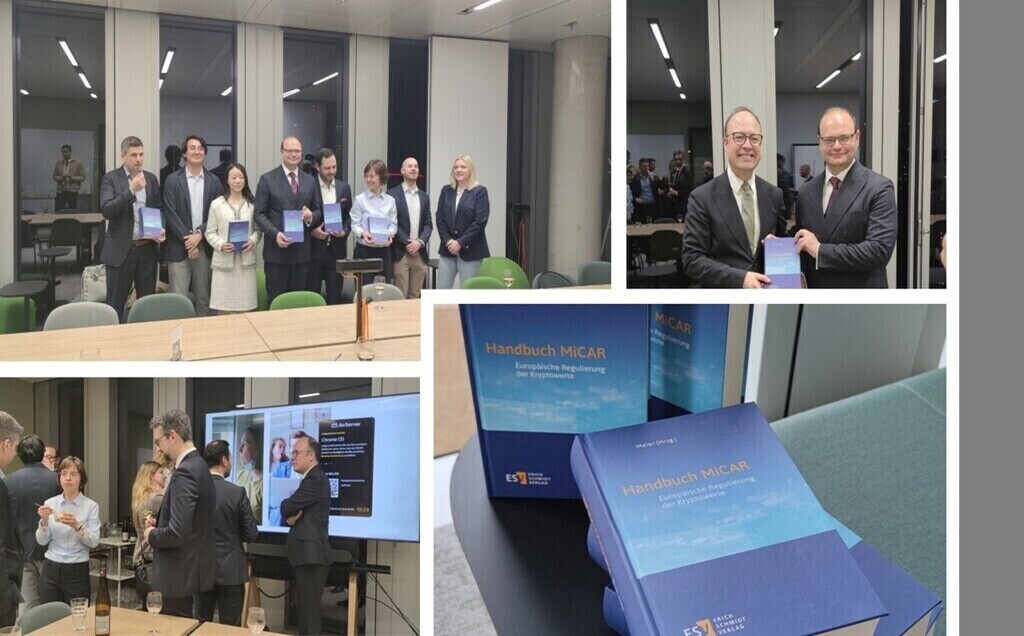 Successful Book Launch at FIN LAW for the New MiCAR Handbook by Dr. Johannes Meier
Presentation of the new MiCAR handbook by Dr. Johannes Meier at the book launch event of FIN LAW.
Successful Book Launch at FIN LAW for the New MiCAR Handbook by Dr. Johannes Meier
Presentation of the new MiCAR handbook by Dr. Johannes Meier at the book launch event of FIN LAW.