
The exact legal classification of prediction markets and the shares traded on them has not yet been definitively clarified in Germany and depends largely on the specific circumstances of each individual case. In this regard, classification as gambling is a possibility, in which case the State Treaty on Gambling would serve as the regulatory framework and the Joint Gambling Authority of the German States (GGL) as the supervisory authority. On the other hand, however, classification as a financial instrument under the financial market regulations applicable in Germany and the EU, with the Federal Financial Supervisory Authority (BaFin) as the competent supervisory authority, is also a possibility. The regulatory classification of prediction markets or the shares traded on these platforms depends crucially on their content. Specifically, it will therefore also depend on exactly how the respective share is structured. If, for example, a share concerns the outcome of a Bundesliga soccer match in such a way that platform participants bet on the victory or defeat of the participating soccer clubs, the share embodying this could constitute a sports bet. This would fall under the State Treaty on Gaming and thus be subject to supervision by the GGL. The organizer or intermediary of such sports bets can apply for inclusion on the GGL’s so-called whitelist and, upon approval, legally offer sports betting. But what is the situation if the shares were structured as financial instruments?
Shares as Financial Instruments on Prediction Markets
One possible structure for such a share, for example, is as a financial futures contract or a derivative transaction. Financial futures transactions are defined as derivative transactions and warrants. Derivative transactions include, among other things, the purchase, exchange, or other structured fixed-term transactions or option transactions that are to be settled at a later date and that depend on an underlying asset such as securities or money market instruments, interest rates, or emission allowance certificates. Furthermore, certain futures transactions relating to commodities, freight rates, climatic or other physical variables, inflation rates, etc., are included. These derivative transactions generally qualify as financial instruments within the meaning of the financial regulations applicable in Germany and the European Union. Shares in a prediction market based on such a derivative transaction should therefore also qualify as financial instruments. As outlined above, BaFin in Germany is generally the competent supervisory authority for the regulatory oversight of transactions involving such financial instruments. It is also BaFin that grants or denies the necessary licenses for the commercial handling of financial instruments. To operate a platform on which users can purchase prediction market shares from the platform operator or other users, the operator would therefore need to obtain a BaFin license, provided that the shares are structured as derivatives.
How Does the BaFin’s General Ruling on Binary Options Apply?
Another regulatory hurdle that operators of prediction markets must take into account is the BaFin general ruling dated July 1, 2019, regarding restrictions on the marketing, distribution, and sale of binary options to retail investors. The general ruling is based on a statement by ESMA, which is why the issue is relevant throughout the EU. Binary options are defined in the general ruling as derivative financial instruments that are settled in cash, where payment is only provided for upon settlement or expiration, and where the payout is limited to a predetermined amount or zero, in the event that the underlying asset of the financial instrument meets one or more predetermined conditions and in the event that it does not meet one or more predetermined conditions. In principle, it is therefore conceivable that shares offered on prediction markets could also meet this definition. This depends on the exact structure of the respective shares. Here, for example, the General Ruling also provides for exceptions for binary options that have a minimum term of 90 days, for which an approved prospectus has been published, and where the provider is not exposed to any market risk during their term. Furthermore, the provider or a company within its group may not realize any profit or loss from the binary option other than the previously disclosed commissions, transaction fees, or other associated fees.
Attorney Dr. Lutz Auffenberg, LL.M. (London)
subscribe to Newsletter-
 FIN LAW – Awarded by WiWo for the Third Time
For the third time, WirtschaftsWoche (WiWO) magazine has awarded FIN LAW and Dr. Lutz Auffenberg, LL.M. (London) as a top Law Firm and Lawyer respectively.
FIN LAW – Awarded by WiWo for the Third Time
For the third time, WirtschaftsWoche (WiWO) magazine has awarded FIN LAW and Dr. Lutz Auffenberg, LL.M. (London) as a top Law Firm and Lawyer respectively. -
 FIN LAW Hosts the Annual Meeting of the Fintech Legal Network
FIN LAW had the pleasure of hosting the Annual Meeting of the Fintech Legal Network and was pleased to welcome members to its offices in Senckenberganlage.
FIN LAW Hosts the Annual Meeting of the Fintech Legal Network
FIN LAW had the pleasure of hosting the Annual Meeting of the Fintech Legal Network and was pleased to welcome members to its offices in Senckenberganlage. -
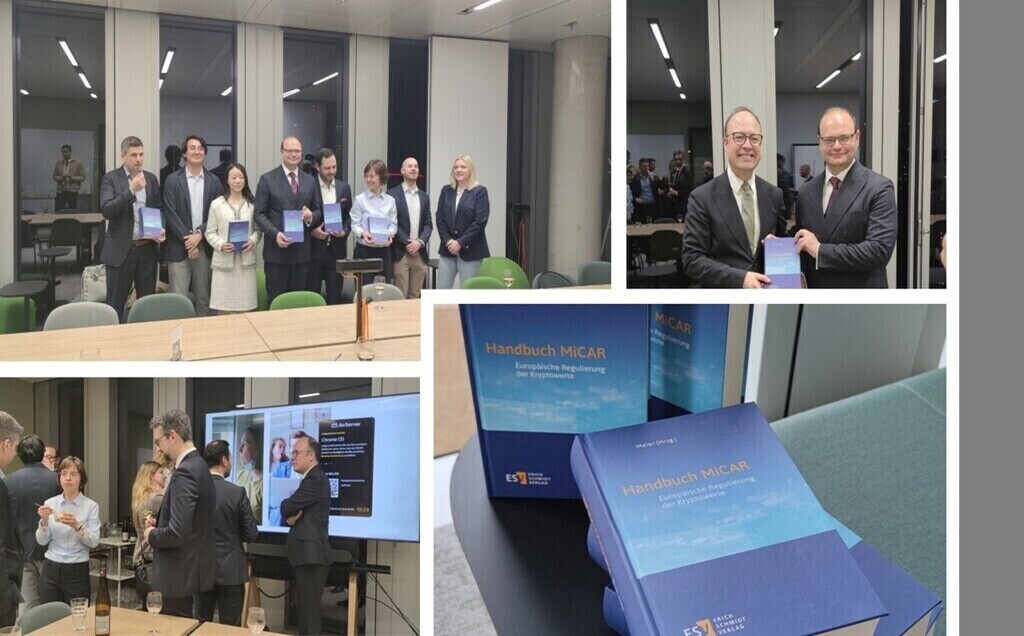 Successful Book Launch at FIN LAW for the New MiCAR Handbook by Dr. Johannes Meier
Presentation of the new MiCAR handbook by Dr. Johannes Meier at the book launch event of FIN LAW.
Successful Book Launch at FIN LAW for the New MiCAR Handbook by Dr. Johannes Meier
Presentation of the new MiCAR handbook by Dr. Johannes Meier at the book launch event of FIN LAW.