
Traditional bank financing is a type of financing involving many hurdles for many companies, especially for startups and SMEs. For one thing, banks typically require collateral before granting loans. For companies that are just getting started, this can already be a difficult—or even insurmountable—obstacle. On the other hand, banks are generally interested in regular payments consisting of interest and principal, and not so much in, for example, profit sharing or a bullet loan. However, these types of repayment or compensation are very attractive to the companies mentioned above. Investors in the capital market can offer such forms of economic participation. When companies and investors in the capital market come together, this often creates economically attractive options for both sides that can serve as interesting alternatives to traditional bank loans. Of course, if such markets were unregulated, they would pose a significant risk to retail investors and open the door to fraud by unscrupulous providers. For this reason, these markets are regulated in Germany by German and European legislation. Within the framework of these regulations, the term “public offering” frequently arises. For which products does this term play a role, and what exactly does the concept entail?
What is a Public Offering, and in Which Context is it Important?
Both Regulation (EU) 2017/1129 (the Prospectus Regulation), which regulates public offerings of securities in Europe, and Regulation (EU) 2023/1114, the Markets in Crypto-Assets Regulation (MiCAR), which establishes rules for crypto-asset markets in Europe, the concept of a public offer is of central importance. In both cases, the offering of the respective regulated products, insofar as it constitutes a public offer, is associated with far-reaching obligations for the respective issuers. The legal definitions are also virtually identical. According to the definition in the Prospectus Regulation, a public offer consists of a communication to the public in any form and by any means that contains sufficient information regarding the terms of the offer and the securities to be offered to enable an investor to decide whether to purchase or subscribe to those securities. If an offer constitutes a public offer within the meaning of the foregoing, this typically results in far-reaching obligations for the offerors and issuers. For securities, a published securities prospectus approved by the competent authority is generally required; for crypto-assets under MiCAR, a published and notified crypto-asset whitepaper is mandatory. These documentation requirements may also be accompanied by obligations regarding the distribution channels for the products. Is raising capital through such products therefore only possible if these extensive obligations are fulfilled?
Exemptions and Private Placements
The respective regulations do, however, provide for exceptions. For example, a public offering of securities is possible even without the prior publication of an approved prospectus if the offering is directed only at qualified investors or at fewer than 150 non-qualified investors per EU member state. Similar exemptions can also be found in MiCAR for the public offering of crypto-assets. Both regulations, however, also have their own specific exceptions. The regulation of crypto-assets is, in any case, modeled after the regulation of securities under the Prospectus Regulation. The situation is different, however, with so-called private placements. Although the term originates from securities law, the concept of a private placement is not defined in the Prospectus Regulation. Legal literature defines it as an offering that is not public, since a “personal connection” already exists between the issuer or its agent and the investor prior to the offering. Whether a private placement can also apply to crypto-assets has not yet been fully clarified; however, given MiCAR’s alignment with the Prospectus Regulation, there is strong evidence to suggest it does. Based on the above, startups and SMEs in particular can thus raise capital through products such as securities or crypto-assets—even without first fulfilling extensive documentation requirements—by means of clever structuring.
Attorney Dr. Lutz Auffenberg, LL.M. (London)
subscribe to Newsletter-
 FIN LAW – Awarded by WiWo for the Third Time
For the third time, WirtschaftsWoche (WiWO) magazine has awarded FIN LAW and Dr. Lutz Auffenberg, LL.M. (London) as a top Law Firm and Lawyer respectively.
FIN LAW – Awarded by WiWo for the Third Time
For the third time, WirtschaftsWoche (WiWO) magazine has awarded FIN LAW and Dr. Lutz Auffenberg, LL.M. (London) as a top Law Firm and Lawyer respectively. -
 FIN LAW Hosts the Annual Meeting of the Fintech Legal Network
FIN LAW had the pleasure of hosting the Annual Meeting of the Fintech Legal Network and was pleased to welcome members to its offices in Senckenberganlage.
FIN LAW Hosts the Annual Meeting of the Fintech Legal Network
FIN LAW had the pleasure of hosting the Annual Meeting of the Fintech Legal Network and was pleased to welcome members to its offices in Senckenberganlage. -
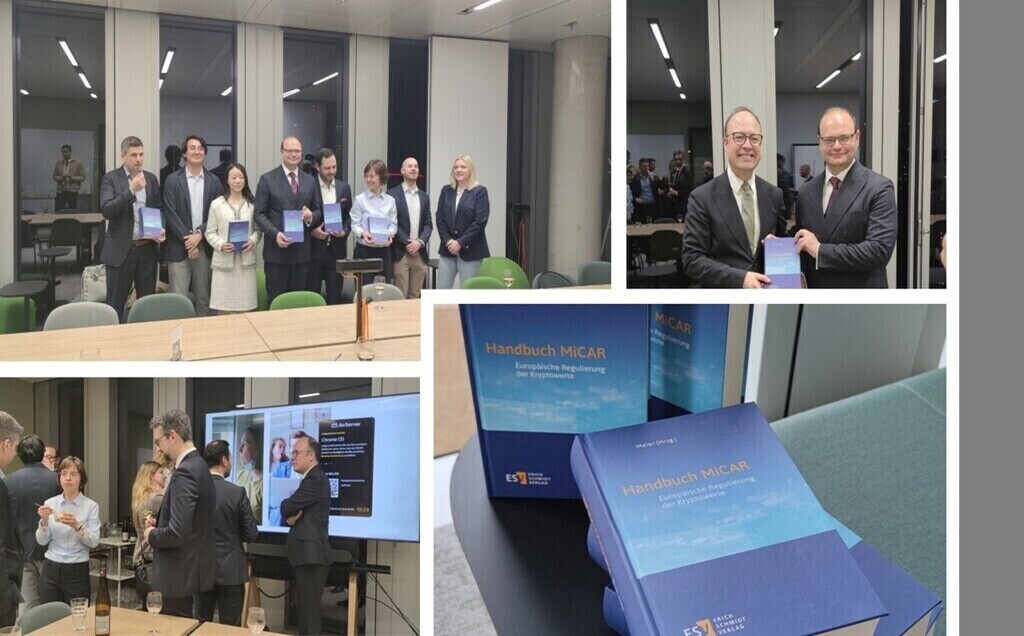 Successful Book Launch at FIN LAW for the New MiCAR Handbook by Dr. Johannes Meier
Presentation of the new MiCAR handbook by Dr. Johannes Meier at the book launch event of FIN LAW.
Successful Book Launch at FIN LAW for the New MiCAR Handbook by Dr. Johannes Meier
Presentation of the new MiCAR handbook by Dr. Johannes Meier at the book launch event of FIN LAW.