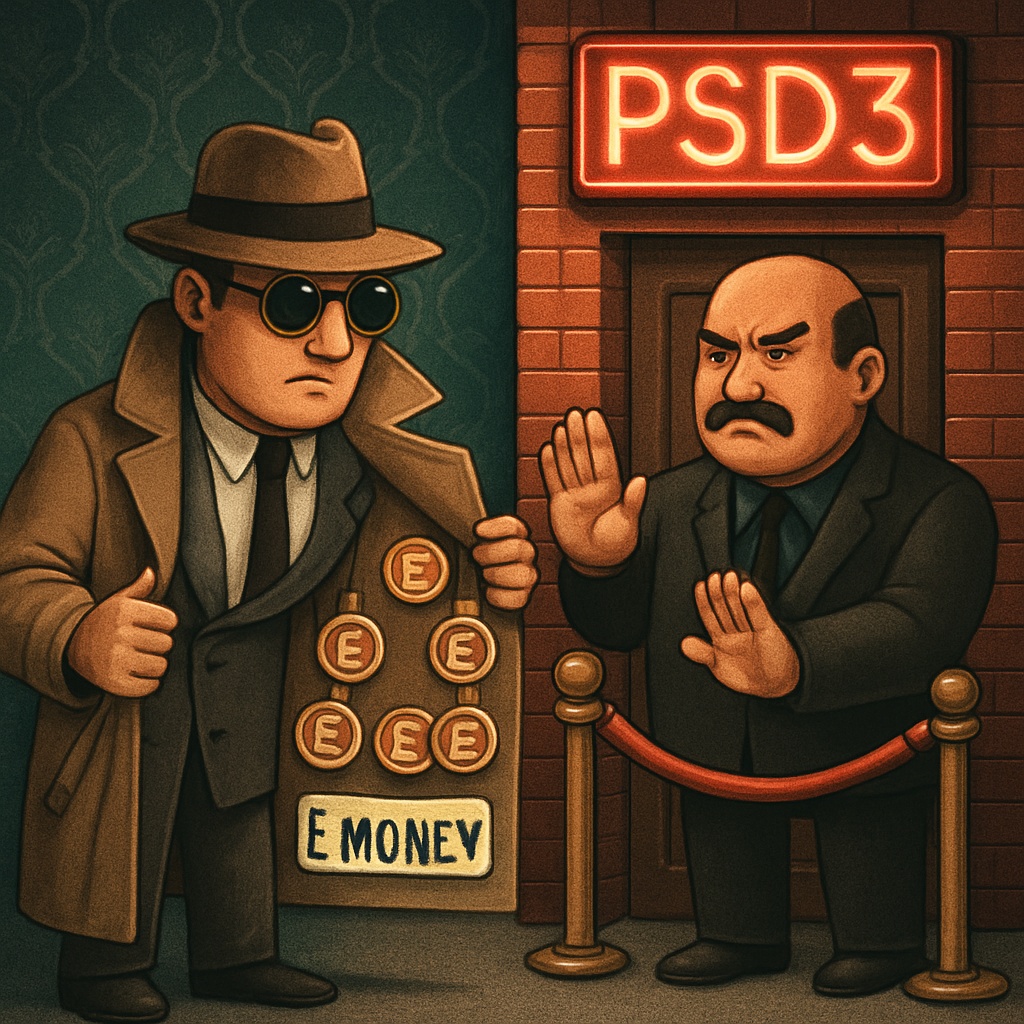
Negotiations on the reform of European payment services law are already well advanced. In future, there will be two new European legal acts, the Payment Services Regulation (PSR) and the third Payment Services Directive (PSD3), which will set out both the private law regulations for payment services in Europe, directly applicable as a regulation (PSR), and the supervisory guidelines for the national legislators of the member states (PSD3). In addition to payment services, the new PSD3 will also regulate the supervisory requirements for companies that conduct business with e-money or issue it. Until now, the relevant provisions were regulated in the second E-Money Directive (EMD2), which is to be abolished when PSD3 comes into force. Art. 3 (4) EMD2 obliges Member States to grant e-money institutions in their respective national supervisory law the possibility of distributing and redeeming e-money via natural or legal persons, also known as e-money agents. However, the issuance of e-money units via e-money agents is not permitted. According to Art. 3 (5) EMD2, e-money units must be issued by the e-money institutions themselves. The German legislature has implemented these requirements in the Payment Services Supervision Act (ZAG). According to Section 1 (10) ZAG, an e-money agent is any natural or legal person who, as an independent commercial operator, distributes and redeems e-money on behalf of an e-money institution. Under the PSD3 regime, however, there will no longer be any e-money agents. The directive provides for the agent concept exclusively for payment services, but not for the new e-money services to be introduced. However, the new term “ distributor” is to be introduced.
How is a Distributor Defined under PSD3?
According to Article 2(36) of the European Commission’s draft directive (PSD3-E), a distributor is a natural or legal person who distributes or redeems e-money on behalf of a payment institution. This definition is very similar to the definition of e-money agents in the EMD2, which is to be replaced. As far as is apparent, the only difference between the definitions is the fact that distributors can be used by payment institutions and e-money agents by e-money institutions. However, since PSD3 also aims to abolish the concept of e-money institutions and instead allow payment institutions to apply for additional authorization to provide e-money services, the reference to payment institutions in the new definition is not surprising. The departure from the term “e-money agent” provided for in the draft PSD3 appears to serve the purpose of establishing a clearer conceptual distinction between agents that can be used for payment services and distributors that can be used for the distribution and redemption of e-money. It should be noted that, under the future PSD3 regime, e-money services are not intended to be payment services, but rather a separate type of regulated service for which payment institutions can obtain a license. Furthermore, it should be noted that distributors are not to be used to provide e-money services, but can only be subcontracted by payment institutions for the distribution and redemption of e-money. The two concepts differ significantly in this respect. The introduction of the concept of distributors therefore serves to clarify the situation.
What May an Electronic Money Distributor Be Permitted to Do?
According to Article 20(1) of the draft PSD3, Member States should allow payment institutions providing e-money services to use distributors for the distribution and redemption of e-money. In this context, Article 20(2) of the draft is, at the very least, misleadingly worded, as it stipulates that payment institutions must comply with the requirements for the use of payment agents set out in Article 19 PSD3-E if they intend to provide e-money services through distributors. Given the clear wording of the definition of distributor in Art. 2 para. 36 PSD3-E and the clear definition of e-money services in Annex II PSD3-E, which only covers the issuance of e-money, the management of payment accounts for e-money units, and the transfer of e-money units, but not the distribution and redemption thereof, the provision in Article 20(2) PSD3-E does not make sense. Until the final version of PSD3 is available, Article 20(2) of the draft should therefore be revised in any case. Instead, distributors should only be used for the distribution and redemption of e-money units. They will not be allowed to provide e-money services that require a license. In this respect, there will be little difference between e-money agents under EMD2 and distributors within the meaning of PSD3.
Attorney Dr. Lutz Auffenberg, LL.M. (London)
subscribe to Newsletter-
 FIN LAW – Awarded by WiWo for the Third Time
For the third time, WirtschaftsWoche (WiWO) magazine has awarded FIN LAW and Dr. Lutz Auffenberg, LL.M. (London) as a top Law Firm and Lawyer respectively.
FIN LAW – Awarded by WiWo for the Third Time
For the third time, WirtschaftsWoche (WiWO) magazine has awarded FIN LAW and Dr. Lutz Auffenberg, LL.M. (London) as a top Law Firm and Lawyer respectively. -
 FIN LAW Hosts the Annual Meeting of the Fintech Legal Network
FIN LAW had the pleasure of hosting the Annual Meeting of the Fintech Legal Network and was pleased to welcome members to its offices in Senckenberganlage.
FIN LAW Hosts the Annual Meeting of the Fintech Legal Network
FIN LAW had the pleasure of hosting the Annual Meeting of the Fintech Legal Network and was pleased to welcome members to its offices in Senckenberganlage. -
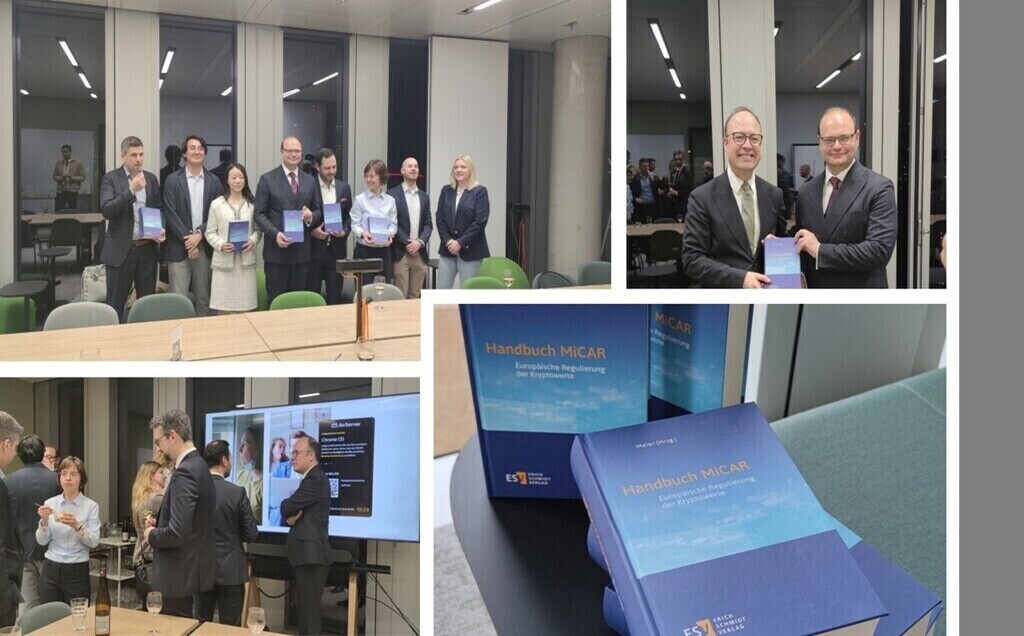 Successful Book Launch at FIN LAW for the New MiCAR Handbook by Dr. Johannes Meier
Presentation of the new MiCAR handbook by Dr. Johannes Meier at the book launch event of FIN LAW.
Successful Book Launch at FIN LAW for the New MiCAR Handbook by Dr. Johannes Meier
Presentation of the new MiCAR handbook by Dr. Johannes Meier at the book launch event of FIN LAW.