
Anyone who wishes to publicly offer securities—which include traditional stocks and bonds—or admit them to trading on a regulated market generally requires a securities prospectus that has been previously approved and published by the competent supervisory authority—in Germany, the BaFin. The relevant requirements are set forth in the European Prospectus Regulation (EU) 2017/1129 and the German Securities Prospectus Act (WpPG). In particular, a prospectus must contain information about the issuer, its business activities and financial position, as well as about the securities being offered and the associated risks. However, the Prospectus Regulation also provides for various exemptions from the prospectus requirement in Article 1(4) of the Prospectus Regulation. For example, a public offering may be made without a prospectus if it is directed either exclusively at qualified investors or at fewer than 150 non-qualified investors per Member State, or if the securities to be distributed have a minimum denomination of 100,000 euros. A minimum subscription amount of 100,000 euros may also exempt an offering from the prospectus requirement. A significant simplification for smaller securities offerings has been in effect since June 5, 2026. The EU Listing Act raised the threshold for prospectus-exempt public offerings of securities from the original total consideration of less than 8 million euros in the European Economic Area (EEA) over a 12-month period to an aggregate total consideration of less than 12 million euros in the EEA calculated over a 12-month period. Although the Prospectus Regulation provides that member states may also opt for a threshold of 5 million euros, Germany has chosen to apply the higher threshold to make it easier for companies to raise capital from investors. In general, other ongoing public securities offerings by the issuer or the offeror, as well as those conducted within the last twelve months, must also be taken into account in the calculation. The new regulation thus gives companies the opportunity to publicly offer securities in larger volumes than before without having to provide a full securities prospectus.
When Is a Securities Information Sheet (WIB) instead of a Securities Prospectus Sufficient?
Even if a securities offering is not subject to a prospectus requirement because the offering volume is less than 12 million euros, this does not automatically mean that no capital market documentation is required in Germany. Pursuant to Section 4 of the Securities Prospectus Act (WpPG), when the provision of the Prospectus Regulation described above is invoked, a securities information sheet must generally be prepared, filed with BaFin, and published. An exception to this rule applies only if the total value of the offering is less than 100,000 euros within a twelve-month period, as well as in other cases governed by law in which the securities information sheet is also not required. The securities information sheet is a significantly abbreviated version of a full securities prospectus. For traditional securities, it may not exceed three DIN A4 pages. For electronic securities under the Electronic Securities Act, as well as for certain digital, unsecured securities, up to four pages are permitted. In terms of content, the WIB must include, among other things, information on how the security functions, the issuer, the material risks, the terms of the offering, and the use of the proceeds from the offering. It must also contain a legally required risk disclosure. Unlike a full securities prospectus, a WIB is not approved by BaFin; rather, its publication is merely authorized. A key difference is that a WIB does not allow for EU-wide notification. A public offering based on a WIB is therefore generally limited to Germany.
When Is a PRIIPs Key Information Document Required Instead of a WIB?
Structured bonds have an interesting feature. If a bond meets the criteria for a packaged investment product as defined by the PRIIPs Regulation (EU) No. 1286/2014, a key information document (KID) must generally be prepared and published before the product is offered to retail investors. This can be particularly relevant for bonds whose redemption amount or returns depend on the performance of an underlying asset, an index, or another benchmark. If a Securities Prospectus is not necessary and a WIB would normally suffice for an issuance and the security to be issued is a packaged product as defined above, the PRIIPs Key Information Document replaces the WIB. In such cases, the preparation of an additional WIB is not required under Section 4(1) of the WpPG. The Key Information Document (KID) is intended to enable retail investors to understand the key features and risks of an investment product and to compare different products with one another. Unlike the WIB, it does not require prior approval by BaFin. Issuers must therefore determine, as early as the structuring phase of a bond, whether it is a traditional debt instrument or a packaged investment product. The designation “structured bond” alone is not decisive in this regard. Rather, the specific structure of the repayment and yield mechanisms is what matters. An incorrect classification can result in the required investor information not being available—or not being available in the correct form—prior to the public offering. The documentation required for a bond issuance in 2026 thus depends in particular on the issuance volume and the specific structure of the security. While public offerings with a total consideration of 12 million euros or more generally require a full securities prospectus, a WIB may suffice for smaller issuances, or a PRIIPs key information document for packaged investment products. Under certain conditions, a public offering is also possible without these documents. Issuers should therefore have the capital markets law requirements applicable to the planned offering reviewed before structuring and placing their bond.
subscribe to NewsletterAbout the author

Dr. Lutz Auffenberg, LL.M. (London)
Attorney, Partner at FIN LAW
Specialist Attorney in Banking and Capital Markets Law
For more than 10 years, Dr. Lutz Auffenberg has advised companies, financial service providers and providers of innovative business models on financial supervisory law, payment services supervisory law, capital markets law and the regulatory requirements for digital financial products.
Areas of practice
- Financial supervisory law and BaFin proceedings
- Capital markets, FinTech and crypto regulation
- Payment services supervisory law
-
 FIN LAW – Awarded by WiWo for the Third Time
For the third time, WirtschaftsWoche (WiWO) magazine has awarded FIN LAW and Dr. Lutz Auffenberg, LL.M. (London) as a top Law Firm and Lawyer respectively.
-
 FIN LAW Hosts the Annual Meeting of the Fintech Legal Network
FIN LAW had the pleasure of hosting the Annual Meeting of the Fintech Legal Network and was pleased to welcome members to its offices in Senckenberganlage.
-
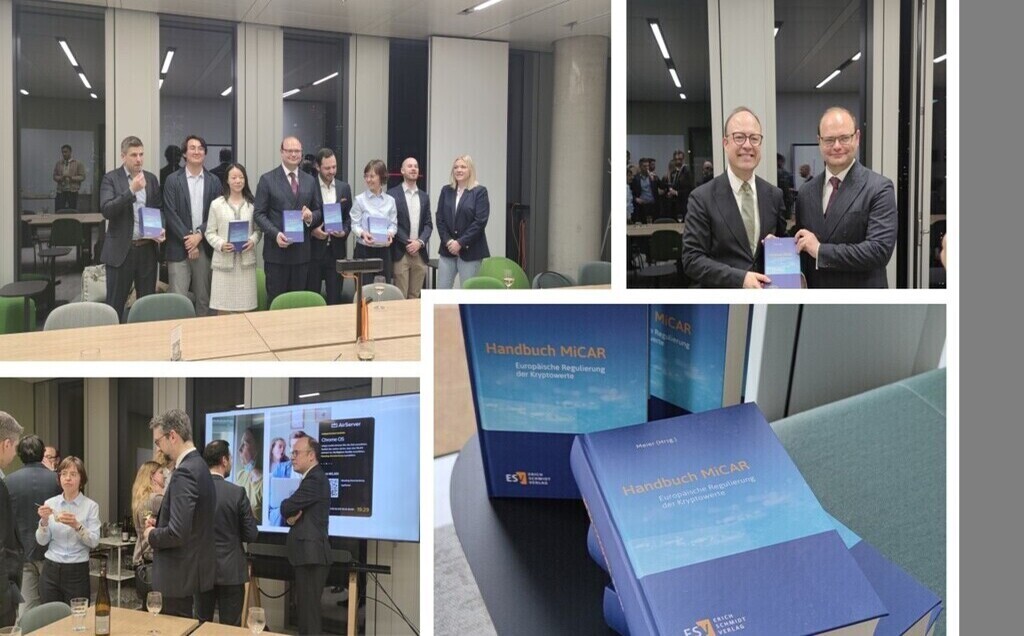 Successful Book Launch at FIN LAW for the New MiCAR Handbook by Dr. Johannes Meier
Presentation of the new MiCAR handbook by Dr. Johannes Meier at the book launch event of FIN LAW.