
Loans aren’t just useful for major purchases like real estate, cars, or equipment for expensive hobbies. In e-commerce, short-term financing—even for very small amounts—has long been common for all kinds of everyday purchases, such as vacuum cleaners, coffee machines, or video game consoles. Consumers use so-called “Buy Now, Pay Later” (BNPL) offers to finance purchase prices ranging from 50 to 1,000 euros—or even more—over shorter periods of a few weeks or months. Since such credit agreements—which are usually relatively easy to obtain—can lead consumers into debt problems just as much as consumer loans for life’s major purchases, European lawmakers have tightened the rules in this area and, with the Second EU Consumer Credit Directive (CCD2), established stricter regulations, including for providers of BNPL offers. Because the CCD2, as an EU directive, does not apply directly to market participants, EU member states must transpose its provisions into national law through national implementing legislation. With its Sales Financing Act (Absatzfinanzierungsgesetz), the German legislature has already made extensive amendments to the provisions of the German Civil Code (BGB) and the Introductory Act to the German Civil Code (EGBGB), the German Banking Act (KWG), the Payment Services Supervision Act (ZAG), and other existing laws—some of which have been in effect since May of this year (2026), while most will take effect on November 20, 2026. It has long been clear to banks and payment service providers that they must align their business models with the new regulations. However, in e-commerce, there will also be relevant changes for merchants themselves, which is why merchants and marketplace operators must also ask themselves when a payment or purchase transaction can become a consumer loan and what role they play in this context.
When Exactly Do BNPL Offers Fall Under the New CCD2 Rules?
BNPL is not a legal term in its own right or a specific type of contract under the BGB, but rather an umbrella term for sales financing models in which the consumer receives the goods or services immediately, while payment—in whole or in part—is deferred to a later date. In practice, this primarily includes purchase on account and installment purchases. It is not uncommon for an external BNPL provider to act as an intermediary, purchasing the receivable or structuring the financing. In the case of installment purchases, the consumer is allowed to pay the purchase price in several installments over a specified period. In the case of purchase on account, although the purchase price must be paid in full in a single lump sum, the consumer may be granted a one-time deferral of payment, which can also serve a loan-like financing function. According to the CCD2, such models are generally intended to be covered. In Recital 16 of the CCD2, the legislator clarifies that modern BNPL models—which are often interest- and fee-free—are specifically intended to be covered. This is because, under current law, there are exceptions for certain scenarios that BNPL providers have been able to utilize for their offers—such as loans of less than 200 euros or those that must be repaid within three months and for which only minimal costs are agreed upon for the consumer. These exceptions are now to be abolished as far as possible. In the future, there will be only one exception remaining in the area of invoice-based purchases, namely when the business grants the consumer—directly, without a third party providing a loan, a payment deferral, or other financial assistance—a payment period of no more than 50 days free of charge, and only limited costs may be incurred in the event of default. Other forms of sales financing may potentially fall within the scope of the new consumer credit law if they serve a function similar to financing. Whether a BNPL offer or other sales financing measure ultimately falls under the new regime always depends on its specific structure and must be assessed on a case-by-case basis.
Who is Considered a Loan Broker Under the New Section 34k GewO?
For e-commerce companies, these changes mean that merchants must exercise caution when structuring their own sales financing and drafting their sales contracts and terms and conditions to avoid becoming lenders themselves. Furthermore, merchants and marketplace providers are also subject to the new licensing requirement for loan brokers under Section 34k of the German Trade Regulation Act (GewO). This licensing requirement, which takes effect on November 20, 2026, applies to companies that, on a commercial basis and in exchange for compensation—which may consist of a monetary payment or another agreed-upon economic benefit—act as intermediaries in the conclusion of consumer loan agreements or financing arrangements, or that provide the opportunity to conclude such agreements. Anyone who advises third parties on consumer loan agreements or financing arrangements, or who otherwise assists in the conclusion of such an agreement, may also be subject to the licensing requirement under Section 34k GewO. Retailers who, for example, suggest BNPL providers or other lenders as payment methods to their consumer customers for the sale of their goods and receive agreed-upon economic benefits in return may be subject to the requirement to obtain prior authorization under Section 34k GewO from the competent authority. Depending on the federal state, the authorization must then be applied for either at the competent Chamber of Industry and Commerce (IHK) or the Trade Licensing Office. To obtain the permit, loan brokers must meet certain legal requirements. Consequently, sellers and e-commerce platforms must also ensure—when selecting the payment methods they accept—that they either offer only those payment methods that are not themselves classified as lenders, or, alternatively, apply for the required permit under Section 34k GewO from the competent authority.
Attorney Dr. Lutz Auffenberg, LL.M. (London)
subscribe to Newsletter-
 FIN LAW – Awarded by WiWo for the Third Time
For the third time, WirtschaftsWoche (WiWO) magazine has awarded FIN LAW and Dr. Lutz Auffenberg, LL.M. (London) as a top Law Firm and Lawyer respectively.
FIN LAW – Awarded by WiWo for the Third Time
For the third time, WirtschaftsWoche (WiWO) magazine has awarded FIN LAW and Dr. Lutz Auffenberg, LL.M. (London) as a top Law Firm and Lawyer respectively. -
 FIN LAW Hosts the Annual Meeting of the Fintech Legal Network
FIN LAW had the pleasure of hosting the Annual Meeting of the Fintech Legal Network and was pleased to welcome members to its offices in Senckenberganlage.
FIN LAW Hosts the Annual Meeting of the Fintech Legal Network
FIN LAW had the pleasure of hosting the Annual Meeting of the Fintech Legal Network and was pleased to welcome members to its offices in Senckenberganlage. -
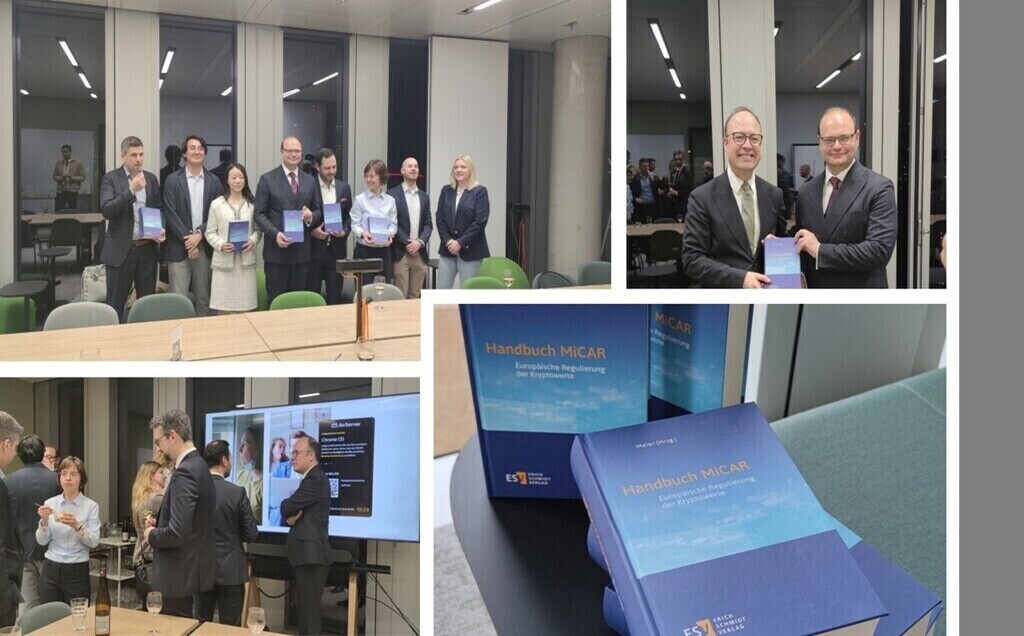 Successful Book Launch at FIN LAW for the New MiCAR Handbook by Dr. Johannes Meier
Presentation of the new MiCAR handbook by Dr. Johannes Meier at the book launch event of FIN LAW.
Successful Book Launch at FIN LAW for the New MiCAR Handbook by Dr. Johannes Meier
Presentation of the new MiCAR handbook by Dr. Johannes Meier at the book launch event of FIN LAW.