
AI technology has long since permeated every aspect of daily life. AI agents are used in nearly every aspect of personal and professional life and are handling their assigned tasks with increasing comprehensiveness. It was therefore only a matter of time before AI agents were allocated specific budgets to carry out their tasks. Recently, for example, Adyen, one of the world’s largest payment providers, introduced “Adyen Agentic,” a new tool designed to handle AI-triggered payments. It is clear that AI-supported services—such as organizing vacations or business trips, including flight, hotel, and rental car bookings, or AI-automated shopping for coordinating outfits based on the latest fashion trends and the user’s specified preferences—will become even more efficient once the AI user no longer has to handle the payment for services or goods themselves. Instead, the AI agent is simply given budgets and specific instructions—for example, regarding prices and delivery times acceptable to the user—and then handles everything else, just like a real assistant. For providers of such AI-powered shopping assistants, this raises the question of whether accepting budgets and making payments constitute payment services subject to licensing under Section 10(1) of the Payment Services Supervision Act (ZAG). If this were the case, a further question arises as to how such business models can be structured in compliance with regulatory requirements.
Can AI Actually Provide Payment Services?
In general, AI-based applications such as AI agents remain merely software and are therefore tools. As such, AI does not, in principle, have its own legal personality and therefore cannot, in and of itself, be subject to regulatory licensing requirements. However, in the vast majority of cases, there is an identifiable provider behind the AI agent who may be subject to obligations under the applicable regulatory provisions. In the case of the integration of payment services, the question of whether a license is required under Section 10(1) of the German Payment Services Act (ZAG) depends on exactly what the AI agent is intended to do in connection with payment transactions. For example, if funds are transferred to the provider’s accounts or wallets and used from there to pay for goods and services, this could constitute money remittance service, which is subject to licensing. If, instead, the AI agent were able to initiate payments from a user’s bank account—for example, because the AI agent is provided with the necessary online banking credentials—this could be classified as a payment initiation service requiring authorization within the meaning of Section 1(1), sentence 2, No. 7 of the ZAG. If the provider of the AI agent even sets up payment accounts in the user’s name, deposit and withdrawal transactions under Section 1(1), sentence 2, nos. 1 and 2 of the ZAG may also come into play. However, in all cases, the exceptions listed in Section 2(1) of the ZAG must also be taken into account. Of particular interest in the case of AI-based shopping assistants is the commercial agent exception under Section 2(1) of the ZAG. According to this provision, payment transactions are not considered payment services if they are carried out through a central clearing house or commercial agent who has been granted authority to negotiate or conclude contracts by either the payer or the payee for the purchase or sale of goods or services. If an AI shopping assistant acts exclusively in the user’s interest, there would, in principle, be grounds for this exception.
What Opportunities Does Agentic Payments Offer to Licensed Payment Service Providers?
Not only online store operators but also payment providers should respond to the trend of delegating purchasing decisions to AI agents. AI agents will make purchasing decisions dispassionately, based solely on the specifications of the prompt and their user. Traditional marketing psychology will therefore no longer work in online stores as it has in the past. Payment providers will need to ensure that AI agents used as shopping assistants have access to all necessary payment methods so that the AI can make the right decision for the user in terms of transaction costs and security and, above all, achieve the broadest possible integration with retail outlets. Already-licensed payment institutions can, in principle, also use their license under Section 10(1) ZAG for new business areas in the sphere of agentic payments and thus tap into new business opportunities. The development of proprietary AI-compatible products is possible, though this requires going through a new product process in accordance with AT 8.1 ZAG-MaRisk. In addition to developing their own offerings, authorized payment institutions can also provide their regulatory infrastructure to AI startups and, through an outsourcing solution, enable those startups’ business models to comply with the ZAG. In any case, Agentic Payments have strong disruptive potential in the payment services industry and thus offer opportunities for innovation and growth that cannot be ignored.
Attorney Dr. Lutz Auffenberg, LL.M. (London)
subscribe to Newsletter-
 FIN LAW – Awarded by WiWo for the Third Time
For the third time, WirtschaftsWoche (WiWO) magazine has awarded FIN LAW and Dr. Lutz Auffenberg, LL.M. (London) as a top Law Firm and Lawyer respectively.
FIN LAW – Awarded by WiWo for the Third Time
For the third time, WirtschaftsWoche (WiWO) magazine has awarded FIN LAW and Dr. Lutz Auffenberg, LL.M. (London) as a top Law Firm and Lawyer respectively. -
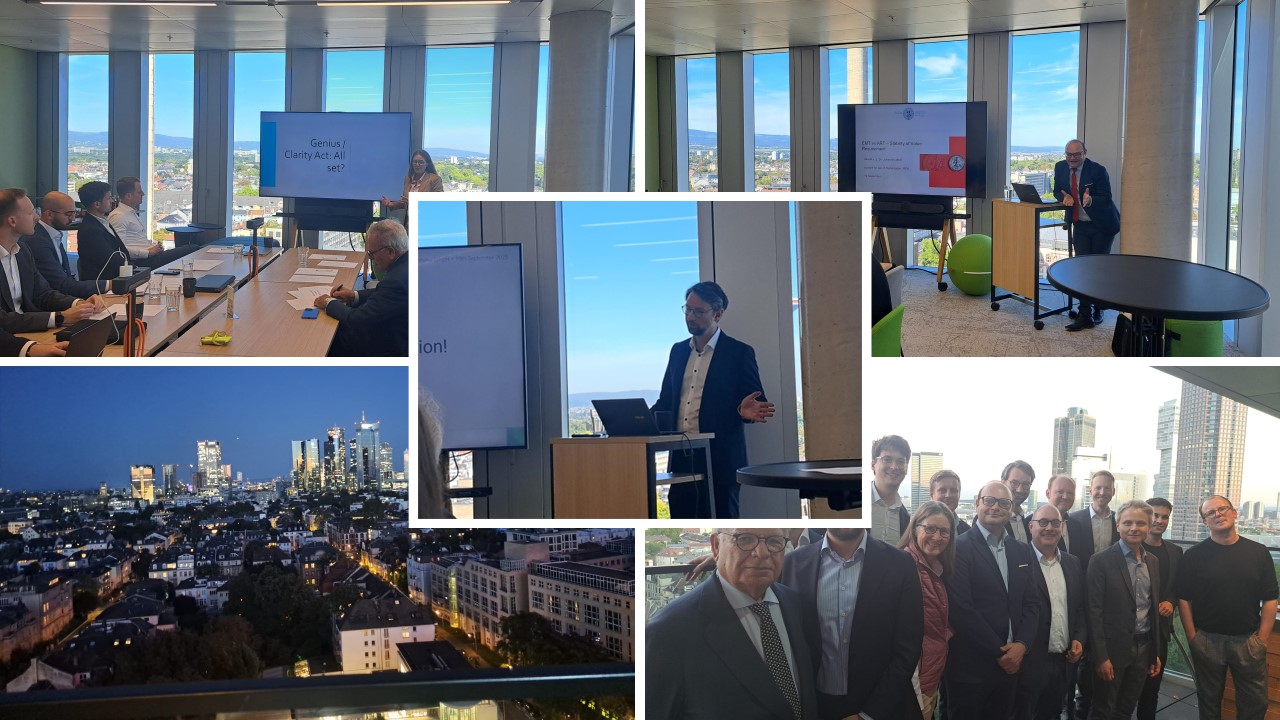 FIN LAW Hosts the Annual Meeting of the Fintech Legal Network
FIN LAW had the pleasure of hosting the Annual Meeting of the Fintech Legal Network and was pleased to welcome members to its offices in Senckenberganlage.
FIN LAW Hosts the Annual Meeting of the Fintech Legal Network
FIN LAW had the pleasure of hosting the Annual Meeting of the Fintech Legal Network and was pleased to welcome members to its offices in Senckenberganlage. -
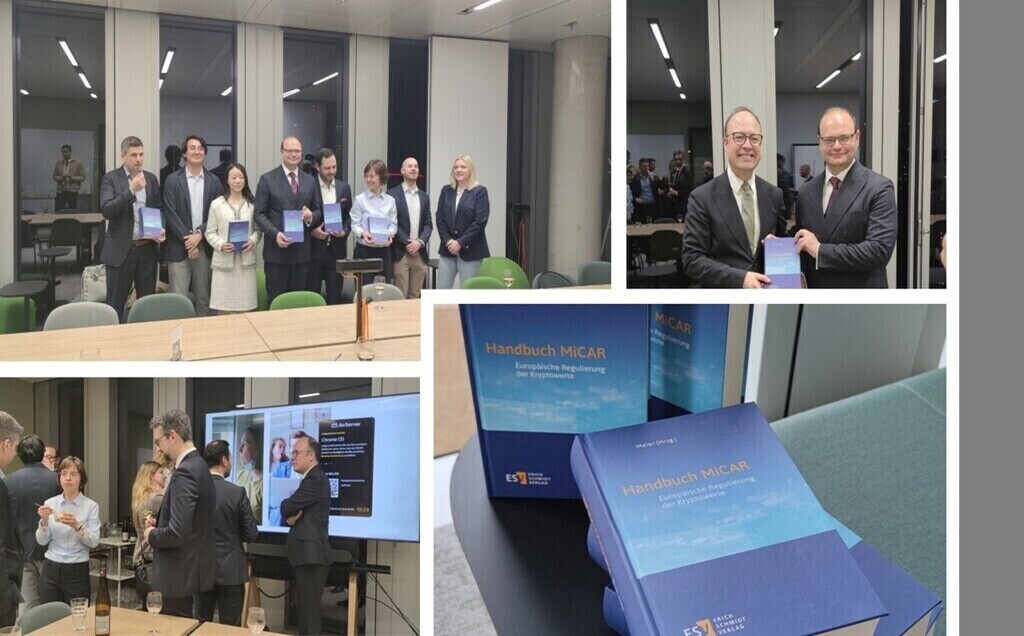 Successful Book Launch at FIN LAW for the New MiCAR Handbook by Dr. Johannes Meier
Presentation of the new MiCAR handbook by Dr. Johannes Meier at the book launch event of FIN LAW.
Successful Book Launch at FIN LAW for the New MiCAR Handbook by Dr. Johannes Meier
Presentation of the new MiCAR handbook by Dr. Johannes Meier at the book launch event of FIN LAW.