
For many companies, raising funds on the capital market can be an attractive alternative to traditional bank loans. The advantages of raising capital through the issuance of securities lie, on the one hand, in the fact that issuers can determine the terms of the issuance themselves, such as maturity, interest rates, repayment terms, and so on. On the other hand, the funds raised through a securities issue do not necessarily have to be secured by the issuer. However, this last point in particular is usually a prerequisite for a bank to grant a loan in the case of traditional bank loans. Of course, the issuance of securities in the EU and in Germany is strictly regulated, not least for the sake of investor protection. For this reason, issuers must also fulfill various documentation requirements when issuing securities. At the European level, the fundamental regulatory framework for this is provided by Regulation (EU) 2017/1129, also known as the Prospectus Regulation. At the national level in Germany, this is supplemented by the Securities Prospectus Act (WpPG). But when exactly must an issuer prepare a securities prospectus, and are there any exceptions to this rule?
A Securities Prospectus is the Standard
The Prospectus Regulation stipulates that securities may only be publicly offered in the European Union following the prior publication of a prospectus approved by the competent authority. Depending on the type of prospectus being prepared—the Prospectus Regulation distinguishes between various types of prospectuses, such as e.g. the EU Growth Issuance Prospectus, the EU Follow-on Prospectus and the Base Prospectus—the effort involved in preparing each type varies significantly. For example, the maximum number of pages an EU follow-on prospectus may have is 50 DIN A4 pages in printed form. In contrast, for an EU Growth Prospectus, the permissible maximum number of pages is 75 DIN A4 pages in printed form. Generally speaking, the preparation of a securities prospectus requires a significant amount of resources from the preparer. Nevertheless, the preparation, approval, and publication of a securities prospectus can be worthwhile simply because a public offering of securities via such a prospectus also includes the possibility of conducting the offering in EU countries other than the one that approved the prospectus, following prior notification of the prospectus. In addition, the Prospectus Regulation itself provides for exceptions under which a prospectus need not be prepared.
Are the Exceptions to the Prospectus Requirement?
The Prospectus Regulation itself provides that it does not apply to certain types of securities. For example, units in closed-end investment funds, as well as securities that are unconditionally and irrevocably guaranteed by a Member State or a local authority of a Member State, are already excluded from the scope of the Regulation. Accordingly, no securities prospectus needs to be prepared for these. Furthermore, the Prospectus Regulation provides that public offerings of securities do not require a previously published and approved securities prospectus if the offering is directed, for example, exclusively at qualified investors or at a maximum of 149 non-qualified investors per Member State. The same applies to offers where the minimum subscription amount or the denomination of the securities is at least EUR 100,000. In addition, the Regulation provides for an exemption from the obligation to publish a prospectus for issuers of securities, provided that the total value of the securities offered in the EU over a 12-month period does not exceed 8 million euros and the Member State in which the issuance takes place has adopted such a threshold. Germany has set the cap at 8 million euros. The current cap of 8 million euros will be raised to 12 million euros in the Prospectus Regulation by the EU Listing Act on June 5, 2026. For such offerings, however, the Securities Prospectus Act currently still stipulates that, for amounts up to a maximum of 8 million euros, issuers must either prepare a securities information sheet (WIB) comprising a maximum of four DIN A4 pages, have it approved by BaFin, and publish it, or that issuers must prepare and publish a Key Information Document (KID) in accordance with the PRIIPs Regulation. Such a Key Information Document does not require approval by the competent supervisory authority. Which documentation must be prepared depends on how the securities being offered are structured. A security that meets the requirements of a “packaged investment product” under the PRIIPs Regulation may only be publicly offered after the publication of a KID. Other securities may only be publicly offered after the preparation, approval, and publication of a WIB.
Attorney Dr. Lutz Auffenberg, LL.M. (London)
subscribe to Newsletter-
 FIN LAW – Awarded by WiWo for the Third Time
For the third time, WirtschaftsWoche (WiWO) magazine has awarded FIN LAW and Dr. Lutz Auffenberg, LL.M. (London) as a top Law Firm and Lawyer respectively.
FIN LAW – Awarded by WiWo for the Third Time
For the third time, WirtschaftsWoche (WiWO) magazine has awarded FIN LAW and Dr. Lutz Auffenberg, LL.M. (London) as a top Law Firm and Lawyer respectively. -
 FIN LAW Hosts the Annual Meeting of the Fintech Legal Network
FIN LAW had the pleasure of hosting the Annual Meeting of the Fintech Legal Network and was pleased to welcome members to its offices in Senckenberganlage.
FIN LAW Hosts the Annual Meeting of the Fintech Legal Network
FIN LAW had the pleasure of hosting the Annual Meeting of the Fintech Legal Network and was pleased to welcome members to its offices in Senckenberganlage. -
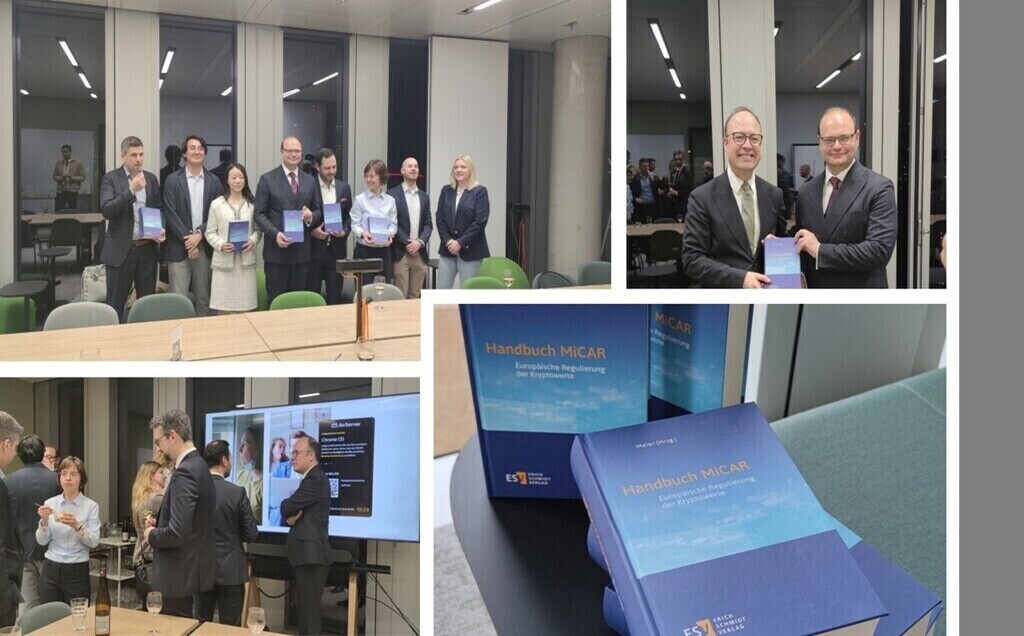 Successful Book Launch at FIN LAW for the New MiCAR Handbook by Dr. Johannes Meier
Presentation of the new MiCAR handbook by Dr. Johannes Meier at the book launch event of FIN LAW.
Successful Book Launch at FIN LAW for the New MiCAR Handbook by Dr. Johannes Meier
Presentation of the new MiCAR handbook by Dr. Johannes Meier at the book launch event of FIN LAW.