
Last summer, the European Banking Authority (EBA) caused quite a stir with its Opinion of June 10, 2026 regarding the interaction betweenSecond Payment Services Directive (PSD2) and MiCAR in the context of e-money tokens (EMT). With e-money tokens, the MiCAR regulator had created a new form of e-money. However, it had not sufficiently considered that e-money qualifies as funds within the meaning of the Second Payment Services Directive (PSD2) and that, as a result, the provision of certain crypto-asset services using EMTs may involve not only crypto-asset services requiring authorization but also payment services requiring a authorization. Consequently, such service providers require both a MiCAR authorization and a license under payment services supervisory law—in Germany, issued by BaFin pursuant to the Payment Services Supervision Act (ZAG). According to the EBA’s Opinion, this issue is particularly relevant in the area of crypto custody within the meaning of Art. 3(1)(17) MiCAR, to the extent that it is offered in connection with EMT. This service may also constitute the operation of a payment account, which requires authorization and would be classified under German law as a deposit and withdrawal transaction pursuant to Section 1(1), sentence 2, nos. 1 and 2 of the ZAG. According to the EBA’s clarification, transfer services for crypto-assets for customers within the meaning of Article 3(1)(26) of MiCAR may also constitute payment services subject to authorization. By contrast, the exchange of crypto-assets for a money amount and the exchange of crypto-assets for other crypto-assets, as defined in Article 3(1)(19) and (20) of MiCAR, shall not be considered payment services.
Additions to the List of Exceptions for EMT in the Final Drafts of PSD3/PSR
In essence, it is apparent that the provision of a specific service should ultimately be subject to a regulatory regime only to the extent necessary to enable it to be effectively supervised by the supervisory authorities. The final compromise drafts of the future third Payment Services Directive (PSD3-E) and the Payment Services Regulation (PSR-E), which have been available since April 2026, therefore provide for new exemptions for these cases. Article 2(2)(a1) of the PSR-E clarifies that payment transactions conducted exclusively in EMT directly from the payer to the payee without any involvement of intermediaries shall not fall within the scope of the PSR. Furthermore, pursuant to Article 2(2)lit. ha of the PSR-E, payment transactions executed by crypto-asset service providers (CASP) acting as intermediaries between buyers and sellers of EMT, in which EMT is exchanged for other EMT or other crypto-assets, are to be excluded from the scope of the PSR. The exchange of EMT for funds or other crypto-assets is also to be excluded if the CASP acts in its own name. Finally, another new exemption is provided for in Article 2(2) lit. la of the PSR-E, according to which payment transactions between CASPs or their branches for their own account are not to fall within the scope of the future PSR. This latest new exemption therefore applies not only to payment transactions involving EMT, but generally to payment transactions involving all types of monetary amounts between CASPs. In accordance with Article 1(3) of the PSD3-E, all of the new exemptions mentioned are intended to apply equally to the provisions of the future PSD3.
Dual Authorisation Requirement for CASPs Under MICAR and ZAG Will Remain Possible in the Future
While the new exemptions under the draft PSD3/PSR regulations exclude certain scenarios from the scope of payment services supervisory law. However, even under the new rules, there will still be many areas in which companies will be subject to supervision under both the provisions of MiCAR and those of the applicable payment services supervisory law. In Germany, these companies will require authorization under Art. 59 et seq. MiCAR and a authorization pursuant to Section 10(1) ZAG, unless other exemptions applicable to their specific business model can be invoked. In particular—as already noted in the interpretation of the cited EBA Opinion—trading activities that qualify as the exchange of crypto-assets for fiat currency or other crypto-assets are given preferential treatment. With the exception of payment transactions directly between authorized CASPs, the problem will persist that CASPs may provide payment services not only for EMT transactions but also, more generally, for fiat currency transactions—including all forms of e-money—as provided for in their respective business models, which they are not permitted to do without an additional license under Section 10(1) of the ZAG. Particularly common in this context are cases involving the transfer of funds, such as when customer funds are paid out to third parties in accordance with instructions. Such activities often constitute a financial transfer business that requires a license. In any case, it is worthwhile for companies to have their business model reviewed from a regulatory perspective by a specialized attorney in order to identify any problematic processes early on and, if necessary, restructure them.
Attorney Dr. Lutz Auffenberg, LL.M. (London)
subscribe to Newsletter-
 FIN LAW – Awarded by WiWo for the Third Time
For the third time, WirtschaftsWoche (WiWO) magazine has awarded FIN LAW and Dr. Lutz Auffenberg, LL.M. (London) as a top Law Firm and Lawyer respectively.
FIN LAW – Awarded by WiWo for the Third Time
For the third time, WirtschaftsWoche (WiWO) magazine has awarded FIN LAW and Dr. Lutz Auffenberg, LL.M. (London) as a top Law Firm and Lawyer respectively. -
 FIN LAW Hosts the Annual Meeting of the Fintech Legal Network
FIN LAW had the pleasure of hosting the Annual Meeting of the Fintech Legal Network and was pleased to welcome members to its offices in Senckenberganlage.
FIN LAW Hosts the Annual Meeting of the Fintech Legal Network
FIN LAW had the pleasure of hosting the Annual Meeting of the Fintech Legal Network and was pleased to welcome members to its offices in Senckenberganlage. -
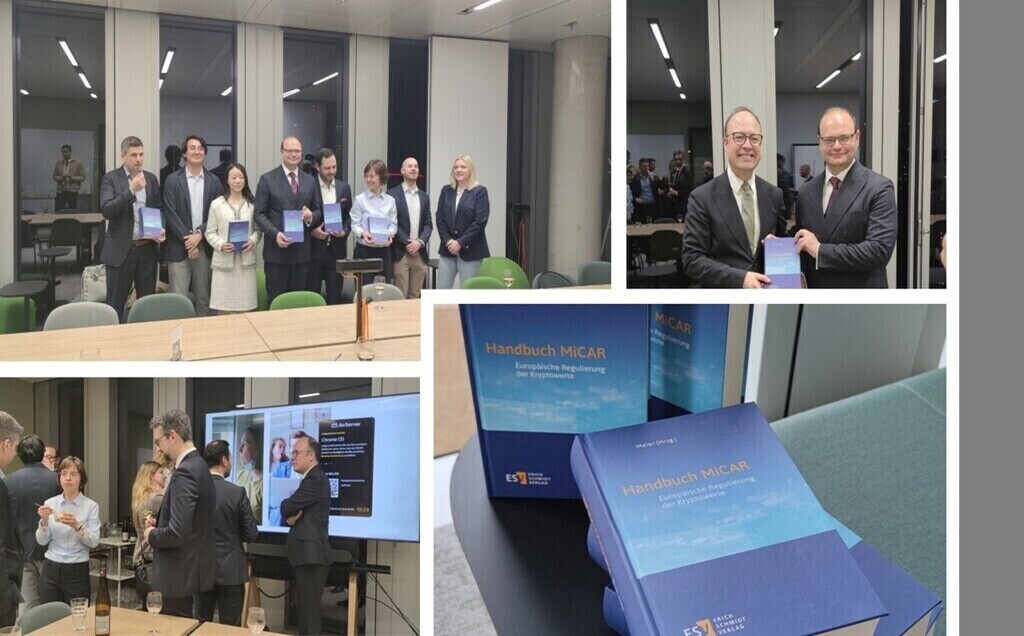 Successful Book Launch at FIN LAW for the New MiCAR Handbook by Dr. Johannes Meier
Presentation of the new MiCAR handbook by Dr. Johannes Meier at the book launch event of FIN LAW.
Successful Book Launch at FIN LAW for the New MiCAR Handbook by Dr. Johannes Meier
Presentation of the new MiCAR handbook by Dr. Johannes Meier at the book launch event of FIN LAW.