
Over the past few years, numerous platforms have emerged on the market that offer so-called day traders the opportunity to invest directly in various financial instruments without the involvement of a broker. The available product portfolio includes not only traditional spot trades in stocks, debt securities, or cryptocurrencies, but also investments in futures, options, and derivative financial instruments. For day traders who do not have enough time to manage their portfolio themselves, so-called social trading or signal following may be of interest. This allows platform users to follow the trading activities of other platform users and implement their trading decisions at the same time. There are various forms of social trading and signal following, in which customers either have published trading algorithms or trading bots to automatically execute the suggested trading decisions in their account, or simply observe the trading activities of another trader to then decide on a case-by-case basis whether and to what extent a trade should also be executed. Social trading and signal following entail a number of regulatory pitfalls that both clients and providers should be aware of. The regulatory obligations of platform operators, signal providers, and clients differ fundamentally.
Which Stakeholders Require a BaFin License for Their Role in Social Trading?
Operators of platforms that enable social trading or signal following generally require regulatory approval to conduct their business. If the trading signals made available relate to financial instruments in the traditional sense, such as stocks, bonds, certificates, futures, or derivatives, the platform operator generally needs authorization to provide the investment services of portfolio management, investment brokerage, or contract brokerage. If trading signals for crypto-assets are published, a licensing requirement under MiCAR may apply for portfolio management, the acceptance and transmission of orders for crypto-assets on behalf of clients, or the execution of orders for crypto-assets on behalf of clients. Users of the platform, on the other hand, do not typically trigger any licensing requirements simply by following signals using their own trading accounts. For signal providers, however, it depends heavily on the specific circumstances of each individual case. To the extent that investment decisions are merely published in the provider’s own securities account, this activity does not yet constitute a licensed activity. However, it is always necessary to carefully examine exactly how the signal provider’s trading decisions are implemented in the user’s account. To the extent that the signal provider receives a genuine mandate to execute trading decisions with effect on the user’s securities account, licensing requirements regarding portfolio management or investment brokerage may apply.
In Individual Cases, the Issuance of Signals May Trigger a Requirement to Register with BaFin
Even in situations where the act of providing trading signals does not itself trigger a licensing requirement under Section 15(1) WpIG or Section 32 KWG, signal providers may still be subject to a registration requirement with BaFin. This may be the case if the publication of trading signals is classified as an investment recommendation or an investment strategy recommendation. According to the legal definition in Art. 3(1)(35) MAR, investment recommendations are information containing explicit or implicit recommendations or suggestions regarding investment strategies in relation to one or more financial instruments or issuers, intended for distribution channels or the public, including an assessment of the current or future value or price of such instruments. Investment strategy recommendations, by contrast, are described in Article 3(1)(34) MAR as the production of information that directly or indirectly constitutes a specific investment proposal or, directly, a specific investment decision regarding a financial instrument or an issuer. If the publication of trading signals in social trading or signal following constitutes an investment recommendation or investment strategy recommendation in this sense, the signal provider may be required to register this activity with BaFin pursuant to Section 86 WpHG. In addition, the provider must fulfill certain compliance obligations and organize its business operations accordingly. Particularly relevant in this context is the obligation to disclose, report, and avoid conflicts of interest in accordance with Section 85 of the WpHG. Furthermore, the recommendations themselves must meet content requirements, including, among other things, clear indications distinguishing estimates from facts, the disclosure of relevant sources, and the date and time of publication.
Attorney Dr. Lutz Auffenberg, LL.M. (London)
subscribe to Newsletter-
 FIN LAW – Awarded by WiWo for the Third Time
For the third time, WirtschaftsWoche (WiWO) magazine has awarded FIN LAW and Dr. Lutz Auffenberg, LL.M. (London) as a top Law Firm and Lawyer respectively.
FIN LAW – Awarded by WiWo for the Third Time
For the third time, WirtschaftsWoche (WiWO) magazine has awarded FIN LAW and Dr. Lutz Auffenberg, LL.M. (London) as a top Law Firm and Lawyer respectively. -
 FIN LAW Hosts the Annual Meeting of the Fintech Legal Network
FIN LAW had the pleasure of hosting the Annual Meeting of the Fintech Legal Network and was pleased to welcome members to its offices in Senckenberganlage.
FIN LAW Hosts the Annual Meeting of the Fintech Legal Network
FIN LAW had the pleasure of hosting the Annual Meeting of the Fintech Legal Network and was pleased to welcome members to its offices in Senckenberganlage. -
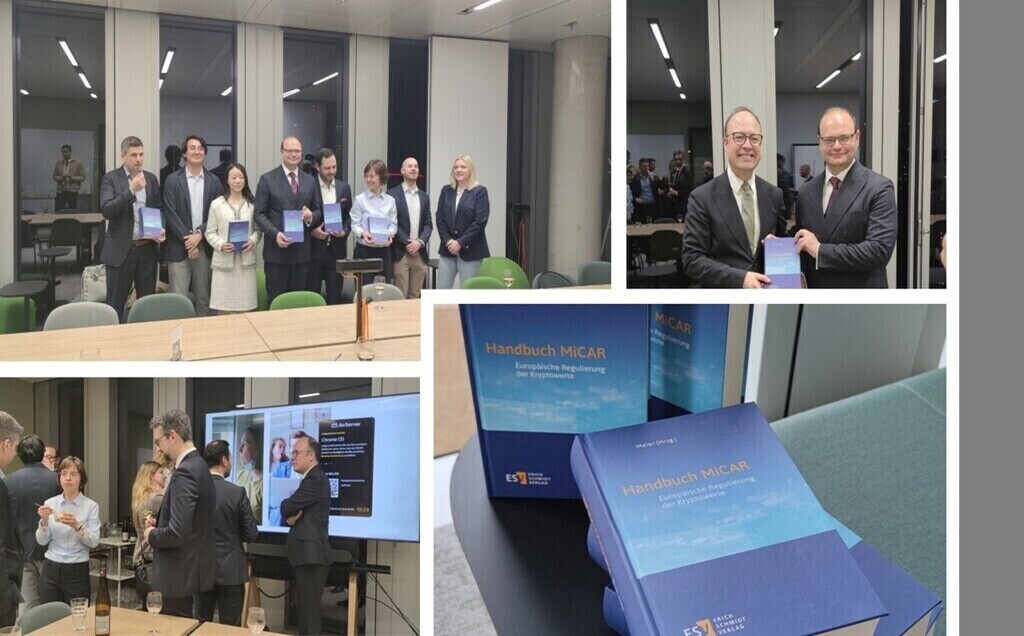 Successful Book Launch at FIN LAW for the New MiCAR Handbook by Dr. Johannes Meier
Presentation of the new MiCAR handbook by Dr. Johannes Meier at the book launch event of FIN LAW.
Successful Book Launch at FIN LAW for the New MiCAR Handbook by Dr. Johannes Meier
Presentation of the new MiCAR handbook by Dr. Johannes Meier at the book launch event of FIN LAW.