
With the EU Listing Act, the European Union aims to make access to the capital market easier and more cost-effective. In particular, small and medium-sized enterprises (SMEs) should be able to raise capital more easily in the future without being hindered by excessive prospectus requirements. This initiative comes in response to growing criticism that European capital markets have become too bureaucratic and expensive compared to their international counterparts—particularly the United States. In this regard, the reform of the EU Prospectus Regulation specifically targets information and disclosure requirements. While initial changes will apply as soon as the Listing Act enters into force at the end of 2024, the key changes will largely take effect starting in March or June 2026. Of particular relevance is the expansion of existing exemptions from the prospectus requirement. Public offerings with a total consideration of up to 12 million euros within a twelve-month period in the Union will be exempt from the prospectus requirement starting June 5, 2026. Previously, the threshold was 8 million euros. For many growth companies, this means significantly simplified access to the capital market. Issuances by companies whose securities are already admitted to trading on a regulated market will also benefit from the new rules. The EU is thus responding to criticism that secondary issuances have so far entailed high costs and significant time commitments. The aim of the reform was therefore not only to make capital market transactions more efficient, but also to make the European capital market as a whole more attractive and competitive.
The EU Growth Issuance Prospectus and the EU Follow-on Prospectus as New Formats for Securities Prospectuses
A key component of the EU Listing Act is the new prospectus formats, which will take effect as early as March 5, 2026. These formats now distinguish between different types of issuers. For companies with securities already admitted to trading on a regulated market, the so-called EU follow-on prospectus is being introduced. The newly introduced EU growth issuance prospectus is intended to be available to small and medium-sized enterprises as well as issuers on SME growth markets and to facilitate fundraising. Both formats are designed to be concise, standardized, and easy to understand. The European regulator’s goal is to reduce preparation costs and improve readability for investors. In addition, mandatory requirements regarding the structure, order, and maximum length of certain prospectuses will be introduced as of June 5, 2026. This is intended to reduce the typical “information overload” that has made many prospectuses virtually unreadable to date. In addition, digital processes will be facilitated or introduced. For example, issuers, offerors, and financial intermediaries will be permitted in certain cases to inform investors exclusively electronically about prospectus supplements. New financial information can also be more easily integrated into existing prospectuses by reference. The shortened deadline for initial public offerings of shares on a regulated market is also likely to be particularly relevant in practice. In the future, prospectuses will only need to be published three working days before the end of the offer period, instead of the previous six. For issuers, this means greater flexibility and faster placements, and thus simpler and faster capital raising.
ESG Requirements Could Reduce the Simplification Effect
Despite all these simplifications, however, it remains unclear whether the Listing Act will actually advance the hoped-for “Capital Markets Union.” In particular, the new sustainability disclosures that are also planned could partially offset the simplification intended by the EU Listing Act. Specifically, disclosure requirements regarding ESG will be introduced as of June 5, 2026. These relate to sustainability reporting and compliance with certain sustainability targets. Furthermore, prospectus liability risks will remain significant. The increasing standardization of prospectuses also carries risks. While it improves comparability, it could simultaneously lead to such a standardized form of disclosure that the specific characteristics of individual issuers and their offerings may no longer be adequately taken into account. Nevertheless, the reforms and simplifications represent a step toward easier capital raising in Europe. Especially since the European regulator’s focus in recent years has been almost exclusively on increased compliance obligations, the simplifications mentioned above send a positive signal to the European capital market. It is therefore worthwhile for issuers, offerors, and financial intermediaries to carefully analyze the new prospectus formats and exemptions and to adapt their capital market strategy to the new legal framework now.
Attorney Dr. Lutz Auffenberg, LL.M. (London)
subscribe to Newsletter-
 FIN LAW – Awarded by WiWo for the Third Time
For the third time, WirtschaftsWoche (WiWO) magazine has awarded FIN LAW and Dr. Lutz Auffenberg, LL.M. (London) as a top Law Firm and Lawyer respectively.
FIN LAW – Awarded by WiWo for the Third Time
For the third time, WirtschaftsWoche (WiWO) magazine has awarded FIN LAW and Dr. Lutz Auffenberg, LL.M. (London) as a top Law Firm and Lawyer respectively. -
 FIN LAW Hosts the Annual Meeting of the Fintech Legal Network
FIN LAW had the pleasure of hosting the Annual Meeting of the Fintech Legal Network and was pleased to welcome members to its offices in Senckenberganlage.
FIN LAW Hosts the Annual Meeting of the Fintech Legal Network
FIN LAW had the pleasure of hosting the Annual Meeting of the Fintech Legal Network and was pleased to welcome members to its offices in Senckenberganlage. -
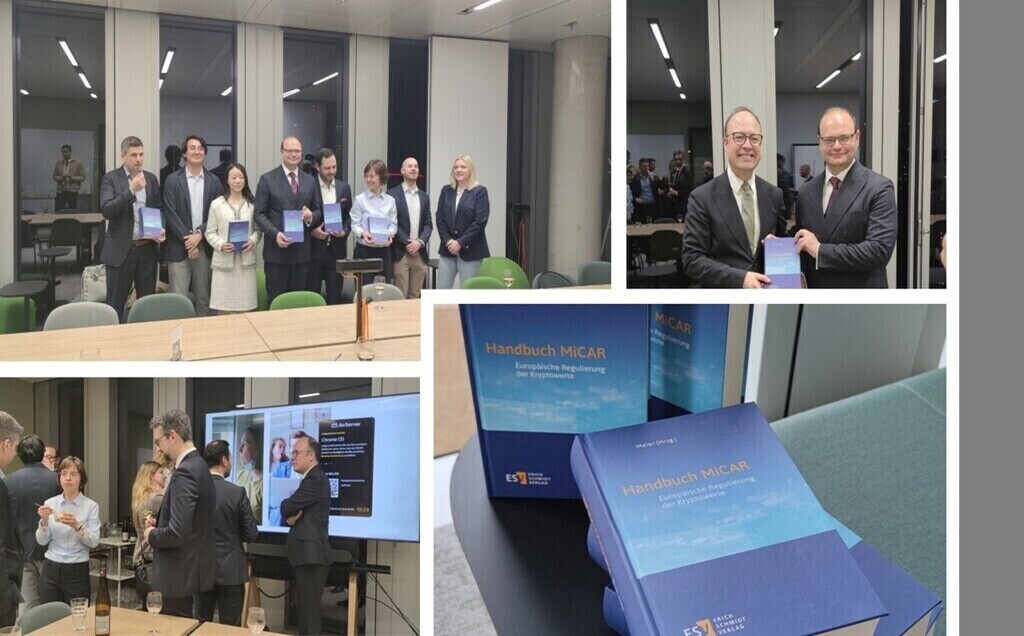 Successful Book Launch at FIN LAW for the New MiCAR Handbook by Dr. Johannes Meier
Presentation of the new MiCAR handbook by Dr. Johannes Meier at the book launch event of FIN LAW.
Successful Book Launch at FIN LAW for the New MiCAR Handbook by Dr. Johannes Meier
Presentation of the new MiCAR handbook by Dr. Johannes Meier at the book launch event of FIN LAW.