
Prediction markets are currently the talk of the town and are experiencing a veritable boom. These are online platforms where users can buy and sell so-called contracts that depend on whether one or more specific events occur or do not occur. Popular events that are frequently the subject of these contracts include, for example, election outcomes (particularly in U.S. politics), as well as the outcomes of sporting and cultural events, but also events from the financial world, such as central bank interest rate decisions, corporate data, or stock market indices. These platforms are often decentralized and built on blockchains such as the Ethereum blockchain. Specifically, users of these platforms purchase shares or contracts that bet on either the occurrence or non-occurrence of the event in question. The price of the respective shares is determined by supply and demand regarding the occurrence or non-occurrence of the event in question. If many users bet on the event occurring, the price of the shares that reward the event’s occurrence rises, and the price of the shares that bet on the event’s non-occurrence falls proportionally. If the relevant event occurs and the user has purchased a share targeting that outcome, they receive a predefined payout. The question arises as to whether these contracts constitute bets or financial instruments, and whether such a model is even feasible in Germany.
Are prediction Markets Gambling or Financial Instruments?
In Germany, online gambling is generally regulated by the 2021 State Treaty on Gambling and is largely supervised and monitored by the Joint Gambling Authority of the German States (GGL). Financial instruments, on the other hand, are regulated both by European regulations and directives—most notably the Markets in Financial Instruments Directive 2 (MiFID II)—and by German laws such as the Securities Trading Act (WpHG). In Germany, financial instruments and compliance with the relevant regulations are supervised by the Federal Financial Supervisory Authority (BaFin). To date, BaFin has not yet taken an explicit position on the topic of prediction markets and the legal nature of the shares offered. The GGL, however, has. In a blog post dated September 5, 2025, on its website, it issued a strong warning against participating in so-called social betting on prediction markets. According to the GGL, these social bets—which relate to events in public or social life, such as political elections, court rulings, natural disasters, social events, or other non-sporting developments, are not eligible for licensing in the Federal Republic of Germany under the State Treaty on Gambling 2021 due to the high risk of manipulation associated with them and are therefore, in the GGL’s view, illegal gambling.
Does this Mean that Prediction Markets Cannot Be Operated Legally in Germany?
Against this backdrop, and particularly in light of the GGL’s statement, one is left with the impression that operating a prediction market platform and participating in or purchasing shares on such a platform is not legally permissible in Germany. However, it seems questionable whether this initial impression is actually accurate. A careful reading of the GGL’s statement reveals that the authority explicitly refers only to “non-sporting events.” The GGL therefore does not address sporting events that are the subject of a contract purchased on a prediction market. In fact, the State Treaty on Gambling expressly provides for the permissibility of betting on defined sporting events with verifiable results and clear rules. Operators could therefore apply to the GGL for a license to organize and/or facilitate sports betting and for inclusion on the so-called whitelist. However, the GGL would have no jurisdiction at all if the social bets and contracts on a prediction market were not gambling but rather financial instruments. The assertion that the operation of a prediction market is not eligible for authorization under the State Treaty on Gambling would then be irrelevant to the regulatory assessment of the platform’s operations. Against this backdrop, it would be conceivable to structure the contracts or share certificates, where possible, as, for example, financial futures or derivatives. The offering of such products is, in principle, legally permissible in Germany provided the relevant authorizations from BaFin are obtained. When planning such business models, it is essential to consider not only the licensing requirements but also any relevant general rulings by BaFin and its general administrative practices regarding the compliance obligations of financial firms. Whether a prediction market platform can ultimately be operated legally in Germany therefore depends heavily on the thoroughness of the business planning and the circumstances of the individual case.
Rechtsanwalt Dr. Lutz Auffenberg, LL.M. (London)
subscribe to Newsletter-
 FIN LAW – Awarded by WiWo for the Third Time
For the third time, WirtschaftsWoche (WiWO) magazine has awarded FIN LAW and Dr. Lutz Auffenberg, LL.M. (London) as a top Law Firm and Lawyer respectively.
FIN LAW – Awarded by WiWo for the Third Time
For the third time, WirtschaftsWoche (WiWO) magazine has awarded FIN LAW and Dr. Lutz Auffenberg, LL.M. (London) as a top Law Firm and Lawyer respectively. -
 FIN LAW Hosts the Annual Meeting of the Fintech Legal Network
FIN LAW had the pleasure of hosting the Annual Meeting of the Fintech Legal Network and was pleased to welcome members to its offices in Senckenberganlage.
FIN LAW Hosts the Annual Meeting of the Fintech Legal Network
FIN LAW had the pleasure of hosting the Annual Meeting of the Fintech Legal Network and was pleased to welcome members to its offices in Senckenberganlage. -
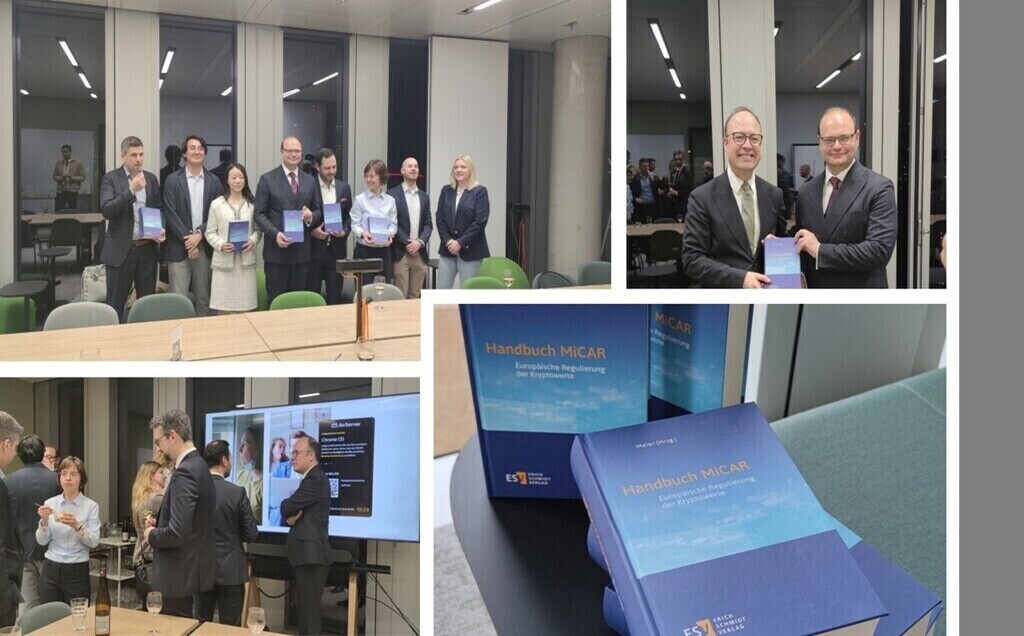 Successful Book Launch at FIN LAW for the New MiCAR Handbook by Dr. Johannes Meier
Presentation of the new MiCAR handbook by Dr. Johannes Meier at the book launch event of FIN LAW.
Successful Book Launch at FIN LAW for the New MiCAR Handbook by Dr. Johannes Meier
Presentation of the new MiCAR handbook by Dr. Johannes Meier at the book launch event of FIN LAW.