
Regulation (EU) 2024/2809, also known as the Listing Act, was adopted on October 23, 2024, and largely entered into force on December 4, 2024. The Listing Act provides for far-reaching changes to various EU legal acts concerning the European capital market. The aim of the changes is to increase the attractiveness of the capital market in Europe and to significantly simplify capital raising for small and medium-sized enterprises via the local capital markets. This objective has been a perennial issue in European legislation, but unfortunately it has not yet been implemented with sufficient effectiveness through the various measures that have been implemented, most notably the so-called Capital Markets Union. In order to achieve a sustainable strengthening of the European capital market this time, the Listing Act provides for changes not only to the Market Abuse Regulation (MAR), MiFID2, and MiFIR. According to the provisions of the Listing Act, comprehensive changes are also to be made to the Prospectus Regulation, which will be particularly attractive for small and medium-sized enterprises. Some of these changes to prospectus law are already in effect, while others will only apply and take legal effect from June 5, 2026. Issuers and providers of smaller securities issuances should therefore be aware of the upcoming changes and check whether they could result in attractive financing opportunities for them.
The EU Growth Issuance Prospectus and the EU Follow-on Prospectus
Regulations governing the new EU growth issuance prospectus and the EU follow-on prospectus have been in force since March 5, 2026. The EU follow-on prospectus can be used by issuers and offerors for public offers of securities and their admission to trading on a regulated market that have been admitted to trading on a regulated market or an SME growth market for at least 18 months without interruption. The form of the EU follow-on prospectus is standardized and may not exceed a maximum of 50 A4 pages in printed form. In addition, it must be written in a comprehensible manner and in a legible font size. The EU growth issuance prospectus may be issued by issuers that qualify as SMEs, as well as by issuers that do not qualify as SMEs, provided that their securities are admitted to trading on an SME growth market or are to be admitted to trading on such a market. In addition, unlisted companies planning an emission with a total countervalue for the publicly offered securities of up to EUR 50 million may also use the EU Growth Prospectus, provided that they did not exceed an average number of 499 employees in the last financial year. Total countervalue must be based on the last 12 months. The EU Growth Prospectus is also a standardized document that must be written in a comprehensible manner and in a legible font size. The maximum number of pages allowed for this prospectus is 75 A4 pages in printed form, which means it can be slightly more comprehensive than the EU Follow-on Prospectus.
What Changes Will the Listing Act Bring for Small Issuances of Up to EUR 12 Million?
Previously, the Prospectus Regulation provided for the possibility of an exemption from the obligation to publish a prospectus for issuers of securities, provided that the total consideration of the securities offering in the European Union did not exceed EUR 8 million over a period of 12 months and the Member State concerned, in which the issue was to take place, had decided on such a maximum limit. Germany had set the maximum limit at EUR 8 million, while numerous other member states only allowed exemptions for smaller issue volumes. For public offerings up to a value of EUR 8 million, the German Securities Prospectus Act has since required either the preparation of a securities information sheet consisting of 3 or 4 A4 pages or the preparation of a key information document (PRIIPs KID) in accordance with the PRIIPs Regulation. From June 5, 2026, the Prospectus Regulation, as amended by the EU Listing Act, will provide that public offers of securities with a total value of up to EUR 12 million in the Union will be exempt from the obligation to publish a prospectus. However, the respective member states may decide to lower this threshold to EUR 5 million. This increased threshold will thus enable smaller companies to raise significantly more capital than before without having to prepare, approve, and publish a securities prospectus. However, the obligation to prepare a securities information sheet will continue to apply in Germany.
Attorney Dr. Lutz Auffenberg, LL.M. (London)
subscribe to Newsletter-
 FIN LAW – Awarded by WiWo for the Third Time
For the third time, WirtschaftsWoche (WiWO) magazine has awarded FIN LAW and Dr. Lutz Auffenberg, LL.M. (London) as a top Law Firm and Lawyer respectively.
FIN LAW – Awarded by WiWo for the Third Time
For the third time, WirtschaftsWoche (WiWO) magazine has awarded FIN LAW and Dr. Lutz Auffenberg, LL.M. (London) as a top Law Firm and Lawyer respectively. -
 FIN LAW Hosts the Annual Meeting of the Fintech Legal Network
FIN LAW had the pleasure of hosting the Annual Meeting of the Fintech Legal Network and was pleased to welcome members to its offices in Senckenberganlage.
FIN LAW Hosts the Annual Meeting of the Fintech Legal Network
FIN LAW had the pleasure of hosting the Annual Meeting of the Fintech Legal Network and was pleased to welcome members to its offices in Senckenberganlage. -
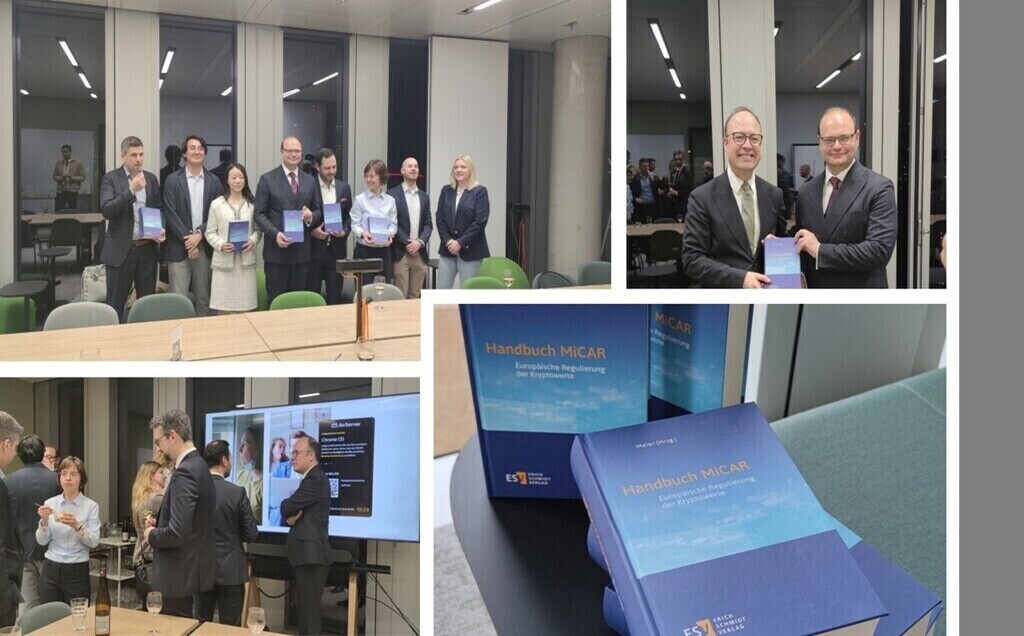 Successful Book Launch at FIN LAW for the New MiCAR Handbook by Dr. Johannes Meier
Presentation of the new MiCAR handbook by Dr. Johannes Meier at the book launch event of FIN LAW.
Successful Book Launch at FIN LAW for the New MiCAR Handbook by Dr. Johannes Meier
Presentation of the new MiCAR handbook by Dr. Johannes Meier at the book launch event of FIN LAW.