
Crypto assets are not financial instruments within the meaning of MiFID2 regulation. This is explicitly clarified in Art. 2 (4a) MiCAR in conjunction with Art. 3 (1) No. 49 MiCAR. Nevertheless, credit institutions and investment firms, particularly in the Federal Republic of Germany, are showing growing interest in trading digital assets. For existing institutions, crypto assets open up new target groups and markets as well as innovative modern product types that attractively expand the product portfolio alongside or in conjunction with traditional MiFID business. In fact, the opportunities to seize these chances are within reach for already licensed credit institutions and investment firms, but also for e-money institutions, UCITS management companies, or alternative investment fund managers, as they can benefit from the notification procedure fundamentally regulated in Art. 60 MiCAR. Article 59(1) MiCAR provides for two options for obtaining authorization to provide crypto-asset services. First, pursuant to Article 59(1a) MiCAR, a company may provide crypto-asset services if it has previously been authorized as a crypto asset service provider. The significantly simpler route is the notification procedure for existing institutions set out in Article 59(1b) MiCAR and regulated in Article 60 MiCAR. According to this, credit institutions, investment firms, e-money institutions, UCITS management companies, and alternative investment fund managers can obtain authorization as providers of crypto asset services by submitting certain information about their planned crypto asset transactions to BaFin without having to go through a full authorization process.
Who Can Benefit from a MiCAR Notification?
Article 60(1) MiCAR grants authorized credit institutions the option of providing all crypto asset services after submitting a complete notification. For investment firms, the notification option is restricted in that, after successful notification, they may only provide those crypto asset services that correspond to the investment services for which they hold a corresponding license in accordance with MiFID regulations. Article 60(3) subparagraph 2 regulates which MiFID investment services correspond to which crypto asset services. In contrast, pursuant to Art. 60(4) MiCAR, e-money institutions are only permitted to provide custody, administration, and transfer services in relation to the e-money tokens they issue after successful notification. If an e-money institution wishes to offer additional crypto asset services, it must obtain the necessary authorization by submitting an application for authorization in accordance with Article 62 MiCAR. UCITS management companies or alternative investment fund managers may notify crypto asset services for the acceptance and transmission of orders in crypto assets for clients, advice on crypto assets, and portfolio management of crypto assets, provided that they hold the relevant authorizations under the UCITS Directive (2009/65/EC) or the AIFM Directive (2011/61/EC). Finally, market operators authorized under MiFID2 also have the option of taking advantage of the notification procedure. If their notification is successful, they can operate a trading platform for crypto assets.
What Requirements Must Be Met and How Long Does the Notification Take?
The notification procedure under Article 60 MiCAR is significantly less complex than a full application for authorization under Article 62 MiCAR. In particular, the notifying institution must present a viable business plan outlining how crypto asset services are to be marketed and offered in the future. In addition, it must provide a detailed and complete description of how the institution will adapt its strategies, procedures, and internal controls in relation to the planned provision of crypto asset services. This includes adapting internal procedures for risk management and money laundering prevention, IT security, emergency and business continuity planning, outsourcing management, and all other procedures relevant to regulatory compliance. Specific details are regulated by Delegated Regulation (EU) 2025/303. With regard to the duration of notification procedures, Article 60 MiCAR stipulates somewhat ambiguously for all types of eligible institutions that crypto asset services to be notified may only be provided once the information to be submitted has been transmitted to the competent authority at least 40 working days prior to the initial provision. According to Article 60(8) MiCAR, the competent authority – in Germany, BaFin – must check within 20 working days of receiving the notification whether the information in the notification is complete. If any information is missing, BaFin shall set a deadline for the applicant to provide the missing information, which may not exceed a further 20 working days from the date of the request. It should be noted that the request period does not count towards the 40 working days specified in Article 60(1) to (6) MiCAR. This means that the notification procedure can actually take 60 working days.
Attorney Dr. Lutz Auffenberg, LL.M. (London)
subscribe to Newsletter-
 FIN LAW – Awarded by WiWo for the Third Time
For the third time, WirtschaftsWoche (WiWO) magazine has awarded FIN LAW and Dr. Lutz Auffenberg, LL.M. (London) as a top Law Firm and Lawyer respectively.
FIN LAW – Awarded by WiWo for the Third Time
For the third time, WirtschaftsWoche (WiWO) magazine has awarded FIN LAW and Dr. Lutz Auffenberg, LL.M. (London) as a top Law Firm and Lawyer respectively. -
 FIN LAW Hosts the Annual Meeting of the Fintech Legal Network
FIN LAW had the pleasure of hosting the Annual Meeting of the Fintech Legal Network and was pleased to welcome members to its offices in Senckenberganlage.
FIN LAW Hosts the Annual Meeting of the Fintech Legal Network
FIN LAW had the pleasure of hosting the Annual Meeting of the Fintech Legal Network and was pleased to welcome members to its offices in Senckenberganlage. -
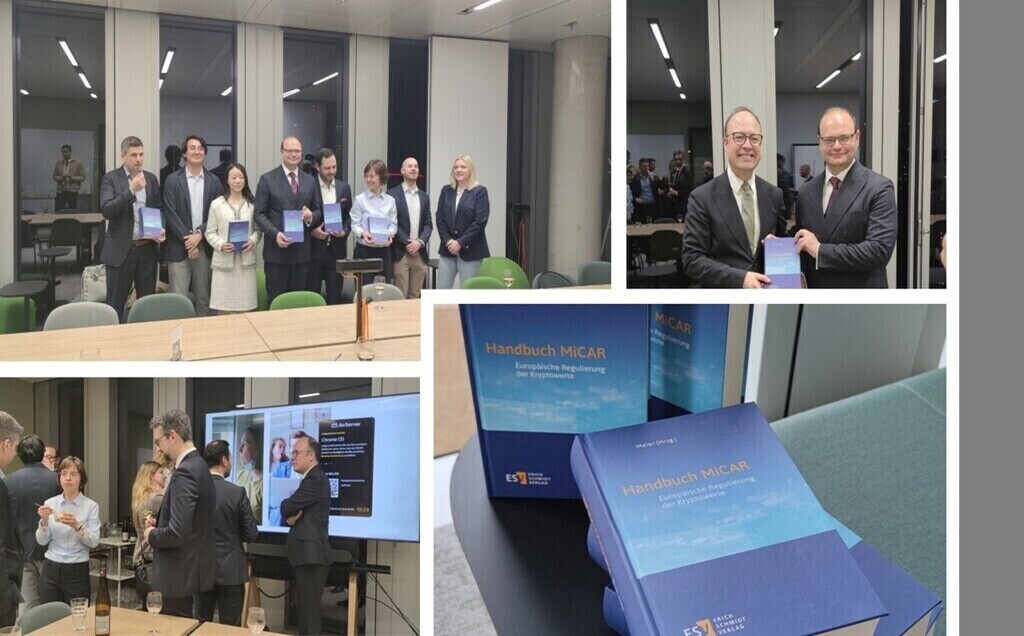 Successful Book Launch at FIN LAW for the New MiCAR Handbook by Dr. Johannes Meier
Presentation of the new MiCAR handbook by Dr. Johannes Meier at the book launch event of FIN LAW.
Successful Book Launch at FIN LAW for the New MiCAR Handbook by Dr. Johannes Meier
Presentation of the new MiCAR handbook by Dr. Johannes Meier at the book launch event of FIN LAW.