The tokenization of so-called real-world assets (RWA tokens) is currently one of the hot topics in the blockchain scene. In this context, the term tokenization refers to the technical and, as far as possible, legal connection of a digital token, usually existing on a blockchain, with a specific tangible object, such, as for example, real estate or a wind turbine, or with a specific intangible object, such, as for example, a right. The tokenization of rights continues to enjoy unbroken popularity in the financial sector. The issuance of security tokens, i.e., the public offering of financial products that are linked to a token in such a way that they qualify as securities within the meaning of securities regulation, has become a very popular form of corporate financing. BaFin qualifies such products, which in terms of content often constitute an investment under the German Investment Act, as sui generis securities due to their tokenization. This is the case if the products meet certain requirements in terms of transferability, tradability on the financial market, and the granting of securities-like rights. When issuing an electronic security under the German Electronic Securities Act (eWpG), the qualification of the products as securities has already been carried out by the legislator, so that products issued under the eWpG unproblematically constitute securities. But how can physical objects such as real estate be tokenized?
Possible Concepts for Tokenizing Real Estate
In principle, the complete tokenization of real estate via RWA tokens, i.e., of land ownership, is not yet provided for in the German legal system. This is primarily because in Germany, the land register is the sole and decisive legal document for assigning land ownership to individuals, and it does not yet allow for digitization, let alone tokenization via RWA tokens. Ultimately, this means that, in general, the person entered in the land register is also the owner of the property in question. However, there are various ways of approaching the tokenization of real estate. One example is the KG model, and another is the subordinated bond model. In both models, the initiator/issuer acquires the property in question and then allows interested investors to participate in it. In the KG model, the initiator would typically establish another company, a trust limited partner. This company would then establish a GmbH & Co KG with the initiator, provided that the latter is a GmbH, whereby the initiator would act as the personally liable partner and the trust company as the (trust) limited partner. Interested investors can then conclude tokenized trust agreements with the trust limited partner, which would transfer the rights of the trust limited partner in the GmbH & Co KG to the investors, i.e., both the rights to profit sharing, as specified in the partnership agreement, and the other corporate rights of a limited partner. In this model, the GmbH & Co KG would be the owner of the property as entered in the land register. The issuance of a subordinated bond is another option for tokenizing real estate. In this case, the issuer usually issues subordinated bonds that are registered in the name of the investor – mostly subordinated loans or subordinated profit participation rights – and tokenizes them. These products grant investors, for example, a share in the profits of the property in question or in the issuer’s corporate profits. In both models, however, the investor does not legally acquire ownership of the properties in question.
What Documentation is Required for the Distribution of the Tokens?
As a rule, and if structured appropriately, tokenized products created according to one of the two models mentioned above will qualify as investments under the German Asset Investment Act (Vermögensanlagengesetz). As explained above, BaFin considers these tokenized investments to be securities for regulatory purposes if structured appropriately. In this respect, the regulatory regime for securities applies to their distribution. The volume of the planned issue is a decisive factor here. For issues with volumes of up to EUR 8,000,000, a securities information sheet of no more than four A4 pages is required or, in the case of a product packaged in accordance with the PRIIPs Regulation and provided that the product is offered to retail investors, a key information document (KID). Furthermore, in the case of issuances using a securities information sheet, distribution to non-qualified investors is only permitted if it is carried out by way of investment advice or investment brokerage through an investment services company. For issuances of up to EUR 20,000,000, a so-called EU growth prospectus could be prepared, approved, and published; for issuances with a volume of more than EUR 20,000,000, a securities prospectus must be prepared by the issuer, approved by BaFin, and published, unless a statutory exemption applies.
Attorney Dr. Lutz Auffenberg LL.M. (London)
subscribe to Newsletter-
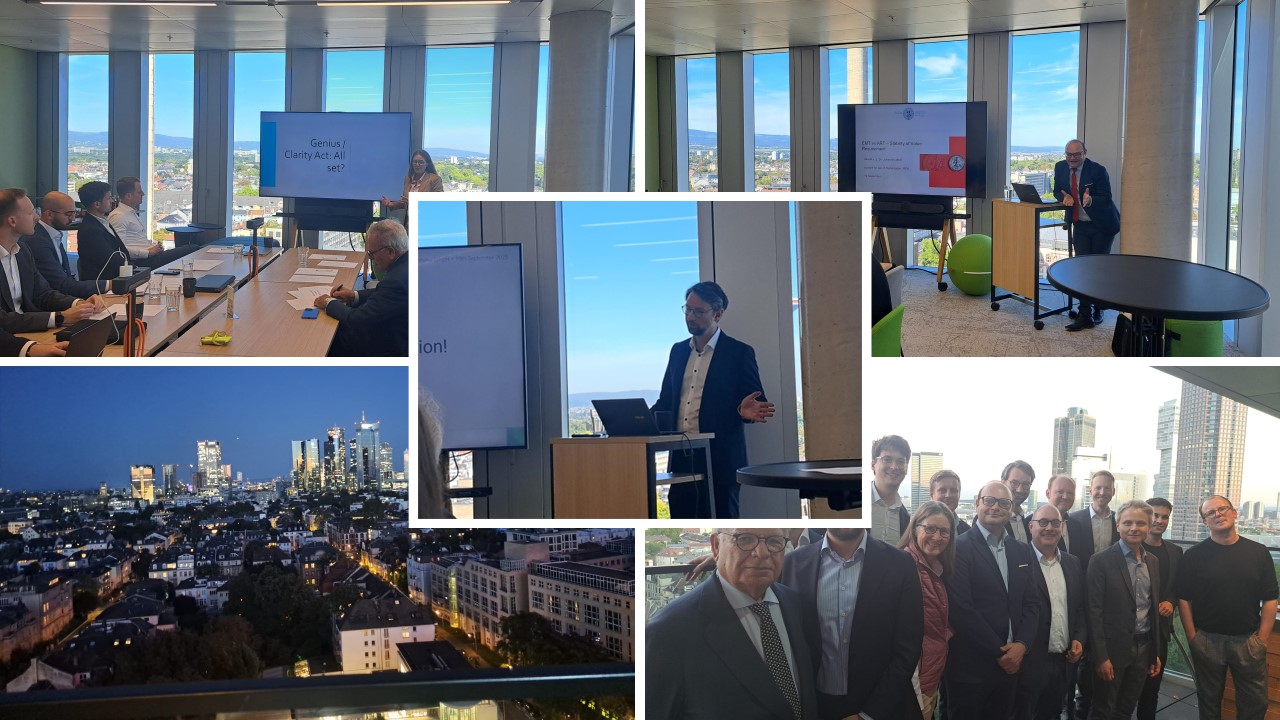 FIN LAW Hosts the Annual Meeting of the Fintech Legal Network
FIN LAW had the pleasure of hosting the Annual Meeting of the Fintech Legal Network and was pleased to welcome members to its offices in Senckenberganlage.
FIN LAW Hosts the Annual Meeting of the Fintech Legal Network
FIN LAW had the pleasure of hosting the Annual Meeting of the Fintech Legal Network and was pleased to welcome members to its offices in Senckenberganlage. -
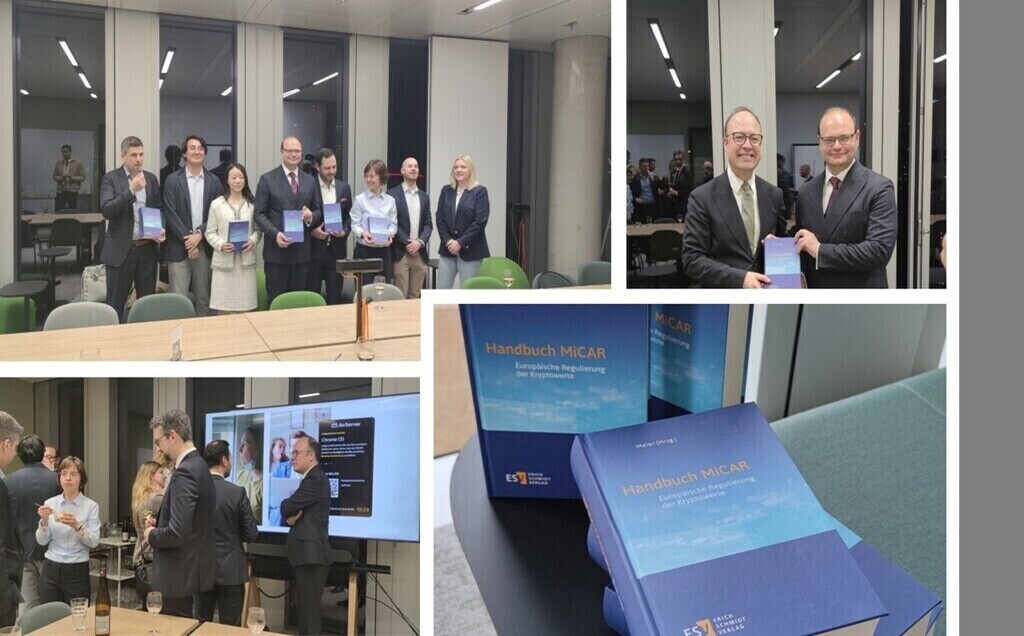 Successful Book Launch at FIN LAW for the New MiCAR Handbook by Dr. Johannes Meier
Presentation of the new MiCAR handbook by Dr. Johannes Meier at the book launch event of FIN LAW.
Successful Book Launch at FIN LAW for the New MiCAR Handbook by Dr. Johannes Meier
Presentation of the new MiCAR handbook by Dr. Johannes Meier at the book launch event of FIN LAW. -
 Lutz Auffenberg and FIN LAW have Again been Recognized by WiWo
WirtschaftsWoche (WiWO) has once again named Attorney Lutz Auffenberg, LL.M., as a top lawyer and FIN LAW as a top law firm.
Lutz Auffenberg and FIN LAW have Again been Recognized by WiWo
WirtschaftsWoche (WiWO) has once again named Attorney Lutz Auffenberg, LL.M., as a top lawyer and FIN LAW as a top law firm.